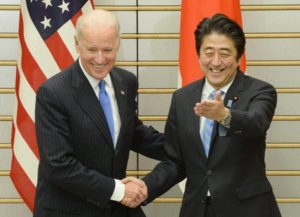
Vice President Joe Biden and Japanese Prime Minister Shinzo Abe
After canceling his trip to Asia during the government shutdown, President Obama has sent Vice President Biden to the region with the delicate mission of confronting the Chinese over recent aggressiveness in the East China Sea, and assuring Japan and South Korea that the U.S. is still their staunchest ally.
Just as the White House was preparing for a Biden trip that was supposed to focus on the region’s economy, China sent the plans into a tailspin by declaring that a large area of the East China Sea was now an air defense identification zone, which requires countries to submit advance flight plans and maintain radio contact before flying over the restricted waters.
The shockingly bold act was quickly defied by the U.S., which last week sent two American B-52 bombers through the zone without advance notice, and then by planes from Japan and South Korea.
The result is a much more politically sensitive mission for the vice president than just talking about trade and currencies.
“The timing couldn’t be worse,” Ralph Cossa, a retired air force colonel and president of the Pacific Forum CSIS in Honolulu, told CNN. “The frustrating thing I’m sure for Biden and company is that they spent a lot of time preparing and the announcement of the air defense identification zone has completely recast the trip.”
Biden will go to Japan, then China, and finally to South Korea, with very different agendas in each place.
In Japan, he’ll be trying to coordinate the U.S. and Japanese responses to China so that they are speaking with one voice. The need for this planning was underscored by the responses to the air defense zone: The U.S. decided that passenger airlines should comply with the Chinese request for advance notification, while the Japanese government ordered the major commercial carriers Japan Airlines and All Nippon Air to refuse to comply. In Japan, Biden will be making appearances with the administration’s very famous new envoy to Tokyo: Caroline Kennedy, who just took up her post last month.
In Beijing, where Biden is due to arrive Wednesday morning, matters will be much tenser, though experts say Biden has a good relationship with Chinese President Xi Jinping, who was his Chinese counterpart—the vice president—until earlier this year. Experts say China is extremely upset that the U.S. so impudently flouted the air zone, which apparently surprised the Chinese.
The Chinese believe the U.S. and Japan are overreacting to the air defense zone—something that at least 20 other countries around the world have. But China’s is the only one that includes territory controlled by other nations: the East China Sea islands known as the Senkaku to the Japanese and Diaoyu to the Chinese, controlled by Japan since the late 19th century, sit in the center of the new air zone.
“So many other countries set up air defense zones decades ago. Our problem is we are doing it too late. Everybody is afraid that China is becoming too strong, too fast,” Xu Guangyu, a retired Chinese military officer and a consultant with the China Arms Control and Disarmament Association, told CNN.
U.S. officials would like China to rescind the designation of the zone, but observers don’t think that would happen.
“We consider it a unilateral effort to change the status quo in the East China Sea. It’s a provocative action, an uncoordinated action at a time tensions already are running high, and that this is not the kind of thing that contributes to the greater peace and security in northeast Asia,” a senior administration official told reporters yesterday on the way to Japan.
In South Korea, Biden is scheduled to meet with President Park Geun-hye, whose administration is upset because China’s new air defense identification zone partially encroaches on South Korea’s existing zone.


