Venezuelan President Maduro Given Power to Rule by Decree

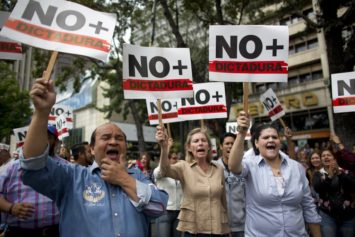
Venezuela’s National Assembly has granted President Nicolas Maduro wide-ranging special powers to rule by decree for one year, a move that he has said is necessary to fully tackle the country’s spiraling inflation.

The decree will essentially allow the president to create laws without parliamentary approval.

The socialist president says he needs greater personal power to stamp out opponents who are waging “economic warfare against his government” as the country struggles with soaring inflation and shortages of basic goods.

Tuesday’s vote over the Enabling Law is the latest move by the elected Venezuelan leader, a protégé of the late President Hugo Chavez, to strengthen his hand as he faces an important political test in municipal elections next month.

“He has to tackle an economy in free fall,” Andy Gallacher said, reporting for Al Jazeera from Caracas, the capital.

“People are really struggling to buy normal household goods.”

Over the weekend, Maduro used his existing authority to make retail appliance stores slash prices, sending troops to keep order among the crowds that quickly formed.

On Tuesday, the Venezuelan unit of General Motors was fined the equivalent of $85,000 for allegedly overcharging and practising “usury” in the sale of car parts to local concessionaires.

The government also asked Twitter to take down accounts of users posting the illegal black market exchange rate for the country’s bolivar currency, which is trading at about one-tenth of the official value.

Read the full story on Al Jazeera

Democracy needs journalism it can trust.

This election season, the stakes are higher than usual — and so is the pressure on newsrooms to soften their coverage, stay quiet, or just disappear. Independent reporting, the kind that answers to readers instead of advertisers or political pressure, matters more in a moment like this, not less.

For over 14 years, Atlanta Black Star has stayed independent and reader-funded. We have no corporate owner and no shareholders telling us what to cover or how to cover it. That independence is also our biggest vulnerability: nothing protects it except readers choosing to fund it directly.

Newspaper ad revenue has fallen more than 80% since 2005, and local newsrooms are closing at a rate of roughly two a week nationwide. When outlets go under in a moment like this, it's rarely the independent, reader-funded ones that get to stick around.

We know a request for support isn't why you came here. But without readers choosing to fund this work directly, the depth of reporting we can do at home and abroad shrinks along with everyone else's. If you're not in a position to give, that doesn't change how much we value you as a reader.

If you are able to, a recurring contribution does more for us than a single one-time gift, because it lets us plan the next investigation instead of just the next invoice. It takes about 30 seconds, no long form, no account. Thank you for continuing to support independent journalism and freedom of the press.

Back to top