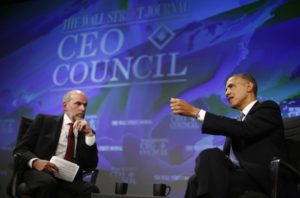
Obama with Gerald Seib of Wall Street Journal
As CNN reports that the number of enrollees in Obamacare has picked up steam in recent weeks, President Obama last night went on the offensive, stating that Republicans deserve some of the blame for the botched rollout of the health care law because they are doing everything they can to make it fail.
The president, speaking at a gathering of business leaders in Washington, D.C., sponsored by the Wall Street Journal, acknowledged that the health-care rollout “has been rough, to say the least.”
Obama said with the government’s information technology team working hard to fix the healthcare.gov website, he predicted it would function effectively for most people by the end of November. But the president said smooth implementation of the law is being hindered by congressional Republicans.
“One of the problems we’ve had is one side of Capitol Hill is invested in failure,” Obama said. “We obviously are going to have to remarket and rebrand, and that will be challenging in this political environment.”
The president said Washington needs to “break through the stubborn cycle of crisis politics and start working together.”
“You know, people call me a socialist sometimes,” Obama said. “But no, you’ve got to meet real socialists. You’ll have a sense of what a socialist is.”
In its state-by-state survey of enrollment in the health exchanges, CNN determined that as of yesterday afternoon, at least 133,257 people had chosen new insurance plans in the 14 states with their own signup apparatuses—nearly half of them enrolled in the past two weeks.
But CNN had a harder time gauging enrollment in the states using healthcare.gov, estimating 43,743 enrollees—while acknowledging the number is based on just a handful of states that have provided updates.
In addition, according to CNN, 58,857 newly eligible people have enrolled in state Medicaid programs, with another 275,131 people signed up to start Medicaid coverage on Jan. 1, 2014.
While the program will desperately need young, healthy enrollees for the insurance companies to make money—the Congressional Budget Office estimated that 7 million people would enroll in private insurance plans through the marketplaces in 2014, and that 2.7 million (about 38 percent of the total) would be between the ages of 18 and 34—the numbers for that population appear to be running behind forecasts.
In the three states that provided their own data to CNN, the under-35 enrollees is less than CBO projected: in Kentucky, 19 percent of enrollees are age 18-34; in Connecticut, 22 percent; and in Washington state, 23 percent.
“There’s general agreement that we need younger and healthier people to offset the costs of sicker people coming into the system,” says Robert Zirkelbach, a spokesman for America’s Health Insurance Plans, an industry group. “That’s what will add more stability. There’s lots of evidence to suggest that people needing serious medical care are most likely to purchase insurance initially. Those who don’t have urgent medical needs are more likely to purchase insurance later.”
The president conceded that the government needed to do a better job with IT.
He said the administration “underestimated the complexities of building out a website that needed to work the way it should,” adding that the government’s IT procurement process is “not very efficient.”
“There’s probably no bigger gap between the private sector and the public sector than IT,” Obama said. “What we probably needed to do on the front end was to blow up how we procure for IT, especially on a system this complicated. We did not do that successfully.”


