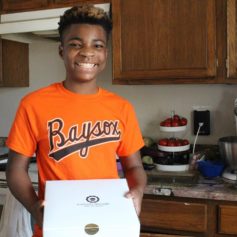
Every year, thousands of young Nigerians travel to the United States to study. While many do well, only a few graduate top of their university class. Emmanuel Ohuabunwa, 22, is one of those select few. However, his story doesn’t stop there. Not only did he graduate top of his class at Johns Hopkins University last year, he made history by becoming the first Black man to do so in the university’s history. Ohuabunwa who hails from Abia State, has been able to make the nation proud and with his efforts has won himself a scholarship to Yale University to get a degree in Medicine.
So how did Ohuabunwa manage to come out tops from such a prestigious academic institution?
1. Resilience
When Ohuabunwa was 13 years old, his family moved to the United States. Though he was taunted and bullied for being African while he was in middle school, he persevered. In his words:
“When I got to the U.S., I was enrolled with my age mates, which meant at 13, I was in middle school. I went to Fondren Middle School, which was in the middle of the ghetto. That was one of the darkest years for me because I encountered a lot of peer pressure. Some of the students, ignorant about Africa, bullied me and called me names such as ‘African booty scratcher’ because to them, Africans were dirty and scratched their butts all the time.
“Some asked me if I lived in mud huts and ate feces for breakfast. I remember one day, when I was walking to the school bus, a boy came from behind and punched me in the face, called me an African and walked away. It took everything in me not to retaliate. I knew that God had put me in the U.S. for a purpose and it did not involve fighting or selling drugs or doing the wrong things.
“My experience during that year gave me a thick skin. I learned to stand for what I thought was right even when the opposition seemed insurmountable. I also learned to look at the positive in all situations. Even though these kids were bullying me, I was still gaining an opportunity to school in America and nothing would stop me from making the best of this opportunity.
“The shocker was that the kid that punched me in the face was Black. I would have expected the Blacks to be nicer to me. Nevertheless, I don’t blame those kids because they were ignorant about Africa. All they knew about us was the stuff they had watched on TV or documentaries, showing primitive African tribes, living in the jungle and making noises like monkeys.
“In regards to the whites, there might have been some minor episodes but again I don’t blame them for it because it is a problem with stereotypes.”
2. Discipline
Though he was constantly bullied, Ohuabunwa knew that he wanted to attend the best school for undergraduate students interested in medicine in the United States. He studied hard in school and took advanced courses to prepare himself. During graduation, he was given an award for the Most Outstanding Senior Young Man at DeBakey High School.
He subsequently won a full scholarship from the Bill and Melinda Gates Foundation to study at any university of his choice in the United States. Luckily for him, he got into the neuroscience program at Johns Hopkins University.
On why he studied neuroscience, he said:
“I studied neuroscience because I was fascinated with the brain, its control of our behaviours and how various diseases, such as Alzheimer’s disease, lead to a decline in its activity. I also minored in psychology because I wanted to understand disorders in the psyche – what causes bipolar disorders or schizophrenia. I did not just want to label them as crazy but to understand what causes these conditions and how we can treat them.”
Ohuabunwa brought his discipline and work ethic to Johns Hopkins University and kept working hard, eventually graduating in May 2012 with a 3.98 GPA. This made him the top student of his graduating class and the first Black man to top any graduating class in Johns Hopkins University’s history.
Source: cp-africa.com