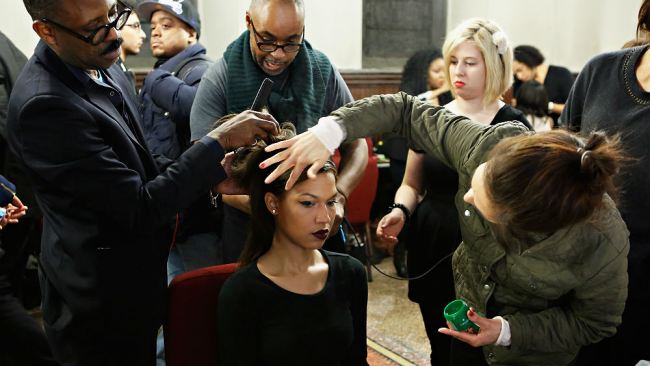
 “I think people do discriminate in the fashion industry, but that it’s unconscious,” Hannan Saleh, street photographer for Essence magazine, told theGrio at the most recent Mercedes-Benz Fashion Week held earlier this month in New York City.
What prompted her observation? I was yet another reporter on the style beat asking: Is fashion racist?
It goes without saying that Fashion Week isn’t just about the sumptuous designs. In addition to being a scene for showcasing eye-catching ensembles, some people are transforming it into a springboard for political action.
New York Fashion Week’s glittering stage has been under scrutiny yet again for the lack of diversity on its runways – a fact made clear as I watched predominantly white models stalk down the runway in Native American headdresses to the tom tom of tribal drums at the Spring 2014 Nicholas K show just days ago.
It was a display of utterly un-ironic cultural appropriation that is surely the stuff of political progressives’ nightmares, and hardly the only evidence of homogeneity.
Bethann Hardison, former model and agent-turned-activist, sent a letter this month to address such displays to governing bodies of fashion internationally, receiving widespread attention for the plight of models of color. Yes, Fashion Week has become an instrument of resistance.
But, beyond the underrepresentation of black models, there is also a startling dearth of black designers, casting agents, publicists, photographers, stylists, and editors in this billion-dollar industry — deficits that are rarely publicly addressed.
During Fashion Week, among a gaggle of fashion fanatics in their most daring sartorial creations, I interviewed celebrity stylist Beagy Zielinski to delve into this broader issue.
Zielinski has styled Tyra Banks, actor Alan Cumming and singer Kelly Rowland, and contributed to America’s Next Top Model during cycle 16 – in addition to styling for major fashion magazines. You would think that such an accomplished woman in style – who is also NOT a model — would have escaped the barbs lesser talents have experienced.
Yet, on the question of whether fashion has a race problem, Zielinski responded with an unequivocal: “Absolutely.”
For Zielinski, who grew up in Germany, there is a persistent misconception that, if you are black, your creative references must be limited to stereotypical associations with black culture.
“As a black stylist, I have people in the industry who, when they meet me in person, assume I must style rappers,” she told theGrio. “It’s clear it’s about what they think black means and has nothing to do with my personal aesthetic or professional experience as a stylist. It’s the same when I go to showrooms and the client assumes I’m the assistant. There is a sense that you can only achieve a certain level.”
Professionals like Zielinski are painfully aware of racial discrimination within the industry, but also feel pressured to conform to industry practices that perpetuate these inequalities.
For her own portfolio, Zielinski admits to featuring white models prominently or else she risks her ability to book clients. “If I do include black models, they have to be very recognizable,” she said.
In her work, Zielinski has observed how often only a handful of black models are sent for review out of dozens of white models, which feeds the self-perpetuating phenomenon of there not being enough experienced black models to cast, thus leading to there not being enough famous black models to feature.
She said starkly, “If casting agents don’t send black models, they don’t get seen.”
Read more at TheGrio.com