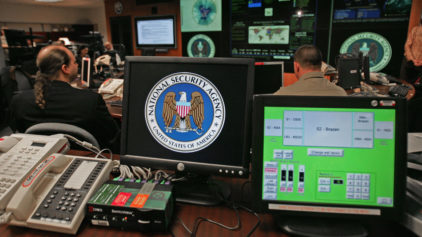
Former NSA contractor Edward Snowden blew the lid off the agency’s surveillance program aimed at American citizens. Just a few weeks ago, the public learned that tech companies like Google and Microsoft were paid by the government agency to spy on taxpayers. Now that more details are coming out about the Snowden files, it shows that the NSA can access even encrypted data.
As reported by nytimes.com:
“Even agency programs ostensibly intended to guard American communications are sometimes used to weaken protections. The NSA’s Commercial Solutions Center, for instance, invites the makers of encryption technologies to present their products to the agency with the goal of improving American cybersecurity.
“But a top-secret NSA document suggests that the agency’s hacking division uses that same program to develop and ‘leverage sensitive, cooperative relationships with specific industry partners’ to insert vulnerabilities into Internet security products.”
The new reports were obtained by The Guardian and The New York Times, and The Guardian sums up the findings as follows:
• A 10-year NSA program against encryption technologies made a breakthrough in 2010 which made “vast amounts” of data collected through Internet cable taps newly “exploitable”.
• The NSA spends $250 million a year on a program which, among other goals, works with technology companies to “covertly influence” their product designs.
• The secrecy of their capabilities against encryption is closely guarded, with analysts warned: “Do not ask about or speculate on sources or methods.”
• The NSA describes strong decryption programs as the “price of admission for the U.S. to maintain unrestricted access to and use of cyberspace.”
• A GCHQ (Government Communication Headquarters) team has been working to develop ways into encrypted traffic on the “big four” service providers, named as Hotmail, Google, Yahoo and Facebook.
The more that is revealed about NSA surveillance, the more disturbing it becomes. This means even for those who went of their way to protect their privacy, the NSA rendered their rights and efforts useless.