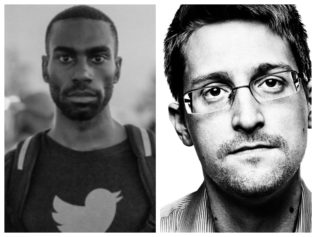
In a story that has rocked Washington insiders and the entire U.S. intelligence community, a former CIA employee working as a contractor at the U.S. National Security Agency has come forward and identified himself as the source of leaks about how the U.S. is spying on American citizens.
Edward Snowden, 29, said he acted because his conscience compelled him to protect “basic liberties for people around the world” and because he was disillusioned about President Obama’s continuation and expansion of the comprehensive surveillance program started under George Bush.
Snowden, who was hiding in a hotel room in Hong Kong, did a video interview with the Guardian newspaper, dated June 6, that was posted on its website.
“I don’t want to live in a society that does these sort of things … I do not want to live in a world where everything I do and say is recorded. That is not something I am willing to support or live under,” the calm, bespectacled former CIA technical assistant said in the interview.
He said he had thought a great deal before coming forward with details of the NSA program code-named PRISM, saying he did it because he felt the United States was building an unaccountable and secret espionage apparatus that spied on every American.
Snowden had been working for the NSA as a contractor employed with Booz Allen, a company that has received billions of U.S. government dollars to partly oversee the extensive surveillance system.
“The NSA has built an infrastructure that allows it to intercept almost everything,” Snowden said. “With this capability, the vast majority of human communications are automatically ingested without targeting. If I wanted to see your emails or your wife’s phone, all I have to do is use intercepts. I can get your emails, passwords, phone records, credit cards.”
Snowden copied the secret documents at the NSA office in Hawaii and told his supervisor he needed “a couple of weeks” off for treatment for epilepsy, according to published reports. On May 20, he flew to Hong Kong. Intelligence experts were stunned that a seemingly low-level employee in Hawaii would have access to such a vast storage of secrets.
The NSA reportedly has begun a criminal probe into the leaked information, with the U.S. Justice Department revealing it was in the initial stages of a criminal investigation following the leaks.
Booz Allen, a U.S. management and technology consultancy, said reports of the leaked information were “shocking and if accurate, this action represents a grave violation” of company policy.
“This is significant on a number of fronts: the scope, the range. It’s major, it’s major,” John Rizzo, a former general counsel of the CIA who worked at the agency for decades, told the Washington Post. “And then to have him out himself . . . I can’t think of any previous leak case involving a CIA officer where the officer raised his hand and said, ‘I’m the guy.’ ”
A half-dozen former intelligence officials, including one who now works at Booz Allen Hamilton, told the Post they did not know Snowden or anything about his background but they speculated that he could have been part of a surge in computer experts and technical hires brought in by the CIA in the years after the Sept. 11, 2001 attacks.
Douglas McNabb, a Houston lawyer who specializes in extradition, said it would not be difficult for the United States to provide justification to extradite Snowden from Hong Kong.
“This guy came out and said, ‘I did it,'” he said. “His best defense would probably be that this is a political case instead of a criminal one.”
Snowden said he left his girlfriend in Hawaii without telling her where he was going.
He said he thought the publicity his revelations had garnered made it all worth the risk.
“My primary fear is that they will come after my family, my friends, my partner. Anyone I have a relationship with,” he said. “I will have to live with that for the rest of my life. I am not going to be able to communicate with them. They (the authorities) will act aggressively against anyone who has known me. That keeps me up at night.”