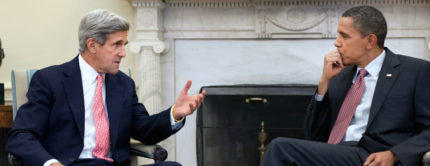
Newly confirmed Secretary of State John Kerry, in the midst of a European tour, is wading into the brutal, intractable conflict in Syria, stating that the U.S. is committed to working with the rebels to speed Syrian President Bashar Assad’s ouster.
After meeting in Paris with French Foreign Minister Laurent Fabius, Kerry also had a surprisingly cordial meeting about Syria with Russian Foreign Minister Sergey Lavrov in Berlin. Russia, one of Assad’s few backers, is pressing to bring the Syrian leader to negotiations if the U.S. could convince the Syrian rebels to come to the table.
Up to this point, the Syrian rebels have refused to negotiate with Assad unless he first agreed to step down from the presidency. But Assad has shown no inclination to agree.
The Russians said they were visited on Monday by Syrian Foreign Minister Walid al-Moualem, who assured them that Assad’s government is ready to sit down with opponents, even armed rebels, to discuss a transitional government. Now the U.S., which is convening a group of the Syrian rebels in Rome, must figure out how to get the rebels to the table.
“I think it’s clear that Russia can deliver the Assad regime on this point, and bring them to the table for talks with the rebels,” Andrei Baklitsky, an expert with the PIR Center, an independent Moscow-based security think tank, told the Christian Science Monitor’s Web site. “Russian diplomacy has been pretty consistent on the need for such talks and Moscow is ready to do its part. But I would think it’s the U.S. that has a problem here. If Washington is going to change its approach, and come out in favor of negotiations, it may find itself unable to bring the rebels to the table. The Syrian rebels are very fragmented, have little common ground, and some of them are completely intransigent. Some of them didn’t even want to go to Rome, to sit down with their friends, much less engage in talks with the Assad regime.”
At the end of the meeting between Kerry and Lavrov, the Russian told journalists that the two had a meeting of minds about the need to take urgent steps to end Syria’s nightmare.
“It’s not that everything depends on us, but we shall do all we can to create conditions for the soonest start of a dialogue between the government and the opposition,” Lavrov said.
The cordiality of the meeting was surprising, given the tension that was clear when former Secretary of State Hillary Clinton met with the Russians. Experts expect Kerry, who is more moderate on the question of Russia, to have a better relationship with Russian leaders.
According to State Department spokesperson Victoria Nuland, Kerry and Lavrov spent most of their time discussing Syria “and how we can work together to implement the Geneva agreement,” which commits both sides to seeking a political settlement.
In Paris, Kerry said Assad “needs to know he can’t shoot his way out of this. And I think the opposition needs more help in order to convince him.”
The conflict in Syria, which began in March 2011, has killed about 70,000 people and created almost a million refugees.
“If the president of the country decides he isn’t going to come and negotiate and he’s just going to kill his people, then you at least need to provide some support for the people who are fighting” for their freedom, Kerry said while in Berlin, but he didn’t specify what support he meant.
Meanwhile, Iraq Prime Minister Nouri al-Maliki in an interview with The Associated Press warned Wednesday that a victory for Syria’s rebels will spark sectarian wars in his own country and in Lebanon and will create a new haven for al-Qaida that would destabilize the region.