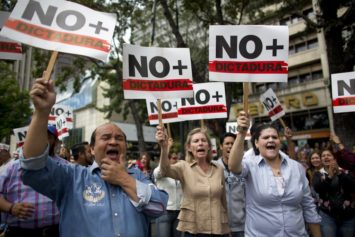
With Venezuelan President Hugo Chavez’s announcement Saturday that he had to return to Cuba to treat the return of his pelvic cancer, the people of Venezuela are contemplating the possibility of life without their charismatic leader, who has ruled the nation for the past 14 years.
Chavez gave a speech in which he said he may not be able to serve his fourth term because he must undergo his fourth surgery and treatment. Chavez practically pleaded with the populace to choose his vice president and confidant Nicolas Maduro, 52, the former bus driver, as his successor.
If “some circumstance” should prevent him from completing his term or starting his next one, Chavez said, Maduro should not only complete the current term but also be elected president to replace him, “in my firm, irrevocable, absolute and total opinion.… This I ask you from the heart.”
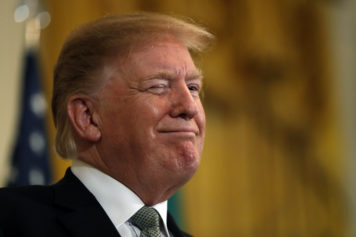
Maduro (in photo above) has been a close friend and confidante of Chavez’s for 20 years—he was among the tiny circle who originally accompanied Chavez to Cuba for his cancer operation. Observers aren’t sure what kind of leader Maduro would prove to be. Genial and well-liked, Maduro is considered a more moderate force in the Socialist regime than many other hard-liners.
“Look where Nicolás is going,” Chavez said in October when he proudly announced his new No 2. “Nicolás was a bus driver on the metro, and look how the bourgeoisie make fun of him.”
The Venezuelan constitution dictates that if Chavez resigns or dies, his vice president would have to be elected in a new election called by Congress. Maduro would likely face a strong challenge from Diosdado Cabello, president of the National Assembly and a former army comrade of Chavez’s, and also opposition candidate Henrique Capriles, who was beaten soundly by Chavez in October and who is running for governor of Miranda state in Sunday’s state and local elections.
Francisco Monaldi, a visiting professor teaching political economy at Harvard University’s Kennedy School of Government, told the Los Angeles Times that Chavez’s announcement amounted to the beginning of a transition of power.
“The doubts are over. Chavez is deathly ill, and he has named his political successor,” Monaldi said.
There have been polls indicating Capriles would beat any Chavez-picked candidates. During the October election, Chavez won 54.4 percent of the vote, compared to 45 percent for Capriles. While the Chavez regime accused Capriles of running a U.S. style marketing campaign for president, Capriles tried to use crime to attack Chavez, saying the country’s high murder rate—50 homicides per 100,000 inhabitants in 2011—was evidence of the president’s poor handling of the country’s crime wave.
Many wonder whether the Chavez political regime, called Chavista, will be able to continue after his death.
“The Chavista legacy will come to an end as soon as he is incapacitated or dies,” Riordan Roett, head of Latin American studies at Baltimore’s Johns Hopkins University, told the Wall Street Journal. “It will be difficult for his band of cronies to maintain the charisma Chávez has created since 1999. They are a humdrum lot.”
Others say that Maduro, running on the memory of Chávez, might have a chance, especially if oil prices stay high. Oil accounts for one-third of the country’s annual economic output, three-fifths of government revenue and 90 percent of export revenue.
“In principle, we think the latest developments get the opposition closer to power and the market will get its long-awaited ‘regime change,’ ” Nomura investment bank said in a note to clients. “However, we think that the market should temper its enthusiasm in the medium term. First, we would not underestimate the emotional aspect of the Chavismo trying to fulfill its leader’s last wish to hold on to power.”