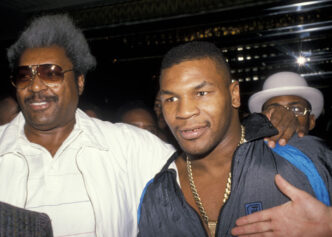
Hector ‘Macho’ Camacho was taken off life support Saturday morning by his mother Maria Matias after being fatally shot in Bayamon, Puerto Rico on Wednesday. He was 50 years old.
Camacho was declared clinically brain dead on Thursday by doctors, but Matias made the difficult decision to pull her son off life support Saturday once his three sons had the opportunity to see their father one last time.
“I lost my son three days ago. He’s alive only of a machine,” said Matias late Friday night. “My son is not alive. My son is only alive for the people who love him.”
The passing of Camacho has left the boxing world with an unexplainable void. The former champion had a reputation for fighting with a flare and fearsome skills as one of the premier fighters of his generaton.
“Hector was a fighter who brought a lot of excitement to boxing,” said Ed Brophy, executive director of International the Boxing Hall of Fame. “He was a good champion. Roberto Duran is kind of in a class of his own, but Hector surely was an exciting fighter that gave his all to the sport.”
Camacho made his professional debut in 1980 against David Brown at New York’s Felt Forum. During his 30-year career he fought some of the biggest boxers to put on gloves, including Sugar Ray Leonard, Felix Trinidad, Oscar De La Hoya and Roberto Duran.
“He excited boxing fans around the world with his inimitable style,” promoter Don King told The Associated Press.
But Camacho also had a troubled career outside the ring, suffering with drug, alcohol and other problems. In 2007, he was sentenced to seven years in prison for burglary of a computer store in Mississippi. Police found ecstasy on Camacho at the time of his arrest in 2005.
A Mississippi judge eventually suspended all but one year of the sentence and gave Camacho probation. He later violated his probation and served two weeks in jail.
In 1998, Camacho’s wife at the time, Amy, obtained a restraining order against him, alleging he threatened her and one of their children. They later divorced.
Despite Camacho’s troubled recorded, he also helped his close friends such as George Lozada. Lozada said hours after being released from prison after serving a murder sentence, Camacho called him and took him shopping.
“Because of him, man, I got what I got today,” Lozada said. “Because of Hector, I stopped the drug scene … He’s helped so many people.”
Camacho helped so many people, but the people of Puerto Rico not been helpful in catching the shooters who attacked Camacho and his friend. The police have not released many details in the investigation, but no arrests have been made.