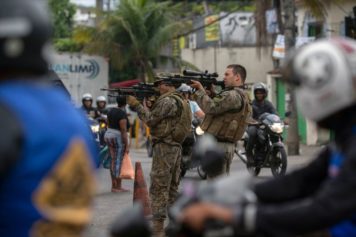
In anticipation of countrywide elections in Brazil on Sunday, the country has deployed thousands of army and navy troops in the poorest neighborhoods of Rio de Janeiro to make sure that voters aren’t intimidated by the local drug lords.
In past elections, drug gangs or vigilante groups have frightened voters into casting ballots for the candidates controlled by the local gangs—in some cases even demanding that they use a mobile phone to take a picture of their vote inside the polling booth.
Local elections are taking place in more than 5,000 cities across Brazil, with nearly 140 million over age 16 registered to vote. Another election will be held on Oct. 28 in cities where no candidate has gotten 50 percent of the vote.
Luiz Zveiter, the head of Rio’s electoral court, said the city was prepared to make sure the election was free of intimidation.
The favelas of Rio have already been occupied by a significant force of police and army soldiers, since Rio is gearing up for both the 2014 World Cup and the 2016 Summer Olympics. But according to reports, many of the poor neighborhoods, known as favelas, still are ruled by the drug lords.
In many Rio neighborhoods, opposing factions are still at war for control of the people. In some communities, the drug gangs have been expelled by the vigilante groups, known locally as militias, which are made up of mostly of off-duty or former police officers. But the vigilante leaders can also be an intimidating factor for voters.
“We are taking preventive measures against ballot stuffing and illicit electoral propaganda,” Zveiter told the BBC.
“Mobile phones will be banned in the polling booth. It will not be possible for a drug lord or a ‘militiaman’ to demand that people take photos of their votes.”
Extra troops will be deployed to different areas of Brazil’s second-largest city until the vote on Sunday.