RIO DE JANEIRO (AP) — Authorities arrested two former police officers Tuesday in the killing of Rio de Janeiro councilwoman Marielle Franco and her driver, a brazen assassination that shocked Brazilians and sparked protests in several countries.
The arrests in Rio came two days before the anniversary of the 2018 killings. While police had questioned many people, before Tuesday nobody had been arrested or charged in the shooting of Franco, a prominent activist for Afro-Brazilian and LGBT rights.

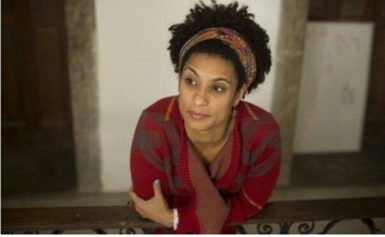
FILE – In this Jan. 9, 2018 file photo, Rio de Janeiro Councilwoman Marielle Franco smiles for a photo in Cinelandia square. Police in Brazil said on Tuesday, March 12, 2019, that they have arrested two suspects in the killing of Franco and her driver last year. (AP Photo/Ellis Rua, File)
“It was a crime against a lawmaker, a woman, exercising her democratic function who had her life taken away in an unacceptable, criminal way,” Rio de Janeiro state Gov. Wilson Witzel told reporters.
While Witzel praised police and investigators for the arrests, the case highlighted deep corruption in Brazil’s police forces, including connections to militias and paramilitary groups that control large swaths of the state.
The suspects were identified as Ronnie Lessa, 48, a retired military police officer, and Elcio Vieira de Queiroz, 46, who was fired from a police force in 2015 for reasons that authorities did not release. Lawyers for both men denied their involvement in the assassination.
Lessa was arrested at his residence in the same Rio condominium complex where President Jair Bolsonaro has his home, authorities said.
Lessa is alleged to have shot Franco and De Queiroz to have driven a car involved in the attack. The car was hit with 14 bullets, four shots hit Franco in the head and three hit her driver, Anderson Gomes, in the back.
Police and prosecutors detailed a “practically perfect crime” that demonstrated “knowledge of the legal and judicial system,” which added to the complexity of solving the crime.
They showed CCTV footage to reporters that tracked the car in which prosecutors said Lessa and De Queiroz drove from the wealthy suburbs of western Rio across the city to downtown, where the suspects waited for two hours outside a meeting that Franco was attending about empowering black women.
Prosecutors said they were able to identify Lessa as the shooter through an image of the shooter’s arm, where they could see the outline of dark parts of a tattoo through a sleeve.
Authorities said they couldn’t yet fully explain the motive for the killings but pointed to signs of intolerance toward the councilwoman’s political agenda.
“It’s a reaction of repulsion to her political actions,” said Simone Sibilo, one of the prosecutors. “Marielle defended minorities, black women, LGBT and other minority causes.”
Siblio did not rule out that Lessa was ordered to commit the crime by someone else. Prosecutors said they suspect Lessa was involved in one of the militias made up of former police and military officers who run extortion and security rackets in poor neighborhoods.
“The investigations have revealed to us the possibility (of Lessa’s) participation in paramilitary activities,” Sibilo said, adding that Lessa’s “name has come up in” connection with other homicides.
Lessa’s lawyer, Fernando Santana, said his client “vehemently denies being involved in any type of assassination.”
De Queiroz’s lawyer, Luiz Carlos Azenha, denied there were any photos of him inside the car on the day of the assassination.
“Treat it as another misstep made by the police and courts,” he said.
Marcelo Freixo, a state legislator and friend of Franco, told Globo TV the arrests were an important step, but the case “has not been resolved.”
“Who sent them (to kill Franco)?” Freixo said. “We don’t accept the version that these people were motivated by passion and hate when they didn’t even really know who Marielle was.”
Family members of Franco expressed similarly mixed reactions.
Anielle Franco, the victim’s sister, said the family was glad to see movement in the case but wanted to understand the motive.
“This wasn’t some criminal on the corner,” Anielle told reporters outside the prosecutor’s office.
Franco, who was black and lesbian and grew up in one of Rio’s roughest neighborhoods, stood out in a country where most politicians are white men. She had been a frequent critic of police violence, particularly in poor neighborhoods.
Marches honoring Franco were planned for Thursday, the anniversary of her killing.
Police and politicians in the state have been under intense pressure to solve the killing, which included sophisticated planning by the assassins, right down to making sure surveillance cameras were shut off on the street where the attack happened.
Witzel, a former judge who was inaugurated Jan. 1, was criticized last year when he participated in a rally with other candidates who had broken a street sign commemorating Franco.
A close ally of Bolsonaro, Witzel ran on promises to get tough on crime and the high-profile arrests may quiet critics who argued Witzel would let the case go unsolved.
“The reality is changing,” Witzel said of the police and reforms underway.