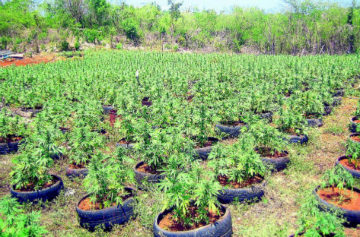
A grandmother charged with taking care of her 11orphaned grandchildren, Khathazile turned to the cultivation of marijuana, one of the tiny country’s sought-after exports.
“Without weed, we would be starving,” a Swaziland woman told the New York Times.
Swazi Gold is the highly potent and valuable strain of marijuana that Khathazile grows, a crop that can be easily sold into the strong drug market of neighboring South Africa. For her and her family, the drug trade is their central means for survival.
Though Swaziland is considered a middle income country, those who reside in the country’s northwest mountains are stricken by poverty. The climate makes conventional farming difficult, and many of the local young people leave to seek work in South Africa or Swaziland’s larger cities as soon as they are able. The old are left to care for the young, and with Swaziland still holding the world’s largest rate of H.I.V. infection, families struggle to establish themselves.
While the crop can yield a profit, it remains illegal within the country. Police search for marijuana fields in March and April, just prior to harvest. Those that are discovered are burnt to the ground, leaving their cultivators devastated and without product. Farmers can produce as much as 25 pounds of marijuana in a single growing season, which is then sold to South African middlemen who visit the villages at harvest time. Unfortunately, due to their status, the Swaziland farmers have little to bargain with. Most make less than $400 from their crop.
“The men come from South Africa to buy, but they cheat us,” said 70-year-old Sibongile Nkosi. “What can we do? If you sit with it the police can come and arrest you.”
Nkosi adopted the crop to provide for her family, but refuses to use it herself. Though it has allowed her to provide for her family, she questions whether or not it is worth it. Required to pay almost $400 in school fees for two of her grandchildren, she has no choice.
“When you are in poverty you must do whatever you can to live,” she said. “If I earn a little something my heart will be content.”