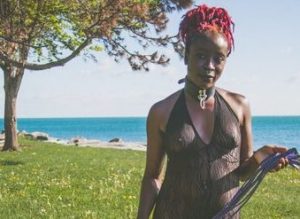
Mistress Velvet initially began her dominatrix career for financial reasons. (@MissVChicago/Twitter)
A dominatrix is using her career to transform how white men see Black women. In what she describes as an “emotional sense of reparations,” Mistress Velvet employs Black feminist theory to help push her mostly white, male clients from fetishizing Black women to having a deeper understanding.
The Domme’s relationship with her submissive subjects has had profound implications for her clients.
“I describe it as a form of reparations ― not in a systemic way like we’re getting land back, but definitely on an individual level, it provides me with an emotional sense of reparations,” she told The Huffington Post in a Tuesday, Feb. 13 article. “That’s because of the nature of the dynamic ― that [my clients] usually are white men, that they’re straight, and they’re usually pretty well-off to be able to sustain a relationship with a Domme.
“I started to think more about my relationship with them,” the Chicago PhD student continued. “A lot of them were asking questions. Some people were saying, ‘This is really impacting me in terms of how I think outside of our sessions.’ A client said he started to notice he would only hold the door open for Black women. One client started an organization for Black single mothers in the South Side of Chicago.”
Still, Mistress Velvet said she wants more of a drastic shift in her clients and “just allowing them to be submissive” doesn’t always do the job. That’s when she employs Black feminist theory from books like Audre Lorde’s “Sister Outsiders” and Patricia Hill Collins’ “Black Feminist Thought.” The chapter on controlling images is one Mistress Velvet definitely has the men read.
“Then, it’s moving from them simply fetishizing Black women, to realizing: This is a systemic issue I’m contributing to by the virtue of being a white man and being rich,” she said.
“In terms of unpacking their way of fetishizing Black women and stereotypes about Black women, I ask them, ‘Why do you want to be in my presence, why do you find me attractive?'” she added. “And sometimes they might say things that then remind me of stereotypes of Black women ― like a jezebel or something ― so I’ll have them read a piece about how what they said is related to this historic phenomenon about thinking about Black women. I say, ‘Here are its roots. Here’s why it’s problematic.’ That way, I can say, ‘You can idolize me, but we need to have it be done in a way that isn’t also problematic.'”