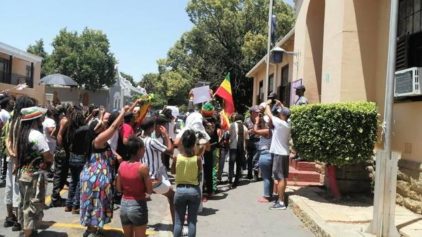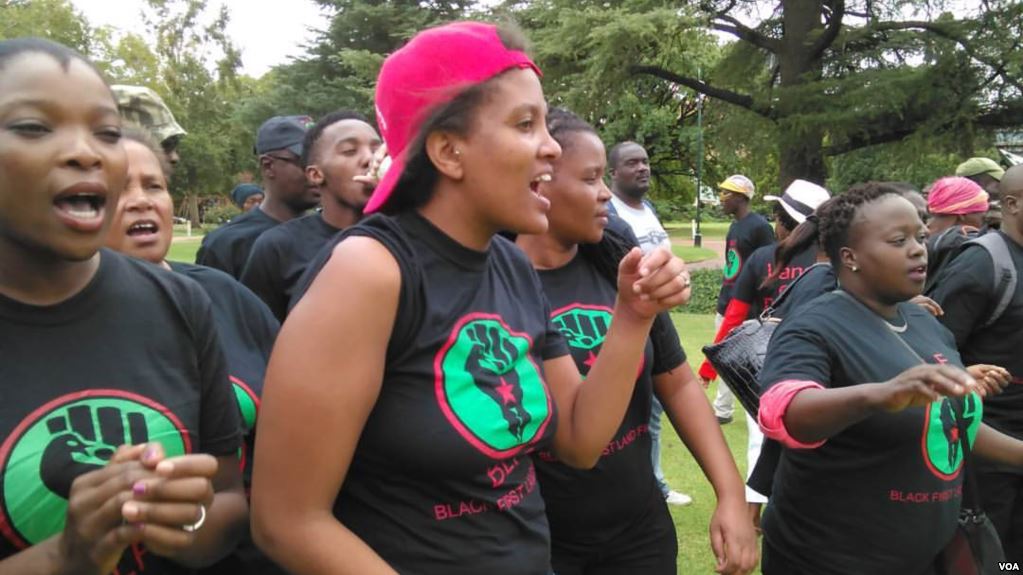
Black First Land First activists gathered Friday morning in Pretoria, South Africa, to demand that land be returned to Black South Africans as compensation for colonial-era land seizures. (A. Powell/VOA)
Pretoria, South Africa — A small but noisy group of South African activists gathered Friday Feb. 18, in the nation’s capital to bring attention to an issue that is gaining momentum at the highest levels of government: How to resolve longstanding issues that leave Black South Africans economically worse off than their white counterparts more than two decades after the end of the racist apartheid system.
Some 200 Black First Land First activists gathered in a soggy Pretoria park named after a long-dead colonial-era president who helped the British empire claim vast tracts of South African land. On this rainy day, protesters wearing “LAND or DEATH” T-shirts sang protest songs seeking restitution for apartheid-era profits from a major South African bank.
As its name indicates, this pressure group has its sights set on something far bigger. Members want land to be given to Black South Africans as compensation for colonial-era land seizures.
This debate has reached the top echelons of government. Just kilometers from the park, President Jacob Zuma, from his office, referred a bill back to parliament that seeks to redress racial imbalances in land ownership.
‘Right to defend ourselves’
Activists say the government’s efforts are insufficient. The far-left group objects to the current policy that allows landowners to hold out until the selling price is acceptable. Lindsay Maasdorp, national spokesman for Black First Land First, says Zuma’s constitutionally based approach is also not enough, and that change needs to come sooner — and that it may not be pretty.
“Black people must stand up and literally take back the land,” he told VOA. “We will not wait for a constitution that is anti-Black and enshrines land theft to determine when we take back land. … We’re saying Black people should not be buying back stolen land. We agree that we should not. White people didn’t come here and just start speaking to us and say, ‘Let me just take it.’ It was a violent process and it continues to be a violent process. … When we confront violence, we will do so with violence, too. Sometimes, it will be with words, sometimes, it will be through dialogue. But other times, it will be physical as well. Why? Because we have the right to defend ourselves against those who have taken our land from us.”
In recent years, anger over land inequality has been accompanied by violence against owners of farms and small holdings. South African police typically report about 500 incidents each year. Unemployed protester Simon Kgofelo, 45, says his lack of land affects him deeply.
Read more here