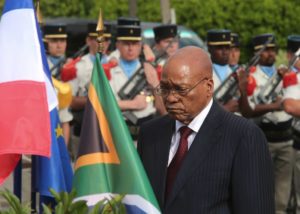
President Zuma visits the memorial site (Photo via Yahoo.com)
One hundred years after they fought together in World War I, white and Black soldiers are finally being honored equally at South Africa’s memorial on the former battlefields in northern France.
South African President Jacob Zuma on Tuesday inaugurated a new memorial wall at the site of the Battle of Delville Wood where some 3,000 citizens fell in July 1916.
“We are here to honor in particular Black people who fell in this war, who were not accorded the respect and recognition they deserved, and which is equal to that of their white compatriots,” Zuma said at the commemoration ceremony.
When World War I broke out, South Africa was still a British colony and the segregationist policy of apartheid had not yet been set in law.
However, Black South Africans faced strict movement and residential restrictions under white minority rule and were treated as lesser citizens.
The South African Native Labor Contingent (SANLC) was formed to provide workers for Allied forces who were struggling with a labor shortage on the Western Front.
However white authorities did not want Black South Africans to have equal footing with Europeans and set strict conditions for the formation of the force, such as them not being allowed to bear arms and that they must live like prisoners in guarded compounds.
Scared that race relations would be undermined at home, the South African government ordered that “all familiarity between Europeans and Natives” should be prevented.
Zuma said the Black South Africans were not allowed to bear arms as “the ruling white elite feared that training Blacks in the handling of fire arms would empower them to, in future, use such military expertise to fight white supremacy.”
However as the war intensified, regulations were relaxed and members of the SANLC were transferred to the trenches.
In northern France, a mixed force of 3,153 South Africans was ordered to hold Delville Wood “at all costs.” They succeeded, but after six days of fighting only 142 soldiers were alive.
Up until 2014 when the remains of Black soldier Private Myengwa Beleza were transferred to Delville Wood — two decades after the end of apartheid — Black South Africans were buried elsewhere in France.
Read more here.