8 Disturbing Images of Instruments of Torture Used on Black People

torture cotton screw

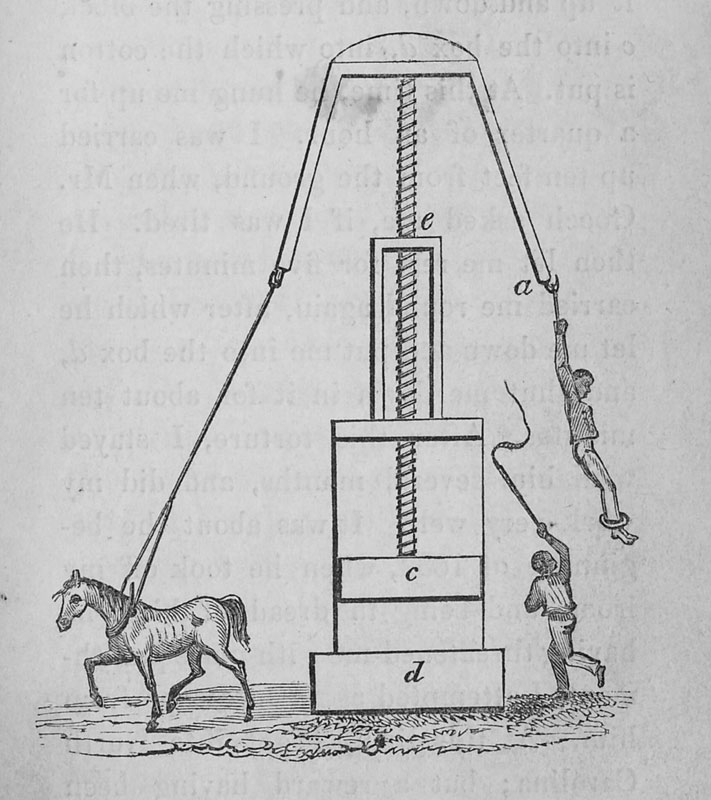
Cotton screw

Moses Roper, a Black man who was born into bondage in North Carolina and eventually escaped slavery in 1835, recounted the torture endured in punishment for running away in “Narrative of the Adventures and Escape of Moses Roper, from American Slavery.”

A machine used for packing cotton became an instrument of punishment. When Roper, who had many attempts to escape the South Carolina plantation on which he’d been enslaved, ran away yet another time, among the “instruments of torture” applied to him was the “cotton screw,” a machine used for packing and pressing cotton.

Roper recalled: “He hung me up by the hands at letter a, a horse moving round the screw e* (*This screw is sometimes moved round by hand, when there is a handle on it. The screw is made with wood, a large tree cut down, and carved in the shape of a screw), and carrying it up and down, and pressing the block e into the box d, into which the cotton is put. … I was carried up ten feet from the ground, when Mr. Gooch … let me rest for five minutes, then carried me round again, after which, he let me down and put me into the box d and shut me down in it for about ten minutes.”
Independent journalism still matters.

We hope this story was worth your time. For over 14 years, Atlanta Black Star has stayed Black-owned and independently run. We didn't get here by waiting on ad budgets that were never built to prioritize us. Our readers did that.

Corporate support for Black media has always been thin. Outlets like ours get roughly 1% of the $170 billion spent on U.S. advertising each year, and that margin is shrinking further as advertisers walk back the DEI-linked commitments they made in 2020. That's the backdrop. It's not why we're asking.

The wider picture isn't any steadier. Newspaper ad revenue has fallen more than 80% since 2005, and local newsrooms are closing at a rate of roughly two a week nationwide. When outlets go under, it's rarely the ones built to center a Black perspective from the ground up that get to stick around.

We know a request for support isn't why you came here. But without readers choosing to fund this work directly, the depth of reporting we can do at home and abroad shrinks along with everyone else's. If you're not in a position to give, that doesn't change how much we value you as a reader.

If you are able to, a recurring contribution does more for us than a single one-time gift, because it lets us plan the next investigation instead of just the next invoice. It takes about 30 seconds, no long form, no account. Thank you for continuing to support independent journalism and freedom of the press.

Back to top