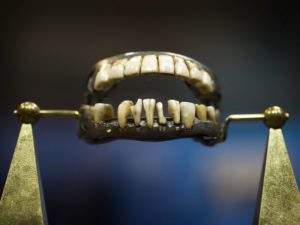
George Washington’s dentures were reportedly made with a mix of both Ivory and human teeth. (Photo by Glen Stubbe/ZUMA Press/Corbis)
The age-old debate into President George Washington’s wooden teeth has been sparked yet again after a Philly Tribune op-ed revealing the nation’s first POTUS actually used humans’ teeth — from enslaved Africans.
Columnist Micheal Coard said his initial Facebook post sharing the “historically truthful information” was met with outrage from internet racists who tried to deny the facts, as shocking as they were, despite them being backed by several researchers. Coard’s post went viral, prompting him to pen an equally explosive President’s Day column for the local paper.
“President’s (not Presidents’) Day is officially called George Washington’s Birthday [and] was created in 1885 to honor the man who enslaved 316 Black human beings at his Mt. Vernon, VA plantation,” he wrote. “It wasn’t just their entire bodies that Washington robbed them of, he also robbed many of them of their teeth. Yes, their teeth!”
Coard explained that in 1784, Washington had the teeth of enslaved Africans transplanted into his mouth. It was just five years later that a Philadelphia dentist made the president’s first full set of dentures made from teeth that were “yanked from the heads of his slaves.”
The article sparked intense debate among readers who refused to believe Washington was capable of such an atrocity. Then there were those who were shocked or saddened by the news altogether.
“Wow, history tried to make this man seem like he was an angel,” one commenter wrote. “But in essence, he was just like all other white slave owners. Barbaric and hateful to people of color.”
“Do you really think that could happen? The roots of the yanked teeth would die, not to mention the high risk for infection for Washington,” another wrote. “… THERE WERE NO ANTIBIOTICS THEN. Mystr;ies [sic] at the museum said his teeth were made of ivory — Now maybe they carved the ivory for him.”
More comments included: “This story is absolute BS. Washington’s false teeth were made from Ivory. Just look at the picture and compare the teeth with your own, the bottoms are too flat.”
Mount Vernon, the historical site of Washington’s Virginia home, has acknowledged that the president had ivory, not wooden teeth. It claimed that at one point, Washington “bought” nine teeth from enslaved Blacks.
“It’s not clear if Washington intend to use these teeth as implants or within a new set of dentures or if he employed the teeth at all,” the museum stated. “While this transaction might seem morbid to a modern audience, purchasing human teeth was a fairly common practice in the 18th century for affluent individuals.”
Readers quickly called bs on the site’s sanitized, revisionist history.
“This article is innacurate,” one person wrote. “George Washington did not buy teeth from “African Americans”, he took teeth out of the mouths of African Slaves. Stop rewriting history ….”
“Washington owned over 300 slaves, so if he had slaves teeth, it’s a safe bet as to how he acquired them. and let’s just say it wasn’t via “fair trade practices,” wrote another.