
Thousands of travelers spent the afternoon of Nov. 13 staring at departure boards that refused to budge.
Gates overflowed, baggage claims filled with frustrated crowds, and planes sat parked from coast to coast as the Federal Aviation Administration took a step it almost never takes.
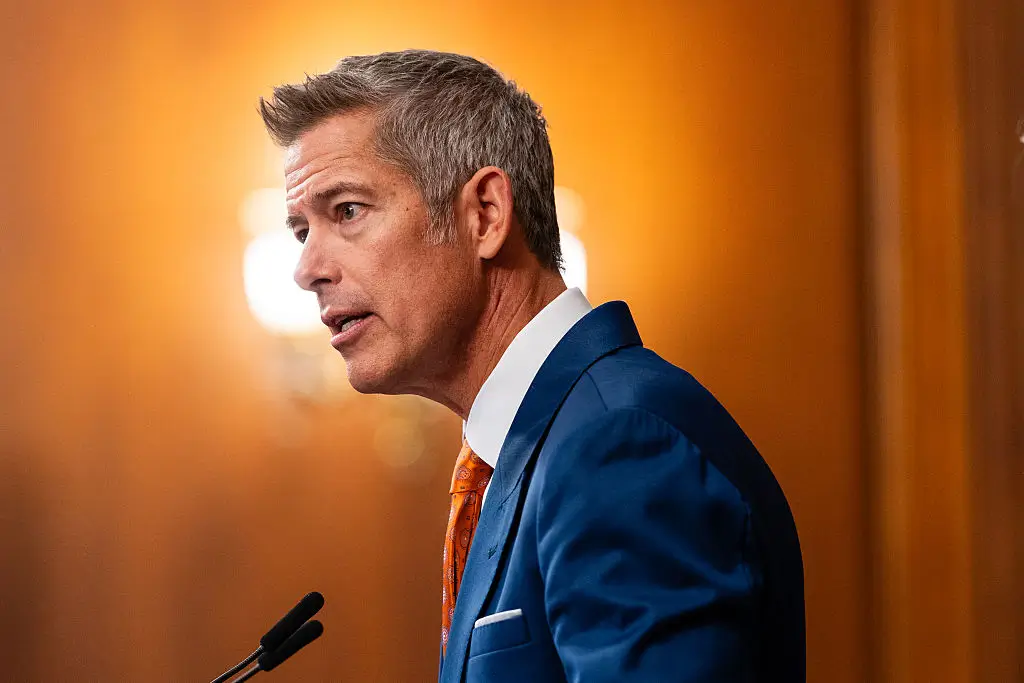
By the time the skies reopened more than four hours later, Transportation Secretary Sean Duffy had an explanation ready and a very expensive request riding right behind it.
The same administration that has spent months touting splashy airport makeovers was suddenly on defense. And once Duffy stepped up to the White House podium, his story of what broke didn’t hold together for long.
The trouble surfaced in the middle of the afternoon, when radar and communications at air traffic control centers across the country became unstable.
The FAA ordered a nationwide ground stop on all departing flights, citing “extraordinary circumstances” and “reasons of safety.” By Duffy’s count, roughly 3,500 planes were already in the air when it hit.
Departures stayed frozen until a little after 8 p.m. Eastern, leaving thousands of flights canceled or delayed and delays set to drag on long after planes started moving again, CNN reported. The last time the entire country was grounded like this was January 2023, when a pilot-alert system crashed.
Homeland Security Secretary Markwayne Mullin said there was no sign of a cyberattack. Duffy, meanwhile, pinned the chaos on what he called an “incredibly old” air traffic control system, explaining that routers got overloaded with data and started giving inconsistent readings. “It was a legacy network problem,” he said.
Then came the pitch. “This is an emergency,” Duffy told reporters, warning that “you will have more of these” unless lawmakers act. “I want $50 billion.”
According to CBC News, the administration had been asking Congress for about $30 billion to build a new system, a number that jumped by $20 billion in a single press conference. Congress already approved $12.5 billion for the overhaul last year.
But Duffy wasn’t the only one at the podium with a theory, and Mullin’s version pointed much closer to home.
“What it appears to be right now is, as Secretary Duffy and FAA was going in and putting patches into the system, they were putting new equipment and new technology, and that new equipment, new technology… it was overwhelming the older system,” Mullin said.
In other words, the “old system” didn’t just give out on its own. By Mullin’s telling, it buckled under the upgrades Duffy’s own department was bolting onto it.
The timing raised even more eyebrows. Just three days earlier, on Nov. 10, the FAA’s new AI-supported traffic tool, SMART, went live in all 22 of the country’s air route traffic control centers, Mediaite reported.
Asked about a possible link, Mullin said, “You can’t rule out anything at this point.” Air Space Intelligence, the company behind SMART, denied its software played any role, and officials have yet to confirm an exact cause.
Under the briefing video Duffy posted to X, critics weren’t buying the sales pitch. “This press conference was an embarrassment. Instead of calming fears, you yelled at people for more money,” one user wrote.
Another added, “Give us money or we can’t guarantee this won’t happen again is a weird way to calm the nerves of a worried nation.”
Others caught the contradiction right away. “You stood in front of America and said we can’t just replace one part. Then proceeded to tell us how you only upgraded one part of a three part system,” one person replied.
Plenty of people questioned where the money has been going instead. “The money spent on Trump’s ballroom should have been spent on outdated systems,” one user wrote, before also taking a swipe at Trump’s planned 250-foot arch near Arlington National Cemetery.
On Atlanta Black Star’s Instagram, one follower put it bluntly: “Firing all your smart, experienced melanated people has consequences.”
Some even dug up Trump’s own words from January 2023, when that last nationwide ground stop happened on Joe Biden’s watch. Back then, Trump took to Truth Social to declare that “all flights have been canceled throughout the Good Ol’ USA due to incompetence and the fact that we are now living in the equivalent of a Third World Nation.”
Duffy is no stranger to squirming in front of the cameras. Back in July, a face-to-face jab from Trump at a White House event left viewers cringing on his behalf.
This time, the stakes are far bigger than a viral clip, with the Thanksgiving travel rush less than two weeks away and Duffy himself promising more outages are coming.


