
A Brooklyn man is now suing the city for at least $100 million after New York police detectives beat and bloodied him in his neighborhood liquor store in April after mistaking him for a suspect in a drug bust.
Viral videos from store surveillance and bystander cameras showed two officers punch Timothy Brown, 46, in the head, slam him against a glass cooler and then headfirst into a wine display rack, shattering bottles, and then drag him by his ankles across broken glass and kneel on him while his leg bled onto the floor.
At the time, New York Mayor Zohran Mamdani called officers’ actions “extremely disturbing and unacceptable,” writing on X that “officers should never treat a person this way.”
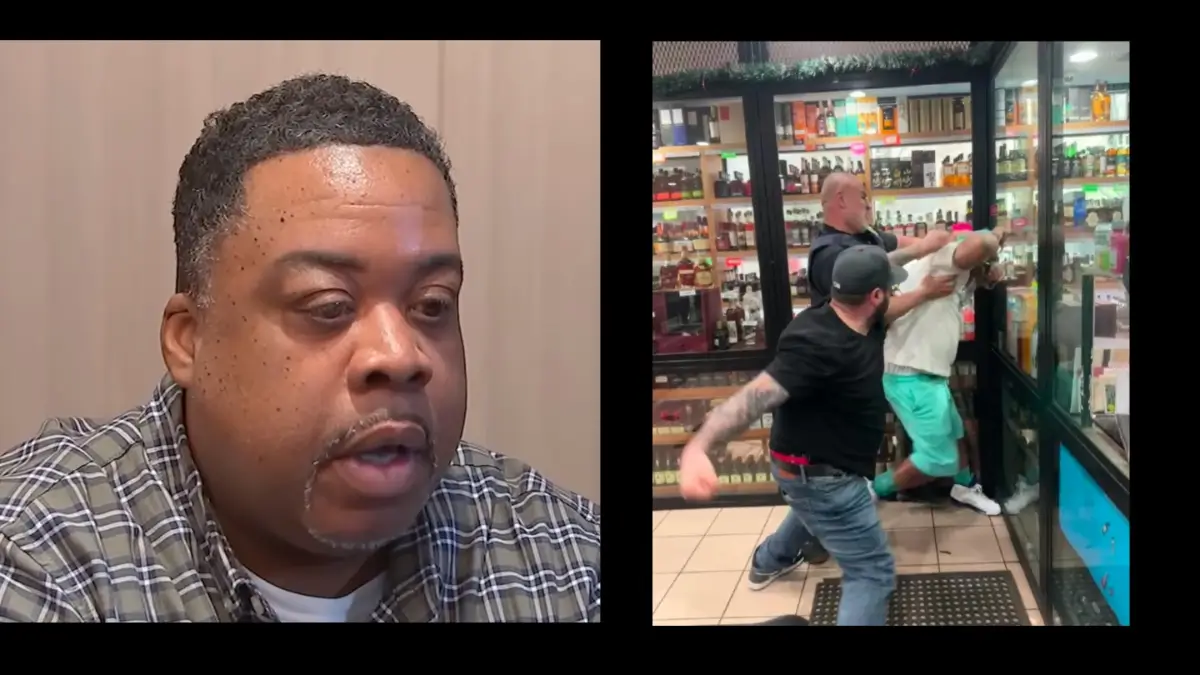
The plainclothes detectives, Volkan Maden and Michael Algerio, were members of the NYPD’s Brooklyn North Narcotics Unit, which had just arrested a man for selling crack cocaine to an undercover officer in the area. They were looking for an accomplice of the seller that the undercover officer had described only as wearing a white shirt and green shorts.
Brown, a home health aide and licensed security guard, had just finished working on the afternoon of April 14, went home, changed clothes, and headed to the liquor store to buy a bottle of wine. He was wearing a white T-shirt and teal shorts, a teal bucket hat, and white sneakers.
When the detectives approached Brown in the back of the liquor store, they seized him without identifying themselves as police officers, “without asking him a single question, without checking with the undercover officer, and without any evidence tying him to a drug sale,” the lawsuit says.
Brown suffered multiple injuries during the takedown, including a broken nose, a severely bruised scalp, and glass embedded in his knee, according to the complaint. His leg laceration took 25 stitches to close. He walked with a cane for several months, suffers from post-traumatic stress disorder, and has not been able to work since the incident.
Finding no drugs or contraband on Brown, the officers arrested him for resisting arrest and obstructing governmental administration in the second degree, charges that the Kings County District Attorney’s office declined to prosecute.
NYPD investigators determined that Brown had no connection to the drug transaction and was not the person officers were looking for.
Brown never resisted the officers, the lawsuit says, and only put up his arms at times to stop the rain of blows coming at him from both detectives.
Store surveillance cameras and the phones of shocked onlookers captured Maden and Algerio’s alleged excessive force against Brown, as neither detective wore a body camera, violating department policy.
The complaint also alleges that the detectives carried no police radios and relied on cellphones and WhatsApp to contact their team. As a result, other officers took several minutes to reach the scene, and investigators never recorded the detectives’ communications.
The department initiated an internal investigation into the officers’ conduct in April and stripped them of their guns and shields, placing them on modified duty, The New York Times reported. It also launched a 90-day review of its entire narcotics division, covering policies, compliance, equipment, training, and supervisory oversight, and disbanded the team responsible for the drug sweep within its Brooklyn narcotics unit.
The department has not made the results of that 90-day review publicly available.
“I want justice for what happened to me,” Brown said at a press conference with his lawyers announcing the lawsuit on Tuesday. “[It] shouldn’t happen to nobody else what happened to me. It was disgusting, and it was wrong, and they have to be punished.”
Derek Sells, the chair and managing partner of the Cochran Law Firm, is the lead attorney in Brown’s case. He told reporters that the lawsuit aims to prevent wrongful arrests based on vague suspect descriptions and reduce police misconduct overall, PIX11 reported.
The city has paid out nearly $800 million to resolve 6,766 cases alleging police misconduct between 2019 and 2025, Brown’s attorneys said.
The lawsuit chronicles the longstanding history of public complaints and civil rights lawsuits claiming the use of excessive force, wrongful arrests, and other serious misconduct against NYPD officers, including the two detectives.
From 2016 to 2021, civilians filed 12 complaints against Maden with the Civilian Complaint Review Board (CCRB), a police oversight agency, the lawsuit says. Seven of those complaints alleged he used physical force, including a 2021 complaint alleging a chokehold and restricted breathing.
The CCRB substantiated 12 allegations against Maden across five complaints. The findings included a 2020 unlawful frisk, two unlawful vehicle searches, and offensive language. Although the board recommended formal disciplinary charges, the NYPD never served Maden with the charges or disciplined him.
Maden also faces allegations in several other civil rights lawsuits. In a 2019 case, a plaintiff accused Maden and other officers of forcing their way into his apartment and punching him. The parties later settled the case. In a separate 2023 lawsuit stemming from a 2021 traffic stop, a plaintiff accused Maden and other officers of using a Taser on him and kicking him.
NYPD “likewise knew that Algerio had a record of complaints and lawsuits involving force,” the lawsuit says. CCRB records show that Algerio faced eight complaints over incidents between 2013 and 2025. Four accused him of using physical force, and the board substantiated one complaint.
Algerio has also faced allegations in other civil rights lawsuits. A 2014 case accused him and another officer of grabbing, pushing, and stepping on a street vendor. The parties settled the case. In a separate 2017 lawsuit, a plaintiff accused Algerio of excessive force, false arrest, and malicious prosecution. The case ended in 2025 with a $20,090 payment to the plaintiff.
Despite the city’s knowledge of the detectives’ complaint, disciplinary and litigation histories, “the City kept both armed and assigned to plainclothes narcotics enforcement, in which they routinely seized civilians on the street,” the complaint says.
It faults the city for failing to “place either detective in any meaningful monitoring, retraining, reassignment, or early-intervention program” or imposing discipline to deter further misconduct.
The lawsuit asserts that the city has, for years, failed to discipline officers whose misconduct the CCRB substantiates.
An audit by the city comptroller, issued in December 2025, found that, of the 1,929 substantiated cases that the CCRB referred to the NYPD without formal charges between January 2024 and May 2025, the NYPD did not implement the discipline recommended in 54 percent of the cases. The police department closed 993 of those cases without any review under a policy that allows it to refuse to review cases received with fewer than 60 days remaining before the limitations period expired.
In cases where the CCRB did bring formal charges, the NYPD failed to serve the charges in 86 of 627 cases, the lawsuit claims.
NYPD also does not use lawsuits to identify problem officers, the lawsuit says, citing a 2015 NYPD Inspector General report that said the city “had no effective method” of combining its data on claims and lawsuits against NYPD members and that the department “was often unaware of the ultimate settlement or resolution of pre-litigation claims.”
The NYPD’s 2025 report shows that a lawsuit judgment or settlement triggers early intervention review for an officer “only when the suit alleges an unconstitutional stop or trespass enforcement, so that judgments and settlements in suits alleging excessive force or false arrest, like those against Maden and Algerio, trigger no review at all.”
Recent NYPD audits also show the city chronically fails to enforce its body-worn camera requirements, despite its knowledge that “the absence of footage defeats accountability,” the complaint says.
In addition to allegations of excessive force, false arrest, unlawful seizure, malicious prosecution, and failure to intervene against Maden, Algerio, and several other responding officers, the lawsuit alleges supervisory liability against a sergeant and two other officers who supervised the narcotics apprehension team, in violation of the Fourth and Fourteenth Amendments, city and state law.
It also alleges the City of New York has municipal liability for the officers’ conduct due to its policies, customs and practices that fail to monitor, discipline, retrain or reassign officers whose misconduct the CCRB substantiates; fail to enforce the wearing and activation of body-worn cameras; fail to train narcotics officers in identifying suspects before seizing them; and for tolerating a persistent practice among its narcotics units of “seizing people without probable cause, using excessive force, and bringing unfounded charges.”
Brown seeks a jury trial to determine compensatory and punitive damages for his physical injuries, mental and emotional distress, lost wages, and future earning capacity.
A spokesman for the NYPD told reporters on Nov. 10 that the agency does not comment on pending litigation.
The defendants, including the city, have 21 days after being served with the complaint and summons to file a response in the U.S. District Court for the Eastern District of New York.


