Billionaire health care executive Rick Jackson, the Republican candidate for governor of Georgia, is edging out former Atlanta Mayor Keisha Lance Bottoms in recent polls after months of what seemed a dead heat between the two candidates.
In daily attack ads on TV and live appearances, Jackson has hammered Democratic candidate Bottoms for her decision not to run for a second term as mayor in 2021 amid pandemic-related turmoil and rising crime in the city.
“When Atlanta faced some of its hardest moments, she chose not to run again. She walked away from the fight. I never will,” Jackson said last month at a campaign event in Savannah, with a strategically placed campaign sign behind him that read, “Character matters,” The Current reported.
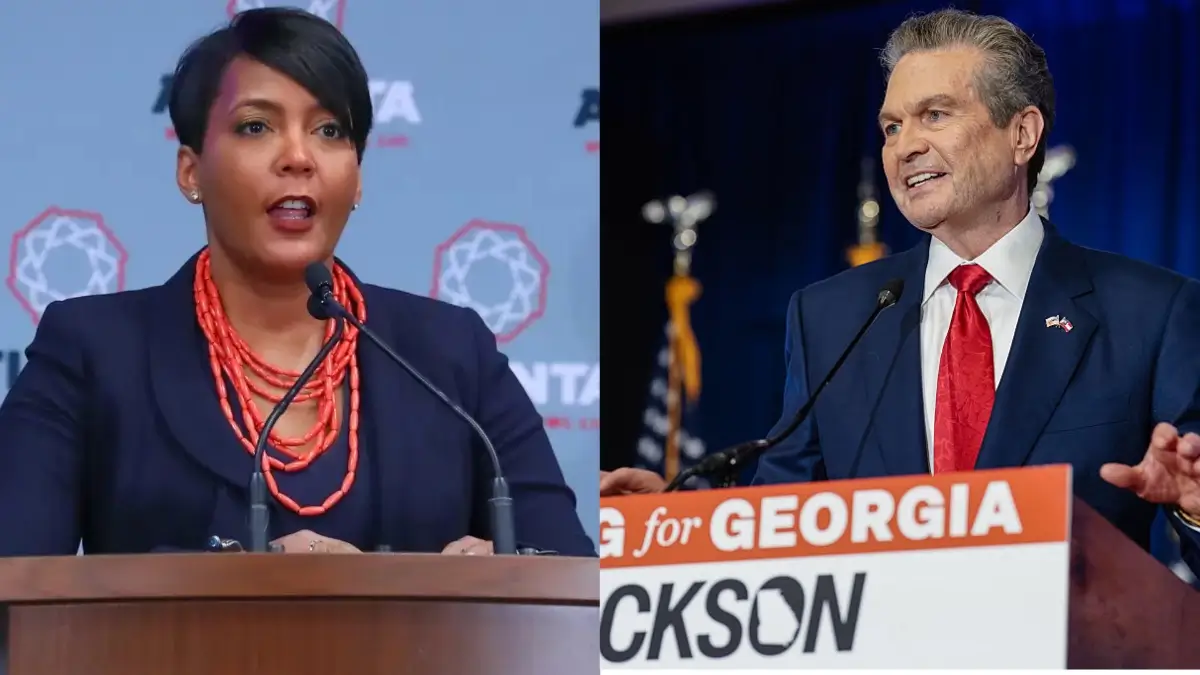
Meanwhile, Jackson frames himself as a political outsider and self-made, successful entrepreneur who overcame a hard-knocks childhood in foster care to amass wealth and influence, relying on his intrinsic savvy and true grit. He says he’ll use his common sense and keen business mind to eliminate waste and fraud in government.
Ever since she announced her decision not to seek reelection in May 2021, saying in a press conference, “I didn’t feel in my heart I should run again,” Bottoms has faced fierce criticism from partisan ranks as well as some Democratic voters for being a “quitter,” which has continued throughout the primary and general election season.
Bottoms has explained her decision to bow out of a second mayoral term as a deeply personal one that arose out of family considerations, a need to protect her own health, and a sense that she had already accomplished a great deal as mayor, including balancing the budget, creating an affordable housing trust fund for low-income families and increasing pay for police and firefighters.
She told The Grio in July 2021, “It’s something that I had just been in deep thought and prayer for a very long time, and that was just really because I didn’t have the peace that I know I should have about a second term,” noting that the pandemic had made her take stock of her life.
At 51, she was mindful that her father had died at age 55, which “certainly makes you think about how you would like to spend your days if these were the last four years I had on earth.”
She worked for the Biden administration as a senior adviser to the president for public engagement from July 2022 to February 2023, then later as a member of the president’s Export Council, advising the president on trade performance and resolving trade-related issues between businesses, labor groups, and government sectors.
Now as Jackson ratchets up the quitter talk to exploit what has long been viewed as a political vulnerability for Bottoms, she is opening up more about the issue and casting her choice to preserve her physical and mental health as a power move.
During an appearance on the syndicated talk show “The Breakfast Club” on Monday, co-host Charlamagne Tha God asked Bottoms, “What changed in you between walking away from city hall and deciding you want this much bigger job?”
Bottoms replied, “My kids were much younger when I was mayor. There was not one single reason for me. I knew it was the best decision for my family and I at that time. And I was really proud of what I had delivered on behalf of the city. … But I knew for me and my family it was best for me to step out at that time. I didn’t even intend on going to the White House. I had turned down the president three times for a cabinet position.”
Noting that when she left the mayor’s office, “I always said that was a comma, not a period. That I knew that I needed to step out at that moment. But I always said, you know, Georgia was going to always would always be in my heart and that I one day I may step back in. … And you got to think about it, you know, people who go to work every day, people make career decisions, they change jobs. I just did it publicly, coming out of, like, a moment for me; honestly, it was realizing I never even saw my kids while the sun was still out.
One day as mayor, she said, “It wasn’t until we were all home during the pandemic and I saw them one day and it was daylight and I’m like, ‘I never see them.’”
At that time, two of her children were in elementary school, one was in middle school, and one was a high school senior, she said.
“So I’d say you know the pandemic was … people called it the great resignation. And I think for a lot of people, including me, it was the great reevaluation, and you know I’ve written about this in the book … my dad died suddenly at 55 and I was experiencing a lot of health issues I’d never talked about publicly — I was pre-diabetic, prehypertension, had chronic inflammation, just a lot of things that I was internalizing on the other side of it. And I know exactly where I went wrong. I know exactly why I experienced those things because in seeing about the city and seeing about my family, I wasn’t seeing about me.”
She said that an internal poll indicated she had an approval rate of 68 percent at the time and was likely to win reelection, as have most incumbent Atlanta mayors.
“So I knew if I had run again I would have won. That’s why I always say that was a decision from strength not weakness. And I don’t regret it.”
Bottoms repeated some advice from her therapist, “who said strong people push through and they have heart attacks and strokes and high blood pressure and they die. Powerful people stop. They feel, they learn the lessons, and then and only then do they move on.
“And for me, you know, preserving mental health is as important as preserving physical health. And I don’t have to tell you this. That’s not a weakness. It’s saying, ‘I don’t want my kids to wake up one morning, and I’m gone like my daddy.’ You know, I want to be healthy and whole. I want to be around for them. I want to be the best version of me that I can be for them and everybody else.”
“Whether you are running for governor, whether you’re serving as mayor, whether you, whatever your life is, it’s about living it in balance,” she said. “And that’s something I did not do when I was mayor.”
Asked if she’s ready to face the challenges of a demanding statewide office this time around, she said, “I’m more than prepared, more than able. And entering this race was a choice. This is, I could have continued to press the easy button in life post-serving as mayor. It’s a choice to enter this. That’s how important this race is to me.”
Bottoms, who would be Georgia’s first female and first Black governor, is running on a campaign that highlights Medicaid expansion, affordable housing, and increased funding for public education.
She has accused Jackson, a political novice whose company has won several hefty no-bid state government contracts for running health care facilities, of Medicare fraud and of trying to buy the election through more than $108 million in self-funded advertising since the primary season.
An AdImpact analysis shows pro-Jackson groups have spent or reserved nearly $76 million in airtime ahead of the general election, compared with about $8 million for Bottoms and her Democrat allies, AJC.com reported. Her campaign itself has just $42,000 reserved for traditional TV ads.
Still, along with the usual midterm bump for minority-party candidates, Bottoms and other down-ballot Democrats are likely to benefit from U.S. Sen. Jon Ossoff’s strong polling and from anti-Trump sentiment weighing down Republicans.
As his polling numbers have ticked up, and he now leads Bottoms by one or two percentage points in recent polls, Jackson has declined several opportunities to debate Bottoms, which she, her staff and Democratic leadership in Georgia have characterized as cowardice.
Their lone scheduled joint appearance before the general election on Nov. 3 is a town hall-style event on Oct. 6 at a TV studio in Atlanta, where voters will pose questions to the candidates.


