A Black police officer in Asbury Park, New Jersey will receive nearly $1.2 million in a settlement of his lawsuit claiming that he faced racial discrimination and retaliation from the city and its police department after reporting a captain’s use of a racial slur.
Ahmed Lawson was 18 years into his service with the Asbury Park Police Department in 2022 and out on patrol overseeing a road construction job when he thought he heard Patrol Captain John Crescio use the “n-word” on a police radio transmission, according to his lawsuit filed in June of 2022 and obtained by Atlanta Black Star.
On a taped line, Crescio appeared to say, “Oh sh-t, they drug that [n-word] out of there,” the complaint says. After hearing this, Lawson approached Lt. Michael Barnes, who worked in Internal Affairs, and Officer Josh Kendle, who both reported they heard Crescio use the n-word during the live radio transmission, as did two other Internal Affairs officers who later heard the tape.
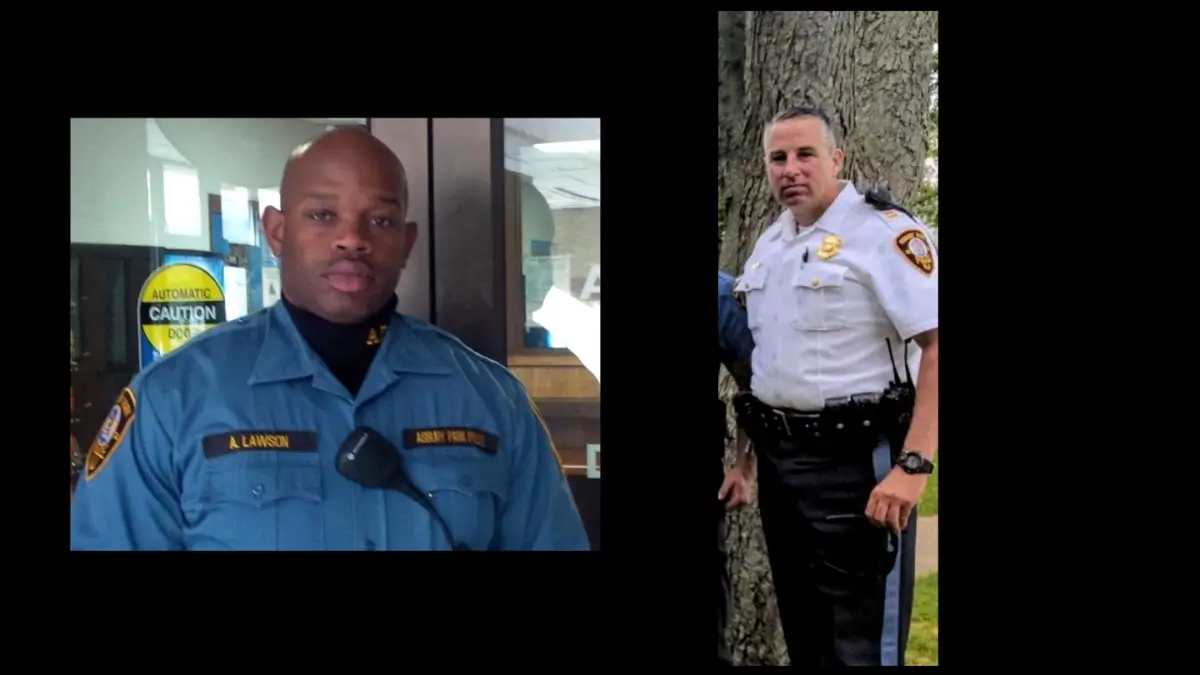
Crescio denied using the slur. During a deposition, he testified that his radio microphone had accidentally turned on while he was speaking on the phone with a friend about deer hunting, and that he was talking about “big bucks chasing the does,” reported TransparencyNJ.
Crescio testified that when he learned of the allegation, he told Internal Affairs that the person who reported it was “an outright liar” and that “the incident never occurred.”
Shortly after Lawson made his complaint, Crescio initiated Internal Affairs complaints against Lawson, Barnes and Kendle, alleging the three had conspired to fabricate the charge against him. Internal Affairs removed Barnes.
Meanwhile, the Monmouth County Prosecutor’s Office received Lawson’s Internal Affairs complaint, and the lawsuit alleges that “Detective Danny Newman admitted the audio of Capt. Crescio sounded like he used the “n-word.”
Despite the fact that “half a dozen people believed” that Crescio used the slur, the lawsuit said, the prosecutor’s office did not sustain the complaints against him.
Lt. Daniel Kowsaluk, an Internal Affairs officer, also recommended exonerating Lawson, Kendle and Barnes from Crescio’s complaint, and a later court filing by Lawson says officials did so.
Lawson claimed that his report of the racial slur by the white captain, which came at a time when other Black officers were publicly complaining about racial discrimination and disparate treatment in the department, led the department to retaliate against him by denying him a promotion to sergeant.
Two years earlier, in March of 2019, a dozen members of the police department, including Lawson, broke off from the local Policemen’s Benevolent Association (PBA) union to form a new local union with the Fraternal Order of Police (FOP). The FOB then consisted of mostly Black officers, a Pakistani American, and a white officer, Craig Breiner.
The lawsuit said Breiner told Lawson that people called him a “race traitor” and “white devil” because he associated with his non-white colleagues.
According to the suit, senior colleagues had previously warned Lawson that a faction of white officers within the department openly identified as members of the “CRAB Club,” which stood for “Crazy Racists Against Blacks.”
In March 2021, an attorney for Sgt. Marshawn Love deposed Lawson in Love’s lawsuit against the department, in which he alleged racial discrimination and retaliation after he reported an off-duty officer who killed his wife. The city ultimately paid $1.25 million in July 2023 to settle Love’s claims.
During that deposition, Lawson testified directly about the “CRAB Club” and pointed to stark disparities within the department, testifying that white officers routinely received preferential treatment over their non-white peers.
Lawson was a certified field training officer, responsible for training newly hired police officers after they graduated from the police academy. The lawsuit said the department sometimes barred him and other non-white officers from training new hires while assigning uncertified white officers to do the job.
In June of 2022, when he filed his lawsuit, Lawson asserted that he had passed the civil service exam and was qualified for promotion to sergeant. At the time, he said, Breiner ranked ahead of him on the civil service list, making Lawson the second-highest-ranked candidate for sergeant.
The department had a longstanding practice of promoting candidates off the civil service list based on the candidate’s current ranking on the list.
However, the lawsuit contends that when Lawson twice signaled his interest to the city manager in filling two vacant sergeant positions, city leadership opted to leave the roles open rather than promote him — a move Lawson asserted was a deliberate act of racial discrimination and career retaliation.
His lawsuit alleged that the city violated the New Jersey Law Against Discrimination by failing to promote him and withdrawing benefits formerly provided to him, constituting racial discrimination, disparate treatment and retaliation.
Lawson sought a jury trial to determine compensatory damages for his alleged loss of compensation, earning power, opportunities for prospective employment, as well as emotional distress and mental injury. He also asked the court to award punitive damages and install him as a police sergeant.
The city denied Lawson’s claims, arguing that no one directed racial discrimination or hostility at him and that he offered no direct evidence that anyone made derogatory or discriminatory remarks about his race to him or about him.
In a brief for their motion for summary judgment to dismiss the case in August 2025, the defendants said Lawson’s allegations about the “CRAB Club,” “an allegedly racist group of individuals for which Plaintiff could only identify one member [former Acting Chief Anthony Salerno], had no bearing on his employment, nor did any alleged member take any discriminatory action against him.”
Salerno was no longer at the department in 2018 when Lawson took a promotional test or when he later sought promotions, the city said.
The brief asserted Lawson had not demonstrated any causal link between the police department’s decision not to promote him and his complaint against Crescio for the alleged racial slur or his giving a deposition in the Love case.
Chief David Kelso testified that no one was promoted to sergeant during the time period, from June 2021 to October 2022 when Lawson’s civil service list ranking was active, nor for a full year after that, because the department consistently had 11 sergeants on active duty and “there was not a need for a sergeant to be promoted nor a spot for an additional one.”
As evidence of its lack of discrimination in promotions, the brief noted that Asbury Park PD regularly promoted “numerous African Americans and minorities” off the civil service list prior to Lawson, when it had vacancies. Of eight people the department promoted, two were African American, two Hispanic, one mixed race, and one female.
“During the entire duration of Plaintiff’s employment, he denied ever having lost time, served a suspension or docked pay as a result of discipline he received,” the city argued. “There is no evidence that anyone said anything to Plaintiff, treated him differently, disciplined or otherwise discriminated against him because of his race.”
The parties settled the civil case in New Jersey Superior Court a week before the June 8, 2026, trial date, according to the court docket.
Under the June 15, 2026, settlement agreement obtained by TransparentNJ, the New Jersey Intergovernmental Insurance Fund, on behalf of Asbury Park, agreed to pay $1,185,000 to Lawson in four installments between July and October to resolve his employment-related claims.
The agreement stated that the settlement, which included attorneys’ fees and costs, did not constitute an admission of wrongdoing or liability and that the parties entered it “solely for the purpose of economic expediency.”
Lawson retired from the department in July 2024 after 20 years of service. Public records published by TransparentNJ show his final annual salary was $129,789, and he now receives a monthly pension of $5,259.
The Asbury Park Press reported that several Asbury Park police officers who belonged to the majority-Black Fraternal Order of Police filed related employment lawsuits, including Lawson.
In his 2020 lawsuit, Lt. Kamil Warraich — a Pakistani American Muslim who served as the highest-ranking officer of color in the department and the FOP president — alleged years of pervasive discrimination, retaliation, and institutional misconduct. The city and its insurer ultimately resolved the litigation with an $850,000 settlement. The city admitted no wrongdoing or liability as part of the settlement.
Breiner, the white officer who said people called him a “race traitor,” served in the Marine Corps and as the FOP’s secretary/treasurer. He sued the department, alleging officials discriminated against him when he sought a promotion to sergeant. The parties settled the lawsuit in June, according to court records, but have not publicly disclosed the terms.
In March 2023, after an increase in Asbury Park police officers filing internal affairs complaints against each other and racial discrimination lawsuits against the department, the Monmouth County Prosecutor’s Office installed an on-site monitor at the department to help investigate such complaints.
The monitor remains active.


