Growing concern over the deteriorating health of Kentucky Sen. Mitch McConnell is prompting some political leaders to consider what comes next if the longtime Republican Senate leader dies or steps down in the coming weeks and months.
McConnell, 84, the Senate’s longest-serving leader, has been plagued with health problems in recent years and hospitalized since June 14 with a mysterious illness his staff has yet to explain.
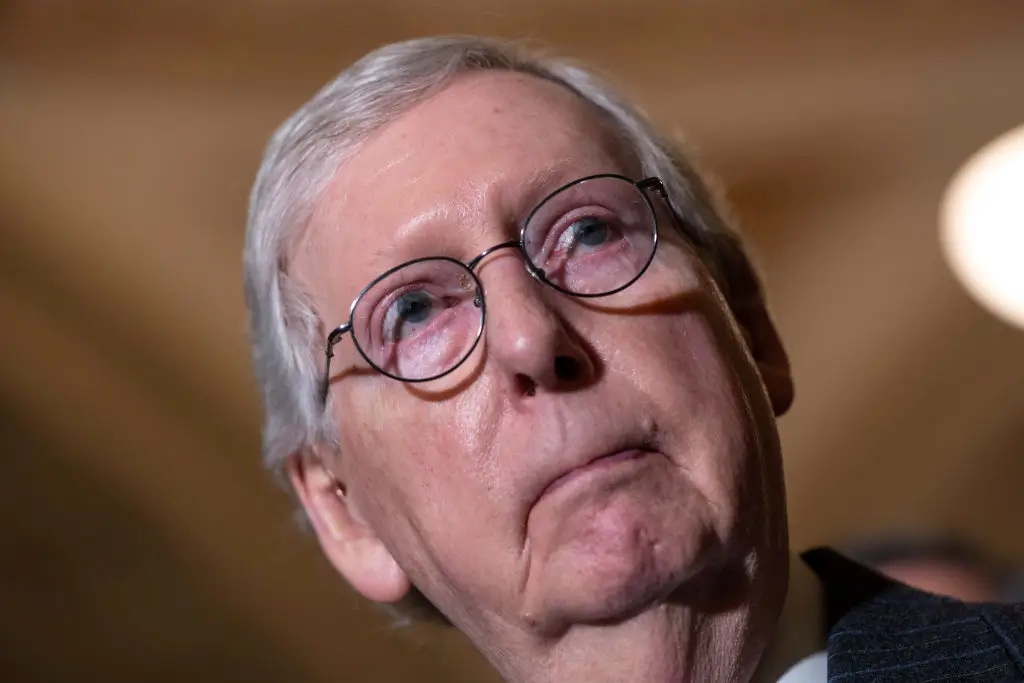
Initially, they said he was “receiving excellent care,” and last week his office released a statement that his condition “continues to improve,” but provided no details on what ails him or his recovery timeline.
But the emergence last week of a recording of emergency dispatch audio from the morning of June 14 indicating that paramedics rushed to an address matching McConnell’s townhouse in D.C. and provided CPR to an unconscious person who may have suffered a heart attack has raised alarm among many politicos over the actual health of McConnell.
Conservative activist Laura Loomer, citing “a high-level source close to the White House,” posted Monday on X that McConnell is “brain dead” and “He’s not coming back” to the Senate.
Kentucky Gov. Andy Beshear, a prominent national leader in the Democratic Party, sent a letter to McConnell’s office on Wednesday asking for an update on the health status of the senator, writing, “Allowing speculation to continue in the media is not fair to the Senator or to Kentuckians,” and wishing him “a safe and speedy recovery.”
Special Election Speculation
If McConnell, who announced earlier this year that he would not seek reelection, is unable to continue serving, Kentucky would need to hold a special election to fill his seat for the remainder of his term.
Under a 2024 law enacted by the Republican majority in the Kentucky statehouse that stripped Beshear of the long-standing power to fill U.S. Senate vacancies, the governor can only call for a special election.
But that election won’t be triggered unless McConnell’s seat becomes vacant within 56 days of the Nov. 3 general election, or by Sept. 8, reported Forbes. After that, the seat would remain vacant until the winner of the general election takes office in January.
Kentucky Rep. Andy Barr, who won the Republican primary for McConnell’s open seat, will face Democrat Charles Booker, a former state representative, in the general election. Barr is considered a strong favorite in the deep red district. Both candidates would likely be nominated by their parties to run in the special election, if one is held.
Some disaffected Republicans, such as former Georgia Rep. Marjorie Taylor Greene, are calling on Republican Rep. Thomas Massie, who lost his May primary to a Trump-backed challenger, to run for the open seat as an independent. Massie has not yet said if he would do so.
The Short-Term Political Stakes
In the meantime, McConnell’s absence in the Senate has real political consequences.
The senior senator has represented Kentucky since 1985. Before his hospitalization, aides pushed him around the Capitol in a wheelchair. He has not voted since June 11.
With the current balance of power in the U.S. Senate consisting of a narrow Republican majority with 53 seats and Democrats and allied Independents holding 47 seats, every single Republican vote is essential.
McConnell’s prolonged hospitalization means the GOP conference operates with one fewer vote on the floor, making it harder to pass budget reconciliation bills, defense packages, or confirm nominees without Democratic support.
His absence on June 23 made a critical difference, The Hill reported, when four Republican senators crossed the aisle to vote with Democrats to approve a House-passed resolution directing President Trump to withdraw U.S. troops from the military conflict with Iran. The measure passed because McConnell and Sen. David McCormick, a Pennsylvania Republican, missed the vote.
The former majority leader’s absence could make it more difficult for Senator John Thune of South Dakota, the current majority leader, to pass key items on the GOP agenda, such as an emergency defense spending bill, which would need 60 votes to pass and faces strong opposition.
Senate Majority Leader Thune and Speaker Mike Johnson, a Louisiana Republican, could struggle to advance a third budget reconciliation package to fund the Pentagon and other GOP priorities if McConnell’s seat remains vacant.
Republicans hold a slim 15-14 majority on the Senate Appropriations Committee, where McConnell chairs the defense subcommittee.His absence has already forced committee leadership to postpone critical markups, blocking defense supplemental packages and broader spending bills.
And for bills that do make it out of committee, several other Republican senators could serve as bottlenecks, including Sens. Susan Collins of Maine, Lisa Murkowski of Alaska, Thom Tillis of North Carolina, and Bill Cassidy of Louisiana, who are frequent swing votes and have a history of defying Trump and the Republican majority.
McConnell’s Condition Remains Murky
For now, a number of McConnell’s political allies insist they’ve recently talked to the senator about current political goings-on.
Conservative commentator Scott Jennings wrote on X that he spoke to his “old friend” on Tuesday morning for 20 minutes about Iran, Ukraine, his recent visit to the Teddy Roosevelt Presidential Library, “and even a little bit of Senate history. I told him we want to see him back at work as soon as possible.”
A Thune spokesperson told NOTUS’s Al Weaver that the Senate leader spoke to McConnell on Monday, The New Republic reported. “They had a lengthy and substantive conversation that covered a variety of topics, including national security,” Weaver recounted.
But some GOP lawmakers have their doubts.
Utah Senator Mike Lee, a MAGA-aligned legislator, wrote on X on Tuesday, “Many of us aren’t speaking about Mitch McConnell’s condition because we know nothing about his condition.”


