Grace Jones was trending over the weekend after Madonna failed to acknowledge all the women who paved a way for sexual performance styles. On Sunday, Oct. 23, the pop star shared a reflection post about the 30th anniversary of her “Sex” book. The scandalous book about her sexual fantasies and same-sex relationships was released in conjunction with her 1992 album, “Erotica.”
Pop Crave captured a screenshot from the 64-year-old’s rant on her Instagram story, where she over-emphasized her influence in the music industry. She mentioned multi-Grammy winner Cardi B and other entertainers who have visibly displayed their sexuality.
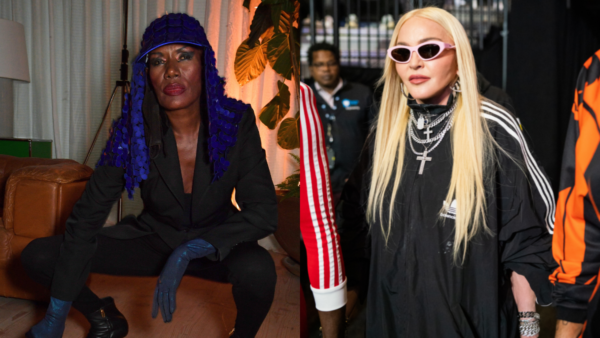
“30 years ago I published a book called S.E.X. In addition to photos of me naked there were photos of Men kissing Men, Woman kissing Woman and Me kissing everyone,” Madonna wrote. “Now Cardi B can sing about her “WAP.” Kim Kardashian can grace the cover of any magazine with her naked a— and Miley Cyrus can come in like a wrecking ball.” She closed with, “You’re welcome b–es.”
Cardi B has publicly kissed and touched women in her videos and performances as Madonna did in the past. But she felt disrespected by the singer’s post and responded with a series of now-deleted tweets. One featured a screenshot of a 2018 article where the 30-year-old praised Madonna as her “real life idol.”
“I literally payed this woman homage so many times cause I grew up listening to her …she can make her point without putting clown emojis and getting slick out the mouth,” Cardi tweeted. These icons really become disappointments once u make it in the industry that’s why I keep to myself.”
By Sunday afternoon, Cardi shared that she “talked to Madonna” and seemingly cleared up any confusion over her reflection post.
But the damage was done as far as Twitter was concerned, as critics began comparing Madonna to other monumental women artists that came before her. Fans believe she was claiming credit for paving the way for women artists to make memorable songs about sex. Others accused the “Like a Virgin” artist of ignoring the contributions of other mainstream women in music, specifically Black women.
In her defense, one person said, “Madonna birthed every single female artist of our time and to say otherwise and discredit her is deluded and wrong. Her DNA is seen in every pop artist today and there’s a reason why she’s transcended music to become a larger than life human figure of culture and art.”
However, many pointed out that Black women artists have been pushing boundaries and exemplifying sexuality in their music and performances long before Madonna.
One person wrote, “Grace Jones, Donna Summer, Lil Kim, Janet Jackson…Madonna was not the first or only female artist to push boundaries with sex.”
Another said, “Women like Donna Summer, Grace Jones, & Janet Jackson PAVED the way & opened the doors for SEVERAL women in the music industry. y’all love to diminish & erase black women’s impact.”
A third individual added, “Black women were literally doing it before her and beside her. again a white person is taking credit for something black people pioneered and also deserve credit for. Donna Summer, Grace Jones, Betty Davis, and Janet we’re singing about f—– and literally MOANING on songs.”
Jones’ aesthetic helped her become a household name in music and fashion — something Madonna eventually became in the 1990s. Some would describe her as a sexually liberated muse who was known for her bold appearance.
“I’m a firm believer that since Grace Jones was a darker-skinned black woman she did not properly receive the accolades that she rightfully deserves,” said one observer. “I believe wholeheartedly the flowers Madonna received were meant for Grace! I wish we saw more of GJ, but I get why we don’t.”
In response to another fan, who noted Jones’ “undeniable” impact, the person added, “Yes! Grace Jones’s impact on the fashion world, ballroom, music industry, sexual liberation, etc…is unmatched & deserves the proper just due!”
“I’m sick of people devaluing the accomplishments & influence black people — esp: black women in massive spaces & on major platforms.”
A few shared photos from Jones’ iconic 1976 cover shoot with photographer Jean-Paul Goude. The “Nipple to the Bottle” singer held a mic while posing in a fairly nude and oiled body wearing a red tube top. One person said, “This alone ended everyone back then and till this day people still try to recreate. Grace Jones is that girl!”
Jones’ image was later published in New York Magazine and served as the artwork for her 1985 album, “Island Life.” Kim Kardashian recreated a similar image for her “Break The Internet” cover of Paper Magazine in 2014.
The 74-year-old explored more about her influence and impact in her 2016 memoir, “I’ll Never Write My Memoirs.” In the text, she explains the importance of standing out instead of following trends from A-list celebrities.
“Trends come along and people say, ‘Follow that trend,’” Jones wrote. “There’s a lot of that around at the moment: ‘Be like Sasha Fierce. Be like Miley Cyrus. Be like Rihanna. Be like Lady Gaga. Be like Rita Ora and Sia. Be like Madonna.’ I cannot be like them — except to the extent that they are already being like me.”