

Critics are asking “where’s the soul?” after learning a white actor will voice the lead role of Joe Gardner in Pixar’s “Soul” for its Denmark rollout.
The movie debuted Christmas Day on Disney+. It stars actor Jamie Foxx as the voice of Gardner, a Black pianist chasing his big break and a life of purpose. The film was lauded for showcasing Black characters through the story of jazz and soul. This is also Pixar’s first film with a Black lead.
“Joe is in all of us, regardless of color,” said Foxx to the New York Times on Dec. 22. “To be the first Black lead in a Pixar film feels like a blessing, especially during this time when we all could use some extra love and light,” he added.
Still, critics say dubbing Foxx’s lines with white actor Nikolaj Lie Kaas forces it through a white filter.
According to The Times, Danish activist Asta Selloane Sekamane says a lack of Black talent could not have been behind the decision to cast Kaas. “It can’t be the constant excuse, this idea that we can’t find people who live up to our standards. That’s an invisible bar that ties qualification to whiteness,” she said.
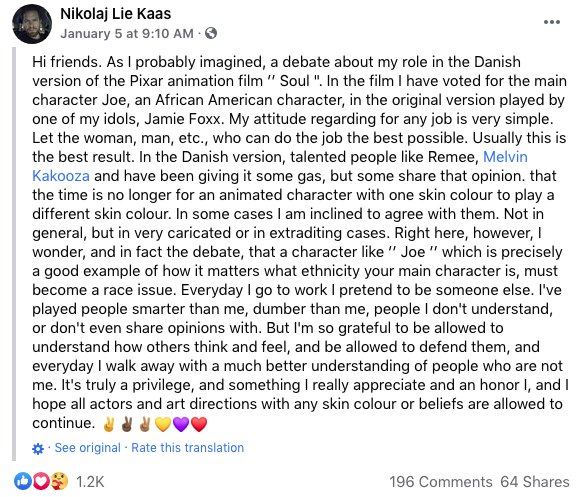
In part, Kaas responded to critics in a lengthy Facebook post: “My attitude regarding for any job is very simple. Let the woman, man, etc., who can do the job the best possible.”
A lack of voice-over diversity is a long-standing issue in the industry. A Vox story outlining the whitewashing of films states: “Animation studios tend to hire a small sample of character actors to voice multiple parts, including any ethnic roles a show may need filled. The prevalence of this practice has led to a hugely whitewashed profession that continues today.”
Charles Rettinghaus, a German dubbing artist, says he too has voiced characters of color.
“It doesn’t matter if you are Black, you should be and are allowed to dub anything,” Rettinghaus told the Times. The issue persists in other countries such as France and Spain where demographics have been blamed.
“Except for a few very young kids, there aren’t a lot of Black actors who were born here and speak Spanish without an accent,” explained Juan Logar, a Spanish dubbing director and voice actor, in the same article. Denmark, a Scandinavian nation of roughly 5.8 million people, is no more than 1 percent Black.
But the standard practice, for some, reinforces structures of racism.
On Twitter the views varied.
“The problem lies in whether it is acceptable for a white actor to ‘sound black.’ The answer is no, it’s not acceptable.”
“This is just one small element to help ‘deal with real racism.’ We need all the big changes too, but small changes add up.”
“It’s ANIMATION, so anyone can do the voice-over.”
“Determine skin color to someone’s voice? seems racist to me”


