A rare 18th century gilded crown has been returned to its rightful place and is in the Ethiopia government’s possession decades after it was stolen.
On Thursday, a ceremony was held in the capital Addis Ababa, to turn over the crown. The bronze heirloom was kept safe by Sirak Asfaw, who left Ethiopia in the late 1970s as a refugee during the “Red Terror” period after Emperor Haile Selassie was overthrown by Marxists, a time of mass killings as the new rulers consolidated their power in political purges.
Asfaw, who is now a Dutch citizen, kept the crown hidden in his apartment in the Netherlands for two decades after finding it in the suitcase of a visitor he was hosting, Yahoo reports. Assuming it was stolen, Asfaw kept hidden for years until he could trust that it could be returned to the African government without incident.
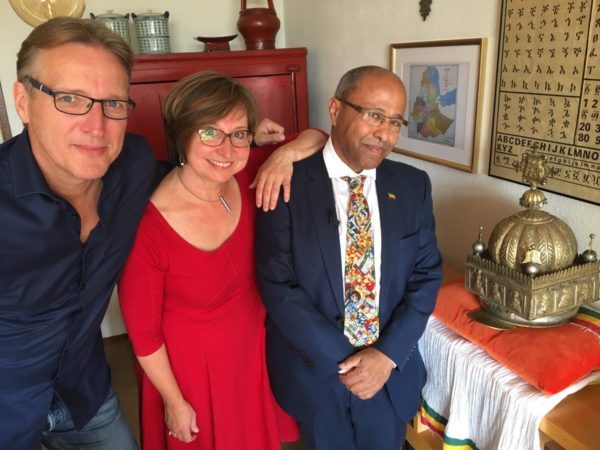
Asfaw personally handed over the crown to Ethiopian Prime Minister Abiy Ahmed. The ceremony was also attended by Sigrid Kaag, the Dutch minister for foreign trade and development cooperation.
“This is a historic day for us,” Ethiopian Minister for Culture and Tourism Hirut Kassaw said.
“He told us someone gave him to look after it. But after realizing it was of Ethiopian origin, he refused to return it back to the owner and kept it for 21 years,” the culture minister said.
News of the crown first emerged in October 2019.
Askaw said at the time he was skeptical about returning “looted heritage to the same regime as the one during which it was stolen. … That is why I have waited for 21 years and have safeguarded it all those years,” he said in a video posted last year.
The Dutch government explained in a statement Thursday that the crown disappeared from the Church of the Holy Trinity in Cheleqot in northern Ethiopia decades ago, apparently sometime after a local priest was photographed wearing in 1993 . But in 1998, Asfaw found it in a suitcase and was apprehensive about trying to return it to Ethiopia’s leaders, so he kept it in his Rotterdam apartment.
The crown, which is believed to have been commissioned by a local ruler in Ethiopia the late 1700s, bears depictions of Jesus Christ, God and the Holy Spirit, as well as disciples.

Asfaw said he felt comfortable returning the crown only after Prime Minister Abiy Ahmed took office in 2018. Ahmed was awarded the Nobel Peace Prize last fall for his work in ending Ethiopia’s long-running conflict with neighboring Eritrea.
“We’re honored and delighted to have been able to facilitate the rightful return,” Kaag, the Dutch minister, said in a statement Thursday.
With the help of Arthur Brand, a Dutch art detective, Asfaw was able to bring the story and the crown to light.
According to Fana Broadcasting Corporate, the crown “is thought to be one of just 20 in existence.”
Now, the crown is on display at Ethiopia’s National Museum.
“We’re honored and delighted to have been able to facilitate the rightful return,” Kaag said.
Many online were happy to hear that the rare African artifact came back home to the motherland.
Check out the reactions.