
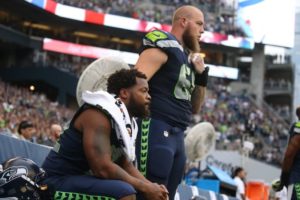
Justin Britt stands beside Michael Bennett during the national anthem before a preseason game. (Source: Seattle Times)
Even at 6 feet 4 and 274 pounds, Seattle Seahawks defensive lineman Michael Bennett isn’t supposed to be one of “those guys.”
You know them. The ones harassed and even killed by police. For selling loose cigarettes, or CDs outside the convenience store. He didn’t have warrants and run during a routine traffic stop. He wasn’t reaching for identification after disclosing he was legally carrying a firearm, or playing with a BB gun in a park.
By just about any objective measure, Bennett is a wealthy man. He’s a married father of three and a millionaire many times over. Just the type of guy that resident Black sports troll Jason Whitlock said is immune from “real racism.”
None of that mattered when Bennett found himself face down on a Las Vegas pavement. Bennett’s crime was running away from the scene of apparent gunshots at a Las Vegas casino — something anyone with sense would do. He detailed what happened next in a letter posted to his Twitter account.
“A police officer ordered me to get on the ground,” the 31-year-old wrote. “As I laid on the ground, complying with his commands to not move, he placed his gun near my head and warned me that if I moved he would ‘blow my fucking head off.’ [As I was] terrified and confused by what was taking place, a second officer came over and forcefully jammed his knee into my back making it difficult for me to breathe. They then cinched the handcuffs on my wrists so tight that my fingers went numb.”
The trappings of success were not enough to shield Bennett, whom The Undefeated recently called “an activist disguised as a football player,” from excessive force at the hands of police because rich doesn’t trump race.
Rich didn’t trump race when former professional tennis player James Blake was tackled by New York police officers in 2015. Blake was thrown to the ground when police “misidentified” him with another suspect.
Rich didn’t trump race when Atlanta Hawks player Thabo Sefolosha saw his season end after an encounter with police in New York left him with a broken leg.
Rich didn’t trump race when NBA player John Henson saw police called on him while he was shopping for jewelry.
Rich didn’t trump race for LeBron James and most recently Texas A&M’s football head coach, Kevin Sumlin, both victims of racist harassment in their homes.
Bennett’s treatment by police should be the call to action his counterparts, all of his counterparts, in the NFL need to get off the sidelines and join the fight for racial justice. One week before his encounter with police in Las Vegas, Bennett directly called on white players to join the anthem protests.
“It would take a white player to really get things changed,” Bennett said on ESPN. “Because when somebody from the other side understands and they step up and they speak up about it … it would change the whole conversation. Because when you bring somebody who doesn’t have to be a part of [the] conversation making himself vulnerable in front of it, I think when that happens, things will really take a jump.”
Bennett isn’t one of “those guys,” but that isn’t stopping police from treating him like one. After Bennett went public with his story, the police union representing Las Vegas police officers began waging a campaign to discredit the Seahawks lineman and imply he deserved the excessive force used on him.
First, the Las Vegas Police Protective Association Metro Inc. wrote to NFL Commissioner Roger Goodell, which cited Bennett’s “disrespect for our American flag, and everything it symbolizes,” when asking the league to investigate Bennett’s account of what happened. The league declined.
Then, reports came that Bennett was being looked at for his role in an alleged altercation in the hours before he was hemmed up and forced to lie face down by police.
Similar smear campaigns have taken place against victims of police violence. Tamir Rice was said to look “menacing.” Eric Garner, Sandra Bland others have also been victims of character assassination at the hands of law enforcement after their deaths.
When it was “those guys” being killed, players who aren’t Black could sympathize but not empathize with the dangers Black people, including their Black teammates, faced in America, a point echoed by Bennett’s teammate Steven Hauschka last year.
“I think a lot of white people are uncomfortable talking about it,” Hauschka said. “I don’t want to speak for all white people, but I know for myself, I’m uncomfortable about the subject. There’s a lot of racial tension that goes way back, and I don’t know what it’s like to be black in this country. I don’t know how any white person could.”
If Bennett can be faulted for anything, it’s foisting the burden of fighting for progress solely on the shoulders of Black athletes. Athletes who have remained on the sidelines have no such cover and no such privilege this time.


