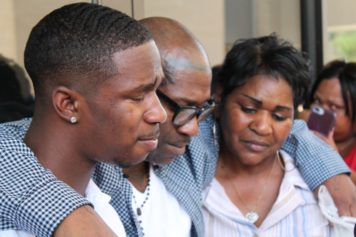
Ledura Watkins, 61, greets family and supporters following his release Thursday, June 15, 2017, from the Wayne County Jail in Detroit. (AP Photo/Corey Williams)
DETROIT (AP) — A Detroit man who spent four decades in prison was freed on Thursday after prosecutors agreed that his 1976 murder conviction hinged on the flimsiest of evidence: a single hair.
Ledura Watkins, 61, walked out of the Wayne County Jail in downtown Detroit after a court hearing in which his conviction was overturned.
“It’s really surreal … kind of unbelievable,” he told reporters. “But I’m feeling great. I expected this to happen. I didn’t think it would take 41 years.”
Watkins was 20 years old when he was convicted of first-degree murder in the 1975 shooting death of 25-year-old Yvette Ingram during a robbery at her home. Police lab analysts tied Watkins to the crime based on a single hair found at the scene, according to the Innocence Project at the Western Michigan University-Cooley Law School, which took up Watkins’ case and asked a court in January to set aside the conviction.
The Wayne County prosecutor’s office agreed that the evidence was flawed under the new FBI standard for hair comparison, Maria Miller, a spokeswoman for the office, said in a statement.
Marla Mitchell-Cichon, the law school’s Innocence Project director, said hair comparison is not based on science.
“It is simply a lab analyst’s subjective opinion and has no place in our criminal justice system. This is why a statewide review of hair comparison cases is critical,” she said.
Watkins, who worked for years to clear his name, said he was looking forward to having dinner with his family, probably at a Chinese restaurant.
“It took me years to get to this point. I don’t want to touch another law book,” Watkins said.
He is the second Michigan inmate to be released in recent weeks after having a decades-old conviction thrown out.
Desmond Ricks was freed in late May after having served 25 years for the killing of a friend outside a Detroit restaurant. An analysis of two bullets taken from the victim showed they didn’t match the gun that prosecutors offered as the murder weapon at Ricks’ 1992 trial.
Ricks was aided by lawyers and students from the Innocence Clinic at the University of Michigan’s law school.