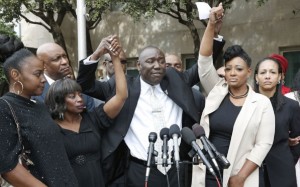
Attorney Benjamin Crump with two accusers in the Holtzclaw trial, Jannie Ligons, second from left, and Shardayreon Hill, second from right. AP
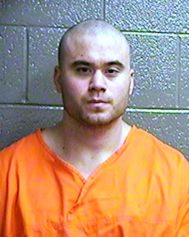
Daniel Holtzclaw, the infamous former Oklahoma City police officer, was sentenced to 263 years after being convicted on 18 of 36 counts that included first-degree rape and forced oral sodomy. He is to serve those years consecutively, effectively amounting to a life sentence. Over a six-month period, Holtzclaw raped and sexually assaulted 13 Black women. An all-white jury convicted him, and his motion for a new trial was denied.
And while this conviction and sentence reveals much about the convicted criminal, it tells us a great deal about Black women and the violence they face in society. Holtzclaw’s victims ranged from a 17-year old young woman raped on her mother’s front porch to a 57-year old grandmother of 12. The grandmother, Jannie Ligons, ultimately brought Holtzclaw down. And at least three of the women, including these two victims, read their victim impact statements, as New York Magazine reported.
“Ever since this happened my life has been upside down,” said Holtzclaw’s youngest victim before sentencing. “I feel like I’m dying on the inside.”
Ligons: “I want my life back” I ask that #Holtzclaw get all 263 years so I don’t have to look over my shoulders @OKCFOX
— Tom George (@TheTomGeorge) January 21, 2016
Victim who was 17 at the time says she “felt like she was dying inside” #Holtzclaw @OKCFOX
— Tom George (@TheTomGeorge) January 21, 2016
“Many women don’t think that anyone will believe them. These women thought that too, but you see what happened,” said Oklahoma County District Attorney David Prater, according to Fox25.
Prosecutors had stressed that Holtzclaw targeted women that no one would believe, as all 13 women were Black and some had been caught up in the criminal justice system.
“I didn’t think anyone would believe me,” as one victim told the court last month, adding, “I’m a black female.”
Benjamin Crump, the high-profile attorney who represented the women, hailed the sentence as “a landmark victory” according to CNN. Crump, who has represented the families of Trayvon Martin and Michael Brown, has criticized the lack of media coverage of these assaults, asking, “Where is the national outcry for their justice?”
“All the women were victims, from the 17-year-old teenager to the 57-year-old grandmother. This is a statement for 400 years of racism, oppression and sexual assault of black women; a statement of victory not only for the ‘OKC 13,’ but for so many unknown women,” Crump said in a statement.
In addition, the reactions from social media tell the story.
I’m no sadist but I swear I could joyfully watch #DanielHoltzclaw cry & cry & cry all day & never get tired of it https://t.co/a9LKWP4XFK
— Courtney Swan (@Courtney__Swan) January 21, 2016
#DanielHoltzclaw‘s motion for a new trial was DENIED by the judge. #ThankOshun
— Son of Baldwin (@SonofBaldwin) January 21, 2016
Kudos 2 the handful of news outlets activists & bloggers who kept shining a light on the #DanielHoltzclaw case & lifting up the survivors.
— Son of Baldwin (@SonofBaldwin) January 21, 2016
Women of Oklahoma City should be praised for raising their voices during #DanielHoltzclaw trial to say #blackwomenmatter @AAPolicyForum
— Kanya DAlmeida (@KanyaDalmeida) January 19, 2016
Anti-violence movements should be grassroots, & center the experiences of Black women & girls. #SayHerName @AAPolicyForum #DanielHoltzclaw
— Kanya DAlmeida (@KanyaDalmeida) January 19, 2016
But was this sentencing a true victory for Black women? Some Black women say no, or that it is at least a bittersweet victory.
For example, Zeba Blay wrote in The Huffington Post that Black women feel they need to bear their trauma alone, and that the justice system was not meant for them. And while this case shows abused Black women that they have a right to come forward, we are reminded that no one matters less to this society than Black women.
“Of course, this sentence should have been a given, but in a judicial system where justice for Black victims often seems like a sheer impossibility, it feels like a minor miracle,” Blay noted. “And yet, an all-white jury has decided that Holtzclaw will have to answer for his actions. This sentencing, of course, doesn’t actually change anything. It doesn’t change the fact that poor Black women are still victims of abuse, that they are largely neglected and ignored.”
In an open letter to the survivors of Holtzclaw’s sexual violence, Black Women’s Blueprint — a human rights organization centered on the empowerment of Black women and girls — expressed its solidarity with these women and pledged to eradicate “sexualized racism and racialized sexism.” Representing multiple generations of survivors of violence from throughout the Black Diaspora, the group wrote in Ebony magazine that in a world that discounts Black women, these victims have made progress toward ending the neglect and devaluation of Black victims of rape.
“This letter is to the sisters assaulted by officers during traffic stops, on highways and byways, in transport from jail cells to the nation’s courtrooms, the backseats of police cars, station bathrooms and on prison floors,” the letter reads. “It is to the incarcerated and arrested Black women routinely assaulted on hospital beds, and for the women left alone with guards and violated in holding cells at precincts and stations all over our cities and towns.”
The group reminds us that the struggle for Black women’s rights is nothing new. Ida B. Wells-Barnett spoke about the sexual and racial horrors facing Black women, and Rosa Parks began her organizing by investigating the rape and torture of Black women in the South. And the struggle continues, according to the open letter, due to the silence in the Black community and in greater society, and the invisibility of Black women and the challenges they face.
“It is unfortunate that we live in a society where police officers in this country still rely on the conquest of Black women to affirm and reaffirm their value, power, masculinity, and existence,” the letter emphasized, adding that Black women and girls have been killed and violated by cops, but forgotten because they were Black and female.
“Within this context, rape is an abuse of power. Black women’s bodies have consistently been violated without national outcry because of harmful stereotypes about them that have been internalized for decades.”