WIMBLEDON, England — Once the Centre Court roof was closed, nothing could stop Roger Federer from winning his record-tying seventh Wimbledon title.
The 30-year-old Federer finally equaled Pete Sampras’ record at the All England Club, and won his 17th Grand Slam title overall, by beating Andy Murray 4-6, 7-5, 6-3, 6-4 Sunday.
“It has worked out so many times over the years here at Wimbledon that I play my best in the semis and the finals,” Federer said. “I couldn’t be more happy. It feels great being back here as the winner.”
Once Murray’s forehand landed wide on match point, Federer collapsed to the grass with tears welling in his eyes. He got up quickly and shook hands with Murray at the net.
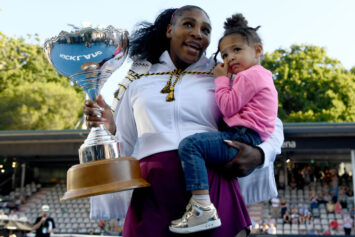
Up in the players’ box, Federer’s wife and twin daughters cheered and smiled as he took his seat to await yet another Wimbledon trophy presentation.
“When the roof closed, he played unbelievable tennis,” Murray said.
Federer is now 17-7 in Grand Slam finals, including 7-1 at Wimbledon. Murray dropped to 0-4 in major finals, with three of those losses coming against Federer.
“It’s amazing. It equals me with Pete Sampras, who’s my hero,” Federer said. “It just feels amazing.”
Besides Sampras, 1880s player William Renshaw also won seven Wimbledon titles, but he did it at a time when the defending champion was given a bye into the following year’s final.
Sunday’s match was the first Wimbledon singles final to be played with the roof closed. The roof was first used at the All England Club in 2009.
Britain has been waiting 76 years for a homegrown men’s champion at the All England Club, and the expectations on Murray were huge.
Thousands of fans watched the match on a huge screen on “Murray Mount,” but left the grounds still waiting for a British winner.
Inside the stadium, Prince William’s wife, Kate, sat in the Royal Box along with David Beckham, British Prime Minister David Cameron and a slew of former Wimbledon champions.
Many of them left a bit disappointed as well.
“Everybody always talks about the pressure of playing at Wimbledon, how tough it is,” Murray said. “It’s not the people watching. They make it so much easier to play. The support has been incredible, so thank you.”
With his victory, Federer regained the No. 1 ranking from Novak Djokovic, allowing him to equal Sampras’ record of 286 weeks as the top-ranked player.
“I never stopped believing. I started playing more, even though I have a family,” Federer said. “It all worked out. I got great momentum, great confidence and it all came together. So it’s a magical moment for me.”
Murray is coached by eight-time Grand Slam champion Ivan Lendl, the only other man who lost his first four major finals.
At the start of the match, Murray was the one dictating play and winning the tough points. He broke Federer in the first game of the first set, and then broke again late before serving it out. It was the first set Murray has won in his four major finals.
The second set was much more even, and both had early break points that they couldn’t convert. Federer, however, finally got it done in the final game of the set, hitting a backhand drop volley that Murray couldn’t get to.
Both held easily to start the third set, but then the rain started abruptly, suspending play for 40 minutes. Shortly after they returned, it turned into a one-man show.
With Federer leading 3-2, they played a 26-point, 20-minute game in which Federer finally converted his sixth break point — after Murray had slipped on the grass three times. Federer lost only five points on his serve in that set.
Source: AP, ESPN