Rep. Ilhan Omar says she must leave her Washington, D.C., apartment after a federal raid exposed her address, raising fears that people threatening her life could also track her children.
The Minnesota Democrat told MS NOW’s Chris Hayes on Wednesday that she can no longer safely stay in the home that federal agents searched Oct. 12 as part of an immigration fraud investigation.
Omar denies wrongdoing and has accused the Trump administration of using federal law enforcement to intimidate her.
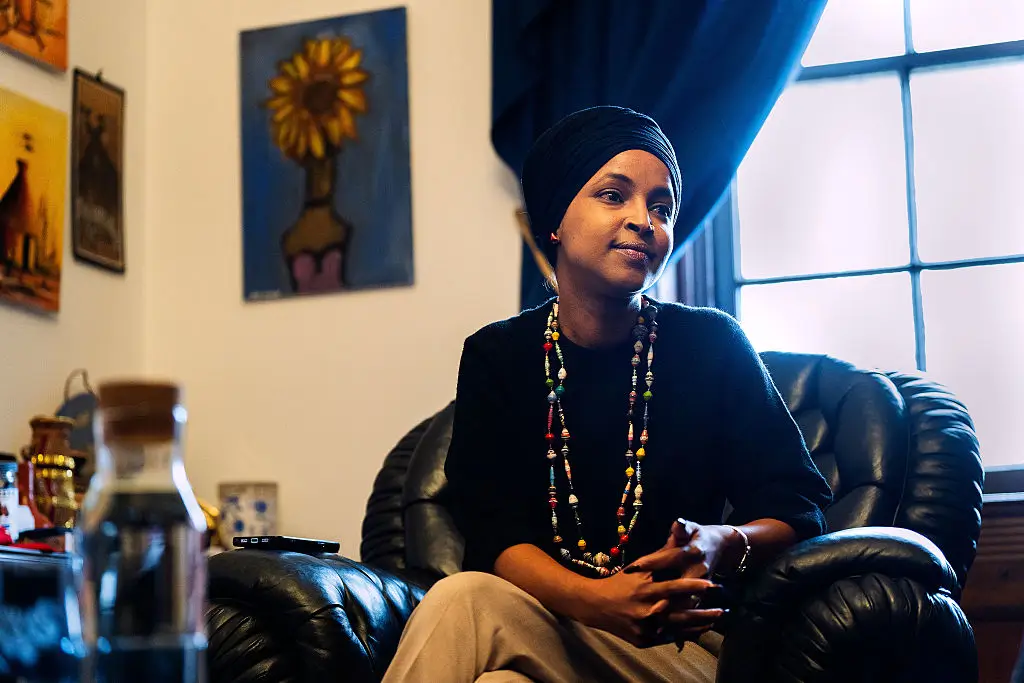
“Obviously, I can’t continue to live there … because our address has been public and with the death threats that I deal with, it’s no longer going to be feasible to be in that house and have my kids visiting off and on, having people track them,” she told Hayes.
Omar, who also maintains a residence in Minnesota, described the search during her first interview since the raid. Homeland Security Investigations carried out the operation under a judicially authorized search warrant, which the Justice Department said was part of an ongoing federal criminal investigation.
White Woman Sobs for 3 Hours After Black Passenger Refuses to Give Up Her Seat on 10-Hour Flight
Florida Cop Took Dead Man’s Home, Then Demanded Money When Family Came Collecting, Police Say
Investigators are examining whether Omar or her late father made false statements about her age during the citizenship process, according to CNN. Omar became a U.S. citizen in 2000 after arriving in the country as a child fleeing Somalia’s civil war.
She said the consequences of the search now reach beyond her, leaving her family to figure out where she can live safely while she fights allegations she says have no merit.
The congresswoman said she had returned from traveling and slept for only about 2 1/2 hours when agents began pounding on her doors around 6 a.m. Her first thought was that something had caught fire.
“You don’t show up to somebody’s house that early in the morning unless you’re trying to freak them out. And you know it obviously did freak all of us out,” Omar said.
“It sounded like an urgent evacuation sort-of situation,” she added. “So it took us a while to figure out what was actually happening.”
Her husband opened the door, and agents presented a warrant, she said. Omar also said they asked her to sign a document waiving constitutional protections she holds as a member of Congress. She refused.
“That was obnoxious. I couldn’t understand why they would think that I would sign such a thing,” she said.
According to Omar, as many as 25 agents searched the home for four to five hours. She said they mostly behaved decently as they went room by room, but the list of belongings they took left her questioning the operation.
Agents seized 17 items, she said, including her phone, older phones belonging to her and her youngest daughter, her husband’s notebooks and a camera his uncle had given him. They also took a children’s Somali phrase book her husband used to learn the language.
“To walk away with 17 items of, like, 10 that were just notebooks and like old phones was such a bizarre, bizarre thing,” she said.
Omar questioned why the administration had publicly accused her of wrongdoing before establishing a case.
“If you had so confidently said I’ve committed a crime, why are you not saying in the beginning … we’re going to subpoena people, we’re going to do a grand jury, we’re going to try to find evidence that would lead to an indictment? It’s just, it’s all bizarre,” she said.
The scrutiny also revives allegations federal officials examined during President Donald Trump’s first administration.
The Washington Post reported that officials reviewed Omar’s immigration records in 2019 but found insufficient evidence to open a full investigation. Omar told Hayes she only recently learned the extent of that review.
She arrived in the United States in March 1995 at age 12 after spending four years in a Kenyan refugee camp. She became a naturalized citizen at 17.
“The people who knocked on my door, searching for papers, literally have his papers,” Omar said of her father. “They are the ones who processed us to come to the United States.”
Although she takes the investigation seriously, Omar questioned the suggestion that she orchestrated immigration fraud as a child.
“It would be a huge undertaking to, I suppose, indict a 12-year-old for being so cleverly conspiring to defraud immigration services to come to the United States,” she said. “I’m sure there are a lot of smart 12-year-olds, but that seems like a leap.”
Trump, who has repeatedly attacked Omar’s background and political views, has continued insulting her while the investigation unfolds.
“I hope they treat her fairly, but she’s a very dishonest person,” he told reporters.
Omar maintains that she has not done anything wrong.
“I am a person of enormous faith,” Omar said. “And I know that … if I continue to live my truth, if I continue to fight for the right things, if I continue to stand up to bullies and people who are carrying out ungodly corruption, I’m going to be OK.”


