Republican desperation as the midterms approach is palpable. Cracks are starting to show, especially among the party’s top two: President Donald Trump and Vice President JD Vance.
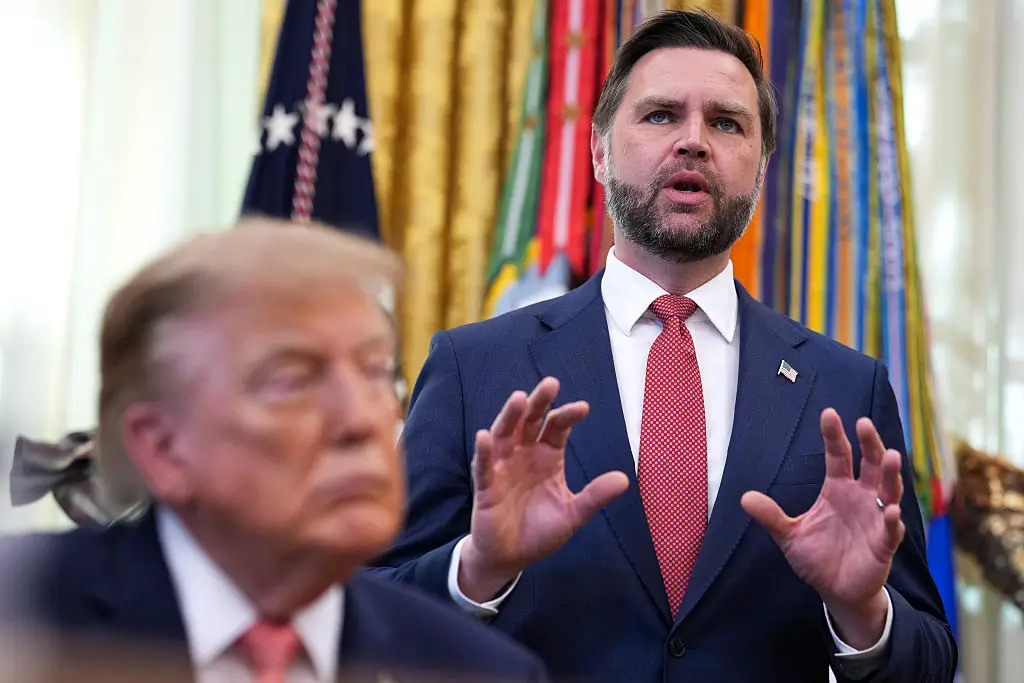
During an Oval Office event on Tuesday, Trump lashed out at a reporter who asked a simple question.
Trump and Vance unveiled a new whistleblower program that offers up to $30,000 for exposing government fraud and waste, news outlets reported.
The White House correspondent for The Independent, Andrew Feinberg, first asked Trump why whistleblowers would use the new program when they could use an existing one.
The historic False Claims Act offers rewards significantly higher than what Trump and Vance are proposing, up to 25 percent more.
A confused Trump seemed unsure of the question and exploded at Feinberg.
“I don’t know who the hell you are, but you better be careful,” an angry Trump sneered as Vance jumped in calling the perfectly legitimate question “dishonest,” according to The Independent.
Feinberg responded to this part of the squabble on X, during the press conference.
“I had told him exactly who I was not five minutes before this exchange,” he wrote.
A little later, Feinberg tried to ask another question about the public golf course in Washington Trump has started overhauling without approval.
“What’s wrong with you? Are you a sick person?” the president of the United States asked a reporter who was just doing his job.
Feinberg responded, “Not at all, sir.”
“I actually think there’s something wrong with you,” a furious Trump whined, barely holding it together.
Feinberg clapped back at Vance on social media after the tense encounter.
Vance posted a clip of the exchange on X.
“President Donald J. Trump eviscerates imbecile ‘journalist’ Andrew Feinberg for misbehaving in the Oval Office: ‘What’s wrong with you? Are you a sick person? I actually think there’s something wrong with you,’” Vance mockingly attacked the journalist.
Feinberg responded, admonishing Vance.
“Mr. Vice President, if you’re going to insult me at least have the guts to tag my account,” he replied.
After Feinberg’s post, social media erupted with plenty of posters praising Feinberg for his guts.
“Whoa. A journalist with a spine,” an X user proclaimed.
Others agreed.
“Well done. The projection of the unhinged imbecility from that pair is off the charts.”
This commenter said what many were probably thinking: “That would imply that he has guts, period. He doesn’t.”
Feinberg even answered at least one MAGA X user critical over the exchange.
“Insult you? You’re a doosh bag. Not the way to behave I [in] the White House. I hope they never let you in there again.”
Feinberg was quick on his feet. “It’s spelled ‘douche,’” he responded.
It seems like Trump mocks and insults reporters every week, and has for the past two years since retaking office.
He’s known for attacking reporters, especially women, when he doesn’t like their questions.
The incidents between Trump and women journalists date back to his first run for office in 2015. He calls them names, dodges questions, gaslights them, yells, and basically throws tantrums when they press him on his statements and policy decisions.
In mid-August, he exploded on CNN’s Kristen Holmes. It happened after she asked about his decision to scale back joint military exercises with South Korea following praise for North Korea’s murderous communist dictator, telling her to be quiet and accusing her of “fake news.” He also threatened her children in a weird social media post
Later that month, he lashed out at PBS News’ Liz Landers after she pressed him on whether he planned to sanction Chinese banks in relation to Trump’s efforts at ending his unapproved and ongoing war against Iran.
He called another woman journalist “stupid” last month for asking questions he didn’t like. He’s commented on CNN’s Kaitlan Collins smile, saying she doesn’t smile enough.
He ordered Bloomberg News journalist Catherine Lucey to shut up last year, demanding, “Quiet, Piggy.”
He also unleashed a furious and deeply personal attack against New York Times reporter Maggie Haberman late last month. He called the Pulitzer Prize-winning journalist a “stalker.” He mocked her appearance and accused her of fabricating a story that he pulled out of an appearance at Ground Zero in Manhattan on 9/11 because he couldn’t make a speech.


