Police arrested a former Florida congressional candidate last week over Facebook posts they said threatened violence against two people if they didn’t support a particular Black candidate for U.S. Senate.
He calls his writing passionate political speech and his arrest a First Amendment violation. A judge or jury may have to decide whether his threats were criminal.
Elijah Manley, 27, has been a political hopeful and outspoken civil rights activist in South Florida for several years. A substitute teacher, he has unsuccessfully run for seats in the Florida Legislature and on the Broward County School Board.
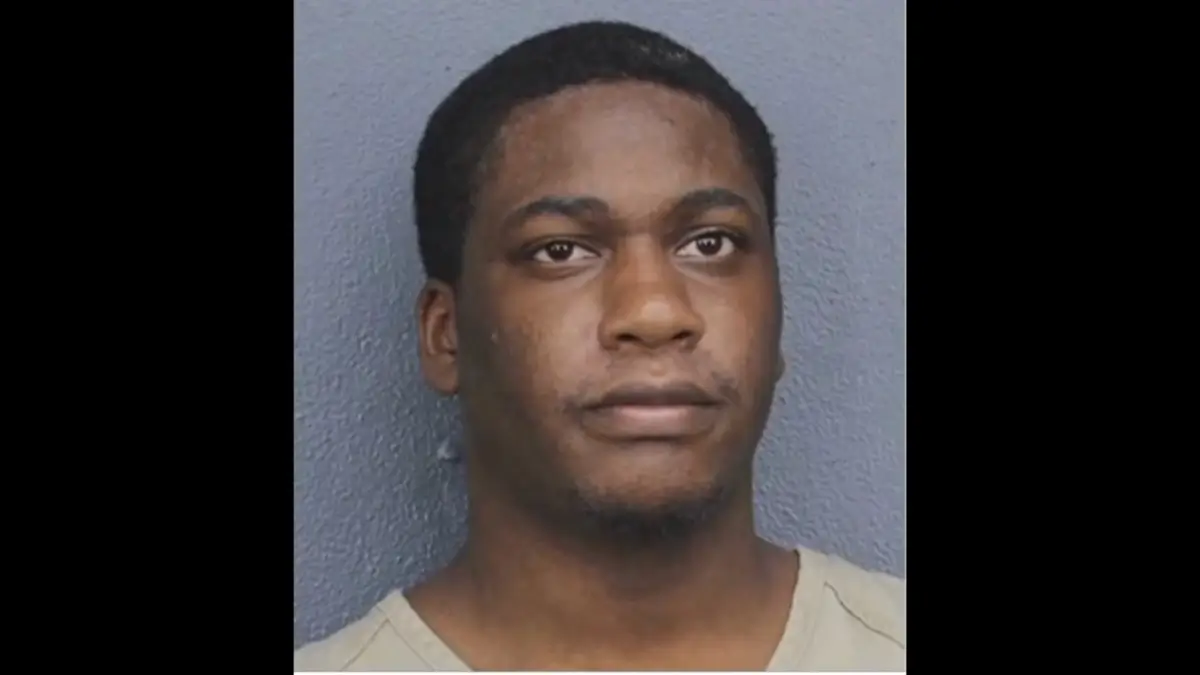
This year, Manley was one of five candidates who ran in the 2026 Democratic primary for Florida’s 20th Congressional District. He lost the Aug. 18 primary to Rep. Debbie Wasserman Schultz, a white Democrat seeking her 11th term. Black leaders criticized her decision to run in the racially diverse district.
In May, Manley posted on X: “Debbie Wasserman Schultz is carpetbagging to FL-20, a Black opportunity district instead of running in her own. DWS is everything that’s wrong with the Democratic establishment. From insider trading to payday lenders. I look forward to retiring her from public office permanently.”
Family Awarded $5.8M After Missouri Cop Killed Mother, Newborn Baby and Allegedly Ignored Protocols
Racist Video Rocks New York High School as Students Walk Out to Protest District’s Response
After his defeat, Manley took to social media to support other Black candidates he hoped would help Democrats ride a blue wave into Congress. Among them was Angie Nixon, a Democratic state senator and union organizer running for the U.S. Senate.
According to a Broward County State Attorney’s Office arrest affidavit, on Aug. 20, while promoting Nixon’s campaign on Facebook, Manley made posts that contained threats of harm to anyone who didn’t support her, including two people he tagged, Local10News reported.
The following day, one of the two people, citing fears for their personal safety, allegedly sent screenshots of the messages to the Broward County Sheriff’s Office Threat Management Unit.
In one post, Manley wrote, “I’m talking to y’all. I saw y’all comments earlier. I’m already pissed off; do not piss me off more. I swear to God, take me to war over this Black woman and promise y’all I will burn y’all mf castle to the ground and anyone else in my way.”
The person who reported the post told the detective that he or she believed the reference of “castle” meant his or her home, the affidavit said.
In another Facebook post, Manley wrote: “This the type shii that will make me snap. Any of you that don’t support Angie Nixon, I promise you I will make your life a living hell to the very end. You better line up behind the Democratic nominee like we always do.”
The reporting person also provided other messages from Manley’s Facebook account that allegedly showed a pattern of threats. One message apparently supported a candidate whose name authorities redacted from the document: “Every Democrat needs to get behind the Democratic nominee for Senate.” Anybody not doing that, I promise you I’m going to cut your f***ing head off.”
The affidavit says police interviewed the two people Manley tagged in the posts, and both said they felt personally threatened. One woman said Manley had come to her home for fundraising and therefore knew where she lived.
A detective called Manley, who acknowledged making the posts, according to the affidavit. Manley told the detective that he wrote the political messages to “challenge” the person’s political opinion and did not intend them as “an actual statement of intended harm.”
Manley also told detectives that he had previously interacted cordially with both people he tagged in the posts despite their political differences, the Florida Sun Sentinel reported.
The detective wrote in the affidavit that some of Manley’s followers “requested that he tone down the rhetoric,” to which he replied, “I’m not toning anything down. I’m tired of being told to tone my voice while white people get away with destroying everything. I want all white people to vote for the Democratic nominee.”
Authorities released Manley on a $40,000 bond with conditions that prohibit him from possessing weapons or ammunition. An additional condition bars him from posting on social media.
Manley and his attorney, Khurrum Wahid, said the posts were part of an ongoing online political dialogue. They insisted that he had no intention of actually harming anyone.
Manley called the situation “a serious First Amendment issue” and indicated that he may pursue legal action, WLRN reported.
“The President of the United States has said worse,” he said.
Wahid said Manley denies the allegations, arguing that the posts were part of an ongoing political discussion rather than genuine threats of violence.
“The social media post in question was a discussion about politics that all parties had mutually engaged in over the course of weeks,” Wahid said in a statement. “We are confident that a trier of fact will see there is no intent to carry out any act of violence. It is unfortunate that our political differences have led some to weaponizing the police instead of using dialogue.”
Legal observers say a jury could decide Manley’s case based on whether his social media posts amount to rhetorical hyperbole or a “true threat.” Manley could face two counts of written or electronic threats to kill or cause bodily injury, a second-degree felony under Florida law, if a grand jury indicts him.
Jurors would weigh whether his posts were jokes or exaggerations rather than real threats of violence. In 2023, the U.S. Supreme Court clarified that prosecutors must prove the speaker “acted with at least recklessness, consciously disregarding a substantial risk that their words would be viewed as threatening violence.”
Florida law criminalizes sending, posting or transmitting written or electronic communications that threaten to kill or harm someone or carry out a mass shooting. Courts apply an objective standard to determine whether a reasonable person would interpret the communication as a serious expression of intent to cause harm.
The Supreme Court’s 2023 ruling in Counterman v. Colorado means the government cannot rely solely on how a listener perceives a message, but it must also prove a subjective standard of what the speaker had in mind.
“Anything that the Supreme Court says about the First Amendment and true threats will control Florida’s statute because obviously the Constitution is really the supreme law of the land,” said Clay Calvert, a senior fellow at the conservative American Enterprise Institute and an emeritus professor at the University of Florida School of Law.
Calvert told Atlanta Black Star that “the recklessness standard in the Counterman decision requires that a defendant has to have some awareness of the impact of what they’re saying. There doesn’t have to be an intent or purpose to put the person in fear of imminent bodily harm or death. They don’t have to know it would do so, but they have to be aware it could. There’s a substantial risk of the possibility that it will be interpreted as a threat of violence, and then you consciously disregard that risk.”
He noted that “context is key” when juries or courts distinguish between harmless political rhetoric and true threats that prosecutors can charge as crimes.
“Courts have made it clear that the context in which words were used is important. In this case, you would have to string together all the messages to examine that context. It’s not one isolated message or post. You have to take them all together to see if what’s there would put someone in a position of fear of bodily harm or death.”
He noted that “to the extent [Manley] referenced specific people” in his threatening posts by tagging them, “it definitely militates against his case” and gives the prosecution some fodder to work with.
If it is true that Manley had been in the complainants’ homes for political fundraising events before he name-checked them in his posts, “that could cause a reasonable person to be in fear that he knows where I live, and he has the ability to act on this threat of violence and carry it out,” Calvert said.
It could also suggest that since Manley knew he’d been to their home before, he “should think twice about saying something” that could cause that person fear, Calvert said.
On the other hand, Calvert said, his defense could argue, as some defendants have successfully argued in defamation cases, that “social media is full of this kind of over-the-top rhetoric and outrageous content, and we expect hyperbole, and people just shouldn’t take statements posted on social media that seriously.”
“Ultimately, if this case goes forward,” he said, “a jury is going to have to look at all the statements and facts in context, hear the argument from both sides, and decide for itself if what he said is hyperbole that is protected speech by the First Amendment, or if it’s in that narrow area of true threats that you cannot make, whether on purpose or recklessly.”
The Broward State Attorney’s Office delayed Manley’s arraignment after recusing itself over a potential conflict of interest, citing the alleged victims’ previous participation in charitable drives the office organized. Prosecutors have asked the Florida governor’s office to transfer the case to another state attorney’s district.
Manley will likely appear for formal arraignment and enter a plea once authorities assign a new prosecuting office.


