A young Black woman was the target of a racially motivated verbal assault while riding on a public bus. A video she filmed capturing part of the incident has since gone viral.
The clip reshared on Atlanta Black Star’s official Instagram shows a white woman with missing teeth scowling at a complete stranger.
She snapped, “Go back to your own country.”
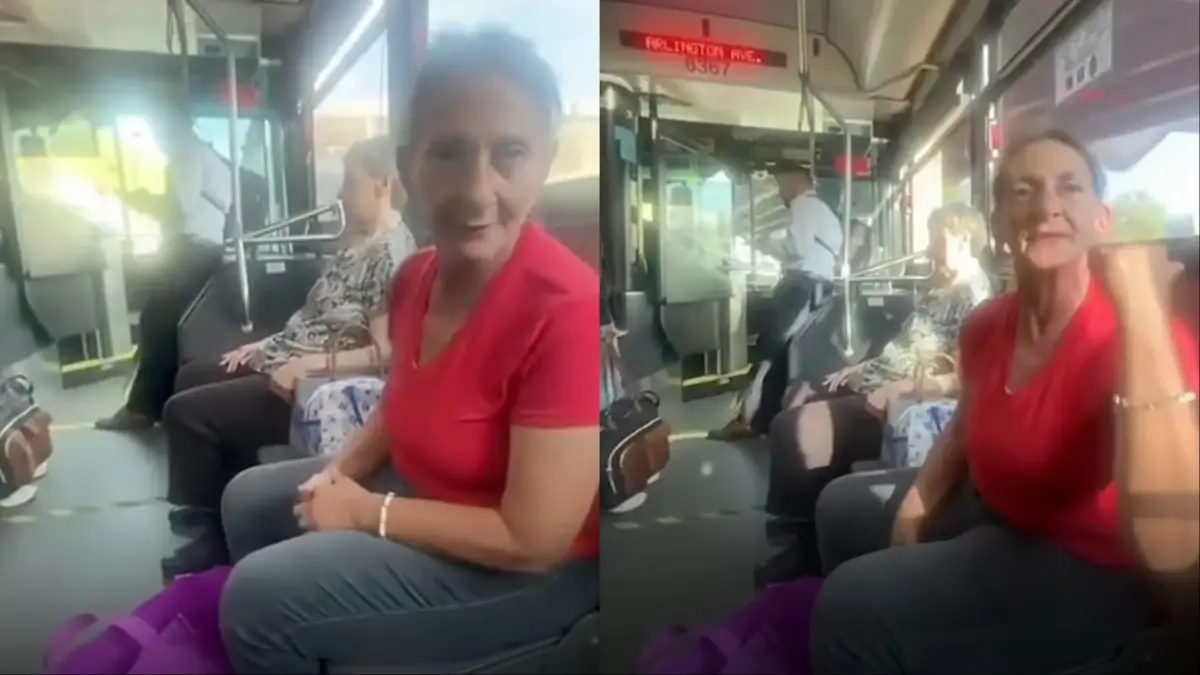
Her ranting eventually prompted nearly the whole bus to turn against her.
“You don’t belong here. This is America. Go back to f–king Haiti, or wherever the f–k you’re from, you foreign f–king b–ch,” she snarled.
The Black woman’s country of origin is unclear, as she remains unidentified, though she spoke without an accent on camera.
Viral Video Shows White Off-Duty Cop Trying to Intimidate Man He Deems ‘Shady’
Clearly stunned, she simply responded, “Oh wow,” and kept filming the meltdown, which escalated from petty insults into physical threats.
“You’re the weirdest f–king c–t,” the aggressor rambled before boasting, “I will snap you like a f–king twig, b–ch. Let’s get off the bus.”
Fortunately, it didn’t get to that point.
But the aggressor continued the harassment, even taking potshots at the Black woman’s appearance.
For her part, the Black woman lobbed a few insults back, telling the white woman to fix her teeth and calling her a “flat-a–ed b–ch.”
It wasn’t until a white male bystander threatened to call the police that the aggressor softened her tone.
Others around the woman, including the bus driver, urged her to get off while the bus was stopped, but she refused, instead promising to “stay quiet.”
The video then abruptly ended, leaving viewers wondering whether she stayed on the bus or whether the police were called.
“So much hate! Leave our brothers and sisters alone!” wrote an outraged commenter.
Another lamented, “To be that old and angry at someone you don’t even know is sad.”
While internet sleuths try to identify her, one commenter dubbed her the “Sabertooth Karen.”
Slurs like “go back to your own country” show how racism and xenophobia can blur together, with Black people frequently treated as foreigners in their own country.
Racially motivated verbal (and physical) assaults continue to disproportionately affect African Americans, according to data from the FBI.
In 2025, the bureau reported a 7 percent decline in overall hate crimes, but Black Americans remain the most targeted racial group, accounting for roughly half of all race-based incidents.
Many viewers believed she got off too easy: “Someone find me a video where a Black person harasses and physically threatens someone else, and nobody intervenes.”
Others focused on what bystanders can do to help.
“The way I would have sat right next to that girl for support. What we talking about? Cause this is NOT what we are doing in my presence,” wrote one person on Atlanta Black Star’s Instagram.
“Too many people don’t stand up to people like this, and that’s why she feels entitled to say it.”


