
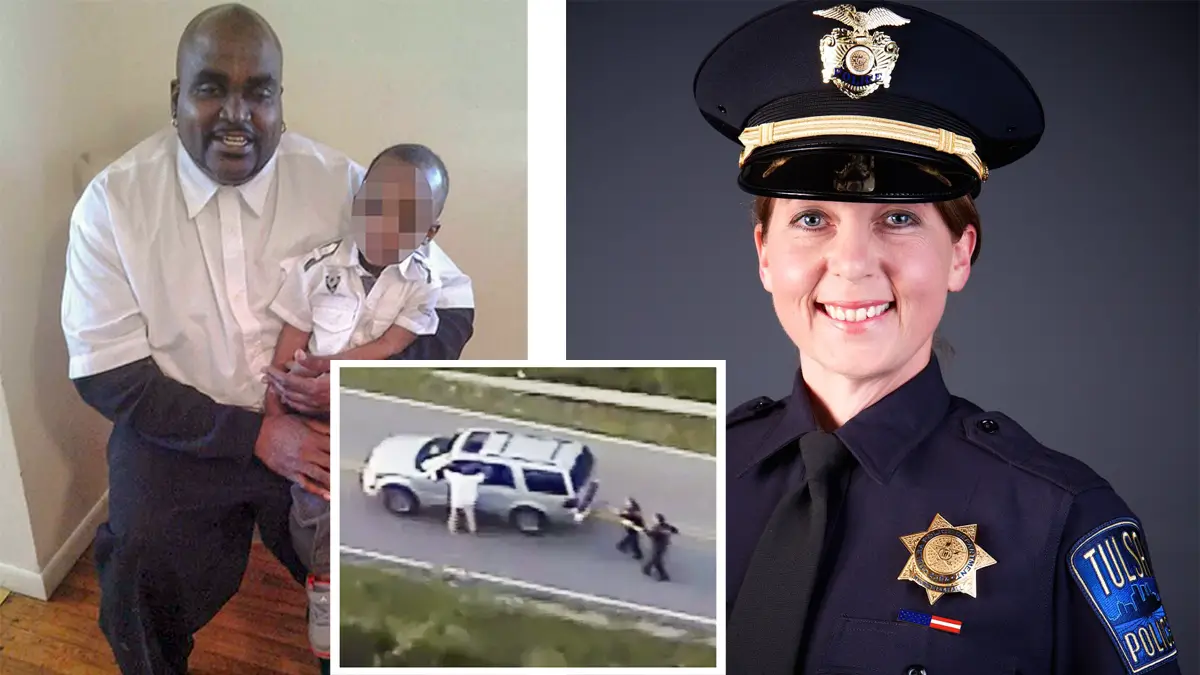
It’s been more than ten years since an Oklahoma police officer shot and killed an unarmed Black man named Terence Crutcher, who had raised both hands in the air.
Tulsa police officer Betty Shelby, a field-training officer, came across Crutcher on a two-lane road after the 40-year-old Black man’s car had stalled on Sept. 16, 2016.
The Tulsa County district attorney charged Shelby with first-degree manslaughter, but a jury acquitted her in May 2017.
Crutcher’s estate filed a civil suit the following month, but after seven years, a district judge dismissed the claim, granting Shelby qualified immunity in April 2024 – protecting her from civil liability.
However, the 10th Circuit Court of Appeals stripped qualified immunity from Shelby in March 2026, allowing the lawsuit against her to proceed.
Shelby then petitioned the U.S. Supreme Court, but the justices declined to hear her case this month, meaning she will now face a civil jury trial in February 2027 unless she agrees to settle the case beforehand.
“A police officer may not seize an unarmed, nondangerous suspect by shooting him dead,” the 2026 appellate ruling states, citing an earlier U.S. Supreme Court ruling.
“Viewing the disputed facts in the Estate’s favor, Shelby violated Crutcher’s clearly established constitutional rights, so we reverse the district court’s grant of summary judgment based on qualified immunity and remand for further proceedings.”
Crutcher’s family is looking forward to the trial.
“Simply a breath of fresh air. I don’t usually have good Mondays or good news on Mondays, but it was just really good news for me and my family,” Crutcher’s twin sister, Dr. Tiffany Crutcher, told local media earlier this month.
Shelby was on her way to a domestic violence call when she spotted Crutcher on the side of the road, later claiming she thought he was under the influence of PCP or experiencing a mental health crisis because he had “a distant look on his face,” the appellate ruling states.
She continued driving, coming across Crutcher’s abandoned vehicle in the middle of the road, several hundred feet away. She came to a stop and peered through the windows, seeing no weapons or people inside.
Crutcher then came walking up, and she asked if the vehicle was his, but he did not answer. She then ordered him to remove his hands from his pockets. Crutcher lifted both hands in the air.
Shelby claimed he kept placing his hands back into his pockets, making her fear for her life, but she did not have her bodycam or dash cam turned on.
However, a police helicopter was recording from above as well as the dash cam from an arriving Tulsa police officer, Tyler Turnbough, both showing Crutcher with his hands in the air.
Turnbough, in fact, had his Taser drawn, firing it at the same time Shelby fired her gun.
And the Tulsa police officers in the helicopter also believed officers would Taser Crutcher.
“Uhh, I think he may have just been tasered,” one of the cops in the helicopter said.
“Shots fired!” Shelby said on the radio.
“Ohhhh,” the helicopter cop said, hovering above the scene, showing Crutcher lying on the street with blood on his chest.
Less than a month after the shooting, the Oklahoma Office of the Chief Medical Examiner released an autopsy concluding Crutcher was under the influence of PCP.
Six days later, Tulsa County District Attorney Steve Kunzweiler charged Shelby with first-degree manslaughter, alleging that she “unlawfully and unnecessarily” shot Crutcher.
During her trial, Shelby testified that she believed Crutcher was reaching into his SUV for a gun and that she fired out of fear. The jury acquitted her during the eight-day trial in May 2017.
She resigned in August 2017 before joining the Rogers County Sheriff’s Office in the county next to Tulsa County.
Seven years later, the district court judge dismissed the lawsuit against Shelby and the city of Tulsa, ruling that qualified immunity protected Shelby because the circumstances did not clearly establish a constitutional violation.
Two years later, the appellate court stripped Shelby of qualified immunity but upheld the dismissal of the lawsuit against the city of Tulsa.
“We therefore proceed from this starting point: despite Crutcher’s partial compliance with police commands, Shelby shot Crutcher while he was standing with his hands up, unarmed, next to the mostly rolled-up driver’s side window, no weapon within reach,” the appellate court ruled.
Shelby petitioned the U.S. Supreme Court, but on Oct. 5, it declined to hear her case, leaving the appellate court ruling in place.
“It was a great day for police accountability, not just in the city of Tulsa but across this nation, especially as it relates to qualified immunity,” Crutcher’s sister, Dr. Tiffany Crutcher, told local media.


