The White House just threw another cover over the Kennedy Center that won’t come off as easily as a tarp.
Donald Trump just pulled a legal move that could block a Black congresswoman from getting the answers about the Center’s future. This includes its looming two-year shutdown.
His team is standing firm, but critics say there’s a glaring problem they can’t explain. The administration’s own court filing may have made things worse.
On Wednesday, Oct. 14, White House deputy counsel Joshua Hoyt told a federal judge that Trump was formally invoking the presidential communications privilege.
This form of executive privilege, in Rep. Joyce Beatty’s lawsuit over the Kennedy Center, CBS News reported.
In a sworn declaration, Hoyt said the privilege covers communications between Trump, his advisers and Kennedy Center staff about how the institution is managed and run.
According to CBS, that sweep includes records tied to the attempted two-year closure, the center’s finances and the push to slap Trump’s name on the facade.
Those records could also shed light on discussions about tearing the building down.
His reasoning? Because the president appoints the center’s general trustees and members of its Advisory Committee on the Arts, Hoyt argued Trump must “familiarize himself” with how the place operates. Without the privilege, he wrote, advisers would be “chilled” from giving candid advice.
The Justice Department went even harder in a separate filing, accusing Beatty of an “extraordinarily intrusive discovery campaign.”
But here’s the catch. That same filing concedes that Trump “is not Chair of the Board of the Center by virtue of his position as the President of the United States.”
The board, stacked with Trump officials and allies, elected him chairman last year, making him the first sitting president to hold the job. The DOJ’s workaround is that his duties as president and as chairman simply “overlap.”
Beatty, an Ohio Democrat and former chair of the Congressional Black Caucus, sits on the Kennedy Center board as an ex officio trustee.
She sued in December after the board renamed the venue the Donald J. Trump and The John F. Kennedy Memorial Center for the Performing Arts and voted to shut it down for two years of renovations.
In May, U.S. District Judge Christopher Cooper blocked the closure and ordered Trump’s name off the building.
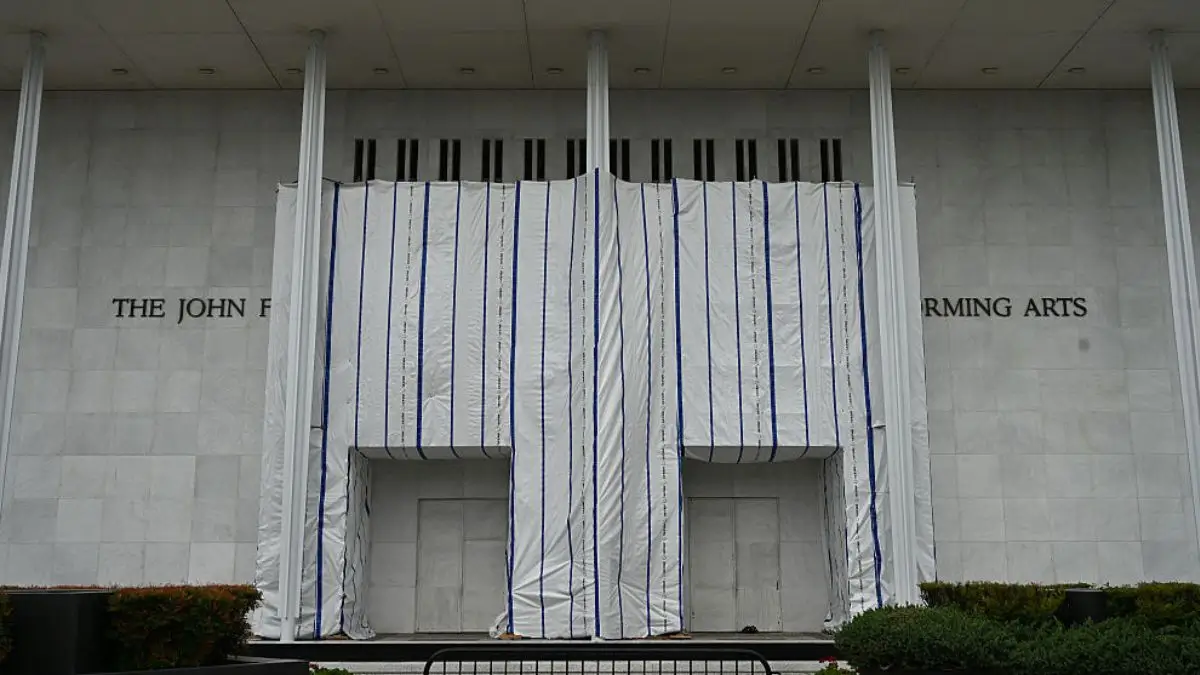
Crews removed it in June, though a tarp now hides most of the front portico. Cooper later allowed Beatty to gather evidence and take depositions, and that’s where things got tense.
Her lawyers say the government refused to hand over any records tied to Trump’s instructions to Kennedy Center staff.
They also accused the DOJ of “improperly asserting a blanket privilege in an unprecedented fashion.” During a deposition last week, a Justice Department lawyer repeatedly told executive director Matthew Floca not to answer certain questions.
Last month, Trump warned the center would close and “end up being ripped down” unless his administration received credit for saving it. Later, photographers captured him aboard Air Force One studying a placard that appeared to read “Kennedy Center DEMOLISHED.”
Executive privilege isn’t absolute. Beatty wants Cooper to decide whether her need for the information outweighs Trump’s claim.
Plenty of people online weren’t buying it. “The Kennedy Center is not an executive entity. It has nothing to do with his executive privilege,” one person wrote on X.
Another asked, “If there’s nothing to hide, why would there be any need to assert executive privilege?” while a third added, “What executive privilege – its a cultural arts center? What is he hiding?”
One user pointed out, “He volunteered for this job. It’s not the job of the president to be the trustee of the Kennedy Center! I hope the judge tells him to take a hike.”
And one person threw the administration’s favorite brag back at it: “The most transparent administration like no one has ever seen before.”
It is the latest twist in an increasingly messy saga. Days before Hoyt’s filing, a daughter of Robert F. Kennedy ripped into Trump’s plans for the building, accusing him of putting her family’s legacy on the chopping block.
Congress commissioned the Kennedy Center in 1964 as a memorial to President John F. Kennedy, who was assassinated that year.
The center relies on federal funding, ticket sales and private donations. Critics argue the public deserves to know how officials make decisions about its future.
For now, the question sits with Cooper: whether a president can treat a seat on an arts board like a state secret.
Trump basically saying The Kennedy Center will be ripped down unless his name is placed on it because in order for him to want to maintain it, his name should be on it. (Cleaner audio version) https://t.co/NEyeS17jhb
— Acyn (@Acyn) September 16, 2026


