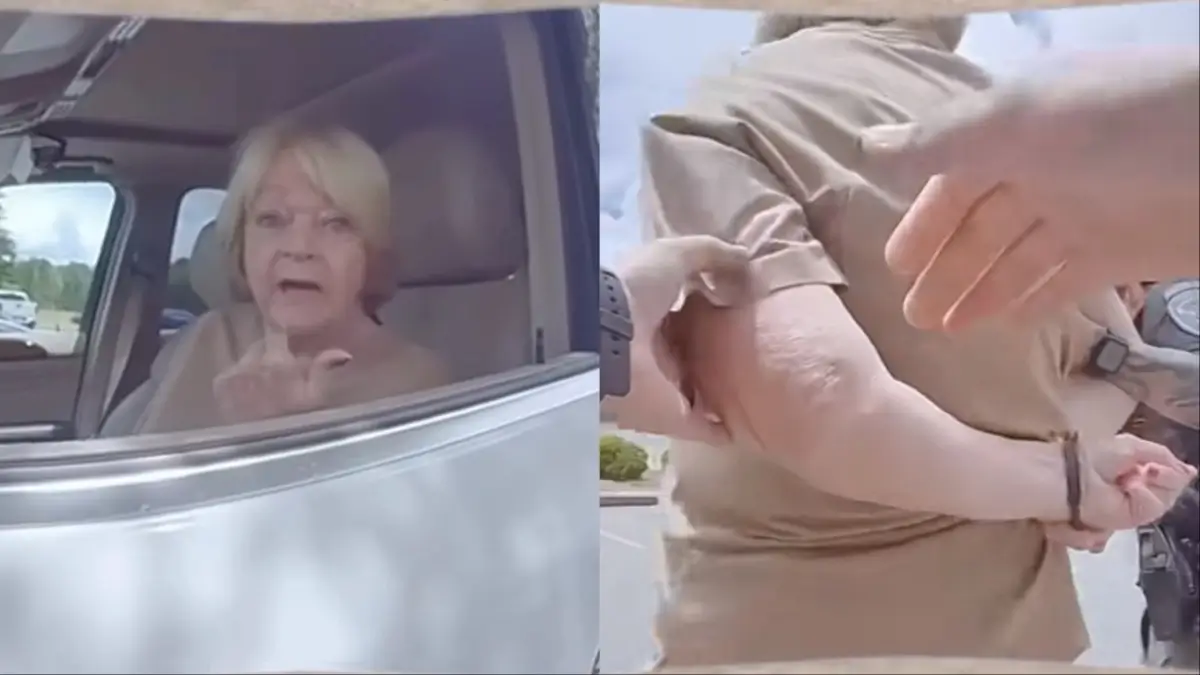
A traffic cop arrested a granny behind the wheel after she told her, “You’re dumb as hell,” and “Shut the f*ck up.”
Two recent videos of a sassy older white woman throwing serious attitude after police pulled her over for erratic driving have racked up a combined 5 million views on TikTok.
Thousands of people flooded the comments section.
Some viewers cheered her on, while others were stunned by what they called entitled behavior, with some saying the incident was a clear example of white privilege.
According to the officer in the video, the unnamed woman now faces two civil citations.
Police also handcuffed her on camera and placed her in a police vehicle, though the exact charges remain unknown.
In the video, she dramatically sighed, slammed her car door in frustration, and shouted at the officer, “Hurry up! This is bullsh-t!”
Viewers could not get enough.
The woman said she was late to a doctor’s appointment, which she apparently considered an acceptable excuse to reverse in the middle of a roadway and then ignore the police’s flashing lights.
But plenty of viewers were willing to give her some slack.
One top comment with 40,000 likes read more like a condemnation of the health care industry than of the woman: “I bet that lady waited months for an appointment.”
Another person chimed in, “Getting a doctor’s appointment nowadays is hard,” and a third wrote, “Girl, give that lady a ticket so she can make her appointment! Damn.”
Others pointed to a frustrating double standard.
One person, who received pushback in the comments section, argued that sympathy would be in shorter supply if she were not an older white woman.
“Everyone is saying to leave this lady alone just because she’s old. So…she can purposely not stop for the police while they’re trying to pull her over and [back] up in the middle of the road?” they asked. “That makes no sense. If she were a POC, this would be an entirely different story.”
Others called it “white privilege at its finest,” with one writing, “the entitlement is insane.”
It’s unclear how the case was resolved. But one thing is certain: antagonizing a police officer, regardless of age or race, is probably never a good idea.


