President Donald Trump told reporters on Saturday that he once held extraordinary power over his longtime political rival, but ultimately chose not to use it.
There were actually two problems with Trump’s claim. The timeline was also off, adding another wrinkle to remarks that didn’t make sense.
The moment came outside the White House when a reporter asked the president about the possibility of Democrats impeaching him a third time if they win back control of Congress in November.
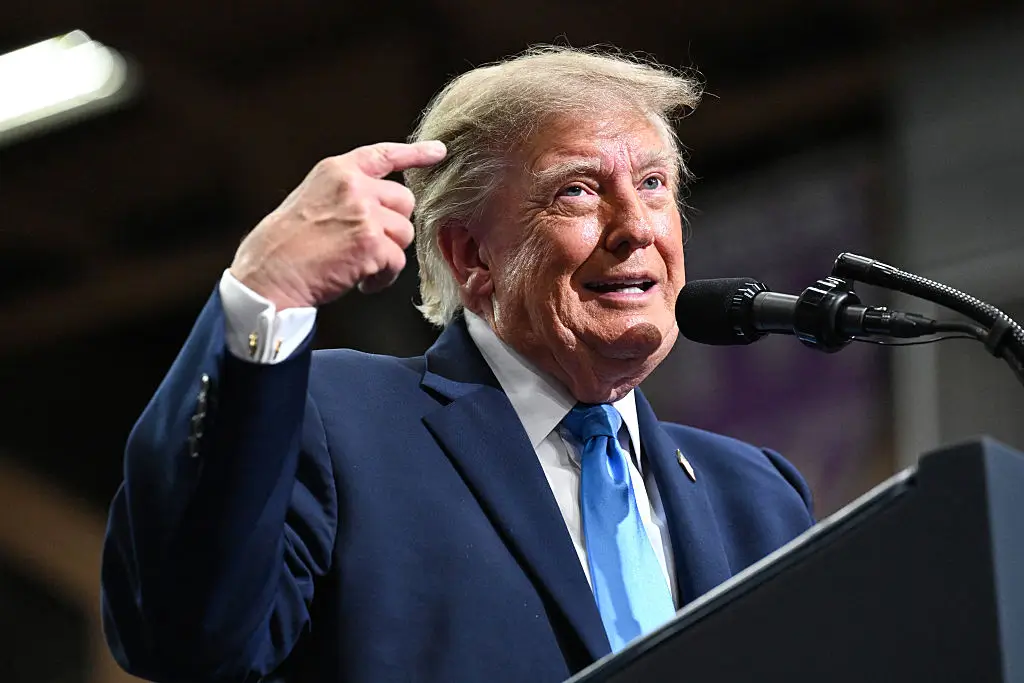
Trump claimed he could have personally impeached Hillary Clinton and removed her from office. But Clinton, the former First Lady and Secretary of State, never served as president. Moreover, a sitting president cannot impeach anyone; Congress holds that power. Clinton had also served in both roles before Trump took office in 2017.
“It’s a fake impeachment,” Trump declared. “And we could’ve done that with Sleepy Joe, but we didn’t do it because it would’ve been inappropriate. I could’ve done that with Hillary Clinton, as you know, I had the chance to do it if I wanted, and I said that would be inappropriate, but with me they like to do it, so …”
Trump’s bizarre claim got both the history and the mechanics of impeachment wrong while coming from a president who actually was impeached — twice.
His first impeachment came in December 2019 over allegations of abuse of power and obstruction of Congress tied to his dealings with Ukraine. He was impeached again in January 2021 after the Jan. 6 attack on the U.S. Capitol. The Senate acquitted him in both cases, allowing him to remain in office.
The Constitution describes impeachment as a congressional process for addressing serious misconduct by federal officials. It says a president “shall be removed from office on impeachment for, a conviction of, treason, bribery, or other high crimes and misdemeanors.”
Impeachment begins in the House of Representatives, where lawmakers vote on articles of impeachment. If a majority votes to impeach, the case moves to the Senate for a trial. Conviction requires a two-thirds vote in the Senate and can result in removal from office.
The president has no role in initiating that process against another president.
That makes Trump’s claim about Clinton particularly striking. Clinton ran against Trump in 2016 but lost the election and never became president. As a result, she could not have been impeached as president during Trump’s first term because she never held the office.
Trump, by contrast, became the third U.S. president to be impeached when the Democratic-controlled House approved two articles against him in 2019. The first case centered on a July 2019 phone call with Ukrainian President Volodymyr Zelensky and allegations that Trump sought an investigation into Joe Biden and his son, Hunter Biden, while allegedly withholding nearly $400 million in military aid to Ukraine unless Trump got his way.
Trump denied engaging in a quid pro quo. Republicans controlled the Senate and acquitted him in February 2020.
The second impeachment came less than a year later. After Trump spent weeks challenging his 2020 election loss and making false claims of widespread voter fraud, a mob of his supporters stormed the Capitol on Jan. 6, 2021, as Congress met to certify Biden’s victory.
The House approved an article of impeachment accusing Trump of inciting insurrection. The Senate again acquitted him on Feb. 13, 2021.
Trump’s two impeachments made him the first president in American history to be impeached twice. Before him, Andrew Johnson was impeached in 1868, and former president Bill Clinton was impeached in 1998. The Senate also acquitted both.
Trump’s claim about Clinton drew sharp reactions online, with critics focusing not only on the factual error but also on the way the president appeared to deliver it without correction.
One commenter accused Trump of repeatedly jumbling unrelated ideas and wrote, “He understands nothing. He conflates random thoughts and thinks it is meaningful. He is a dangerous ignorant misogynist.”
Another reaction focused on Trump’s repeated political attacks and his supporters’ response to them: “Wow, when does it stop with this moron? Lies after lies. Impeach & Imprison Trump.”
A third commenter questioned why Trump’s family and inner circle appeared to allow such remarks to continue, writing, “I heard this clip too. He’s totally lost his s**t. He’s the senile old gramps being shepherded from place to place, spouting nonsense. And his wife and children seem to think it is fine not to intervene. He should be spending his final months at Mar-a-Lago with them, and them alone.”
Another commenter took aim at Trump’s supporters, writing, “He just says anything and his followers believe all his lies or laugh like this is all a joke.”
Trump’s confusion about impeachment comes against the backdrop of something he actually did pursue while president. He repeatedly pressed the Justice Department to investigate his political opponents, including Hillary Clinton.
The Mueller report documented that Trump asked Attorney General Jeff Sessions to reverse his recusal from the Russia investigation so he could direct the Justice Department to investigate and prosecute Clinton. Sessions did not do so.
Trump continued publicly pushing the issue. In November 2017, he complained that the DOJ was not “going after Hillary Clinton and her emails” and questioned why he was not allowed to get more involved. Around the same time, Sessions assigned Utah U.S. Attorney John Huber to review matters involving Clinton, including allegations surrounding the Clinton Foundation and the Uranium One deal. Huber’s inquiry ultimately produced no criminal charges or other tangible results.
The Clinton Foundation itself also became the subject of a renewed FBI investigation after the 2016 election. By early 2018, agents were examining whether donations to the foundation had been connected to official acts during Clinton’s tenure. The investigation continued into the final years of Trump’s presidency. In January 2021, federal prosecutors declined to charge the foundation, prompting the FBI to close its investigation.
View on Threads


