For a project that President Donald Trump once described as a privately funded ballroom, the White House construction site has become something much bigger, and far more complicated.
About 250 workers are laboring in two 10-hour shifts, seven days a week, as crews race to build the massive complex that Trump says will improve White House security, according to Radar.
Now, with the Supreme Court allowing construction to continue while the legal fight plays out, the breakneck pace of the work is becoming central to the controversy.
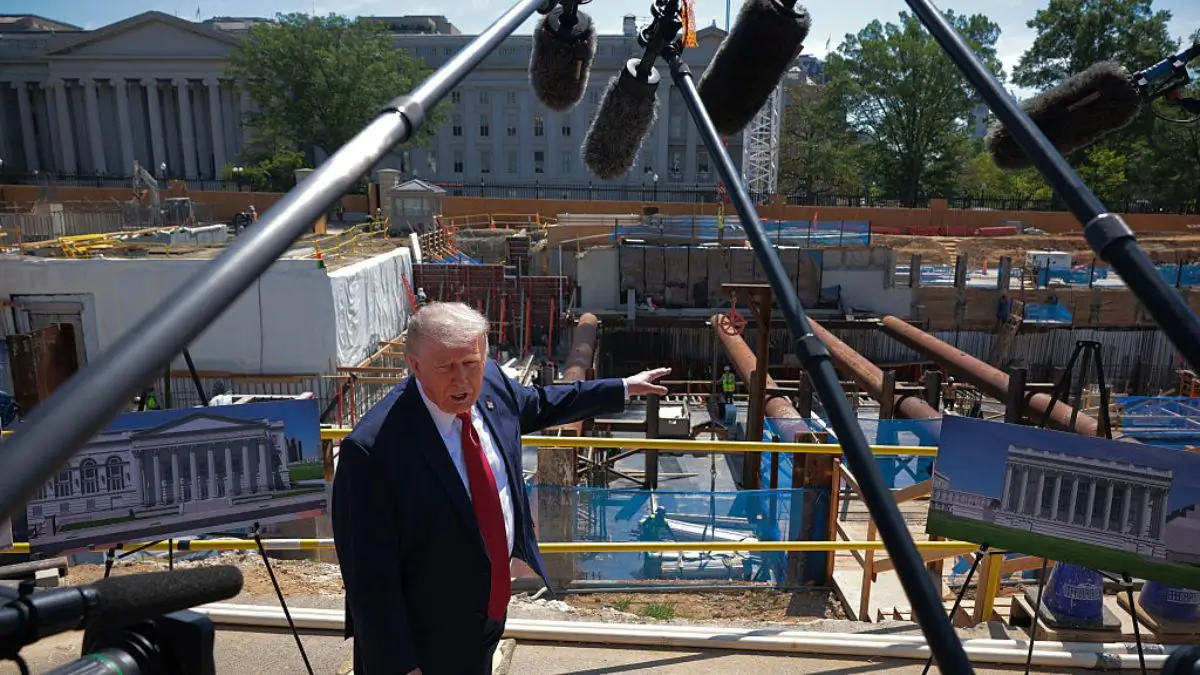
Chief Justice John Roberts on Aug. 21 temporarily allowed the Trump administration to continue construction on the $400 million project while the Supreme Court considers whether the White House can proceed without congressional approval.
The decision gives Trump a short-term victory, but new reporting also raises questions about the cost, the use of taxpayer money and whether the administration is moving so quickly that it could leave the courts with little meaningful ability to stop it.
Roberts’ one-page order did not explain his reasoning or set a timetable for the court’s next decision. He acted because he oversees emergency appeals from cases in Washington, the Associated Press reported. The order came just hours before lower-court rulings were set to force a halt to aboveground construction.
Trump celebrated the ruling during a political appearance in South Carolina.
“When they say proceed, I think that’s a good thing. That’s a good thing,” Trump said.
The National Trust for Historic Preservation, which is challenging the project in court, has accused the administration of trying to “outrun” judicial review by pushing construction forward at extraordinary speed.
Court filings say about 250 workers are operating in two shifts every day, seven days a week. The preservation group argues that the administration should not be allowed to create urgency by rapidly advancing a project whose legality is still being decided.
The Trump administration has rejected that argument as “false.” Its lawyers say officials are racing to address security threats and that delaying Trump’s access to the project’s security features creates an unacceptable risk.
Those features go well beyond a ballroom. Court filings describe a sprawling security complex extending five stories underground, with hardened concrete, steel and rebar. The planned infrastructure includes bomb shelters, medical facilities, military installations, specialized protective systems, sniper positions and a rooftop drone port.
Administration officials have said crews designed some materials to withstand ballistic attacks and even the effects of a nuclear blast.
The administration argues that the ballroom and security infrastructure are so closely connected that crews cannot simply separate them. The National Trust disputes that position and says Trump lacked unilateral authority to proceed with the aboveground portion without Congress.
However, three former officials have revealed that a heavily fortified nuclear bunker already exists deep beneath the White House. The government secretly built it more than a decade ago.
The facility can shelter the president and dozens of top aides during a national security emergency, the officials told The Washington Post.
The revelation comes as construction of a new White House ballroom and helipad reportedly stands about 65 percent complete.
More than 60 feet beneath the White House complex, the existing bunker can house dozens of people for several weeks, two former officials told the Post. The Obama administration secretly completed the facility.
Before then, the best-known White House bunker was the Presidential Emergency Operations Center, or PEOC. The government built it beneath the East Wing in 1942 during World War II.
According to former officials, the newer facility can withstand a nuclear blast. It would let the president and senior aides keep running the country from a secure command center during a catastrophic attack.
Its existence could undercut the Trump administration’s legal argument that national security requires construction of the ballroom and its planned underground bunker, the former officials told the Post.
Journalist Ronald Kessler previously referenced the Obama-era facility in his 2018 book, The Trump White House: Changing the Rules of the Game.
Kessler wrote that the Sept. 11 attacks prompted construction of the more secure bunker. He said the facility includes a self-contained air system and enough food to sustain occupants for months.
The legal fight has also exposed a widening gap between Trump’s public descriptions of the project’s cost and internal government estimates The Washington Post obtained.
Trump has repeatedly said the project would cost no more than $400 million and that private donors would cover the entire cost. In March, he told reporters: “This is taxpayer-free. We have no taxpayer putting up 10 cents.”
But a contractor estimate prepared for the White House more than three weeks earlier put the total cost at $600 million, with more than half expected to come from taxpayers. By then, the government had already approved more than a dozen payments to Clark Construction totaling tens of millions of dollars in public funds.
The records show the projected cost climbing from $270 million in July to $478 million in October and then $600 million by March. The March estimate projected $155 million from the Secret Service, $149 million from the White House Military Office and $3 million from the Executive Residence — all taxpayer-funded sources.
The White House has maintained that Trump and private donors are paying for the ballroom.
“President Trump and generous American patriots are funding the ballroom to the tune of approximately $400 million, which will be a secure and appropriate venue for Presidents for generations to come,” White House spokesman Davis Ingle said.
The project’s funding has already drawn resistance from some Republicans. Seven Republican senators joined Democrats in blocking legislation that would have authorized $400 million in federal spending for the ballroom and security upgrades.
“President Trump indicated that the ballroom was going to be built with private donations,” Republican Sen. Susan Collins of Maine said. “I think that’s the commitment that should be kept.”
The legal dispute began after Trump ordered the East Wing demolished to make room for the planned 90,000-square-foot ballroom. In March, U.S. District Judge Richard Leon ordered aboveground construction halted, finding that the National Trust was likely to succeed in arguing that the president did not have the authority to undertake the work without congressional approval.
“The President of the United States is the steward of the White House for future generations of First Families. He is not, however, the owner!” Leon wrote, according to AP.
An appeals court upheld the halt, with two judges saying Congress must decide the project and that it was “not a matter for Executive self-help.” A Trump-appointed judge on the panel disagreed, arguing that the preservation group lacked legal standing.
The administration has since emphasized the project’s security components, particularly after an alleged would-be attacker tried to reach the White House Correspondents’ Association dinner at the Washington Hilton in April. Trump and Republican allies argued that a new, more secure venue was necessary.
The administration says crews have already completed 65 percent of the ballroom, while private donors have spent or committed about $200 million
Some voices online questioned whether the president should have such broad authority over the White House grounds.
“It’s not his house to do what he wants, but this court doesn’t want to get on his bad side,” one observer wrote.
Another reaction focused on the broader implications of the court allowing construction to continue.
“There are ZERO checks on this out-of-control madman!”
One commenter took a more sarcastic view of the frantic construction schedule.
“That’ll be some quality construction right there.”


