A historic power outage is exposing the vulnerabilities of a predominantly Black, economically distressed city, where residents are struggling not only to restore electricity but also to access food, gas, safety, and basic emergency assistance.
Many in Gary, Indiana, have been sitting in the dark for days after catastrophic storms slammed the area on Aug. 11, killing at least seven people across Northwest Indiana.
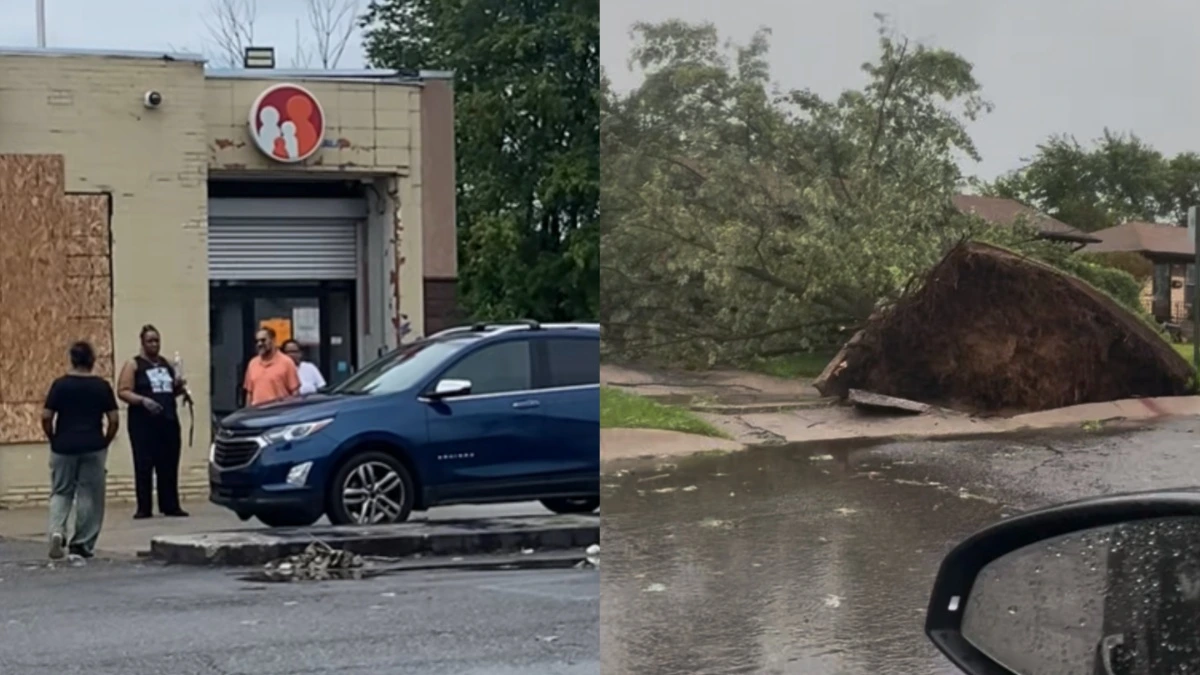
The powerful derecho brought winds approaching 100 mph, toppled trees, and caused widespread damage to roads and electrical infrastructure across the region.
‘Largest Outage Event’
Northern Indiana Public Service Company (NIPSCO) calls it the largest outage event in the company’s history, with more than 300,000 customers losing power during the storm. More than 1,200 additional mutual-aid crews and contractors were brought in to help with restoration efforts.
Thousands of residents remain without power a week later.
Ajahalla, 27, who lives in Gary but asked to be identified only by her first name, told Atlanta Black Star she has been without power for a week. She said her mother and other family members left Gary a few days after they lost electricity.
“The sky got pitch-black dark, with 100 miles per hour wind,” the mother of two described. “And after that, we were in the dark; everything was pitch black.”
Gary Mayor Eddie Melton said Tuesday that city officials had assessed more than 2,000 damage sites and requests for assistance across the city. More than 80% involved fallen trees and blocked roads, he said.
The city said 75% of reported blocked roads had been reopened as crews continued clearing debris and responding to damage.
Officials Response
NIPSCO said it expected about 90% of impacted customers to have power restored by Tuesday night, with full restoration expected by Friday, Aug. 21. As of Wednesday morning, the utility had restored power to 282,000 customers.
NIPSCO has attributed the prolonged restoration effort to the scale and geographic reach of the damage, including destruction to poles, power lines, substations, and other electrical infrastructure.
Some Gary residents, however, said they have struggled to determine where restoration crews are working and when power will be restored in their neighborhoods.
Ajahalla said surrounding communities appeared to have power restored while Gary residents remained in the dark.
Some residents told ABC 7 they understood NIPSCO was dealing with the worst outage in the company’s history but wished the utility had been more transparent about where crews were working.
Ajahalla blamed Melton for failing to communicate with residents during the first days of the crisis.
“Every other mayor seems like they were out and about, getting ready to help with the storm,” she said. “It wasn’t until about two days later that our mayor even mentioned it and tried to put some on-the-ground relief.”
Another resident, Raven Summers, who was without power for six days, says she believes the mayor is doing his best.
“One mayor cannot carry an entire city through repeated disasters alone,” she told Atlanta Black Star.
Melton highlights the city’s progress but acknowledges it still has a long road ahead.
“We have made progress … At the same time, we know there is still significant work ahead of us,” the mayor said Tuesday.
A Week Without Power in a City Already Struggling
Gary entered the storm with deep economic challenges.
About 33% of Gary residents live below the poverty line, according to Census data. The city’s median household income is less than $39,000.
For residents already struggling to afford food, a weeklong power outage creates another hardship. Without electricity, refrigerators and freezers cannot safely preserve food, while damaged businesses and gas shortages can make it difficult for residents to replace spoiled or lost groceries.
Ajahalla said some residents rely heavily on discount stores such as Family Dollar to feed their families.
“We have a lot of elderly [people],” she said.
Food giveaways have consequently become a critical part of the storm response. Community organizations, businesses, and local officials have distributed meals, groceries and other essential supplies to residents across Gary and Northwest Indiana.
The Dean and Barbara White Community Center in Merrillville, NIPSCO, the city and other organizations have worked to serve hundreds of meals to residents, according to ABC 7.
Bill Mix, owner of Remix Catering and Events, said he and his team have fed more than 2,000 people since Sunday.
“A lot of people are out of power here,” he told WGN9. “A lot of damage has been done. Trees are everywhere. I mean, even myself, we’ve been out of power the past five days, so we’ve been going to the stores every day, clearing out the stores, doing what we can do.”
Summers also praised her community for coming together in time of tragedy.
“Even without power, my aunt found ways to cook large meals and feed our neighbors every day so people around us could have something hot to eat. Families checked on each other. People shared what they had. Our community has been tested repeatedly, and we are still trying to pull together,” she said.
More Than Just Power
For Ajahalla, the crisis has extended beyond food.
“It got to a point where we have literally been competing for hotel rooms,” she said.
She said she has children and other family members to worry about and eventually left her home because she no longer felt safe staying there.
For Summers, the disaster adds another layer of devastation after an E-1 tornado destroyed her home and displaced her in June.
“We were told our building was condemned and that we had only a week to retrieve our belongings,” she said. “I became homeless in five minutes.”
Summers is still waiting for the “meaningful assistance” she was promised after that tornado. In the meantime, she is living in a one-bedroom apartment with family.
Darkness Raises Public Safety Concerns
The prolonged outage has also created concerns about public safety.
Gary already has a reputation for high crime, Ajahalla said, and she believes the darkness has made the situation worse.
“It’s extremely dangerous,” she said. “I can’t even explain how dark it is at night.”
Concerns escalated further after a NIPSCO vehicle was struck by gunfire overnight while crews were working to restore power. Video from NBC Chicago showed the NIPSCO SUV with its rear window partially shattered.
“Let me be clear: this type of violence is absolutely unacceptable and will not be tolerated in the City of Gary,” Melton said. “These crews are here for one reason — to help our residents and restore electricity to families who have already endured days without power.”
Melton said state troopers would be deployed to provide additional security for NIPSCO crews.
No one was injured, and police are investigating.
Aid Slow to Arrive
Ajahalla said she felt the response from FEMA and the Red Cross was slower than she expected compared with other places.
Federal assistance became available Aug. 15, four days after the storm. The Indiana Department of Homeland Security’s disaster resource program said eligible residents may qualify for emergency grants of up to $5,000 for essential needs, particularly for people displaced from their homes.
In the meantime, cooling centers opened around Gary, while Lowe’s partnered with the city to provide cleaning supplies, chainsaws, flashlights, and batteries, according to WGN9.
AT&T confirmed it is waiving overage charges and providing unlimited talk, text, and data for eligible customers through Sept. 11. The company also partnered with the Red Cross to provide charging lockers at the YMCA in Gary.
Verizon is also providing Wi-Fi and charging stations at the YMCA.
Residents have been instructed to document damage, keep receipts, and report storm-related losses.
What Happens Next?
Many questions remain unanswered about this mass power outage in Gary.
“This is Gary, Indiana–the hometown of Michael Jackson–but many of us have felt invisible,” Summers said. “We need people outside of Gary to know what is happening here.”
Atlanta Black Star reached out to NIPSCO for information about the specific cause of the prolonged outages, the company’s history of extended outages and whether customers will receive any compensation.
The company had not yet responded as of publication.
For now, residents like Ajahalla are waiting in the dark. She said the crisis has changed how safe and secure she feels in the place she calls home.
Meanwhile, Summers remains optimistic in the face of challenges, saying she believes in the community of Gary.
“I survived an EF-1 tornado in June. Two months later, my family endured another devastating storm and nearly a week without electricity. We are still here. We are still helping each other.”