President Donald Trump is once again casting himself as the victim, this time invoking the word “reparations” to argue the federal government owes him compensation for years of what he described as unfair treatment.
The extraordinary comparison immediately reignited criticism, particularly as Black Americans continue pressing for reparations tied to slavery and generations of systemic discrimination.
Speaking to reporters in the Oval Office on Monday, Trump argued that the federal government reversed course on a tax dispute after he entered politics, insisting officials had unfairly targeted him for years before suggesting he deserved compensation for what had happened.
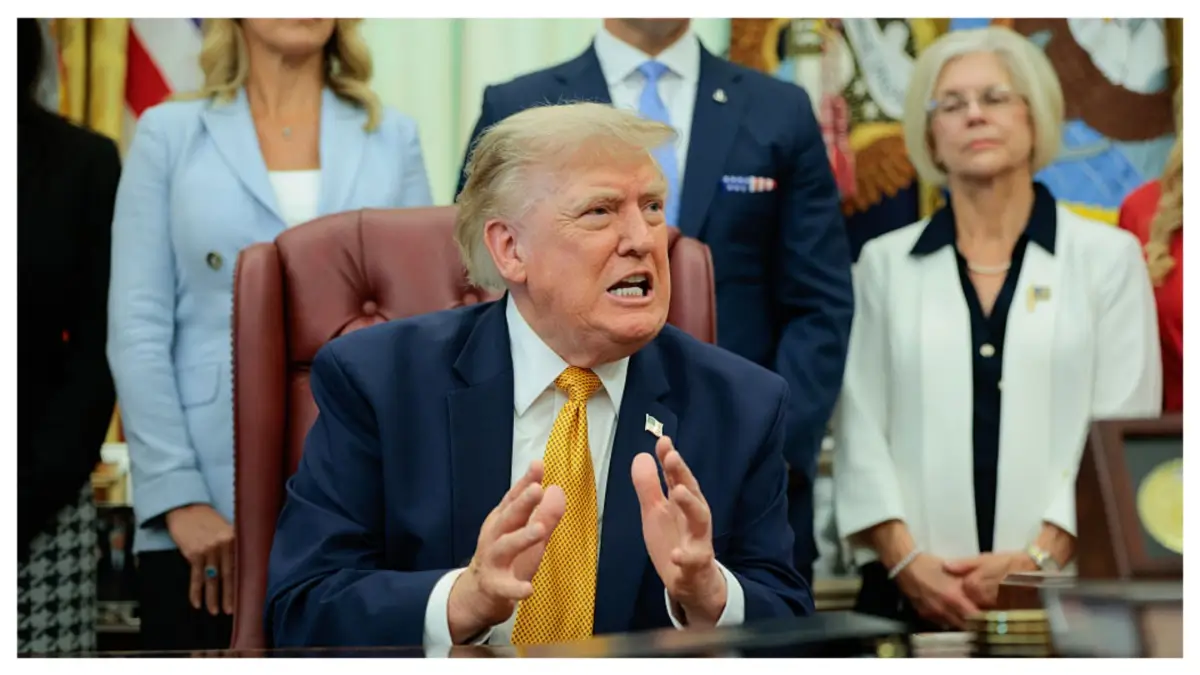
The remarks came after acting Attorney General Todd Blanche abandoned the administration’s proposed $1.8 billion compensation fund and as Trump again defended the controversial settlement tied to his lawsuit against the IRS.
“First of all, I had a 10-year case that was settled until I announced I was running for office. It was a settled deal, like I’ve been doing all my life. I’ve been audited every year for my entire life, which I have a lot of wealthy friends. They were never audited to this day,” Trump said.
“They were never audited. I was audited, and my deal was settled in writing. It was settled, subject to final approval. Then I announced I was running for president, and all they did was haunt me with it. They ended the settlement and they went after it, and they went after me illegally. And they did a lot of bad things to me, like they did to other people. And I was treated very unfairly by the IRS. I was — it was weaponized against me.”
He then suggested he deserved compensation.
“And what they did here was very, I frankly, uh, if you talk about reparations or if you talk about payment, what they did to me, I had a very good case against them,” Trump claimed.
Trump’s bold remarks immediately drew criticism from reparations advocates, who argued the comparison diminishes the decades-long movement seeking compensation for descendants of enslaved Black Americans, while also reigniting scrutiny over a tax settlement that continues to shield Trump and his family business from IRS audits.
The proposal had drawn bipartisan criticism, with opponents arguing it could have benefited people convicted in connection with the Jan. 6, 2021, attack on the U.S. Capitol whom Trump later pardoned.
Blanche rescinded the fund in a letter to Republican senators whose support he needs for confirmation as attorney general, according to The Associated Press.
However, a separate provision negotiated as part of Trump’s settlement with the IRS remains in place, preserving retroactive audit protections for Trump, his sons Eric Trump and Donald Trump Jr., and the Trump Organization.
The settlement stems from Trump’s $10 billion lawsuit against the IRS, which accused the agency of failing to safeguard his confidential tax information after an IRS contractor leaked tax return data affecting more than 400,000 taxpayers. Trump and his family sought roughly $10 billion in damages.
Last month, U.S. District Judge Kathleen Williams ruled that the lawsuit had been filed for an “improper purpose.” While she did not invalidate the settlement, she said the government could not characterize the agreement as the product of a legitimate legal process. Trump has appealed that ruling.
Legal experts and lawmakers from both parties have questioned whether the audit protections are lawful, citing a post-Watergate statute intended to prevent presidents from influencing IRS investigations.
Asked about Blanche’s agreement with Senate Republicans, Trump insisted he had little involvement in the negotiations.
“I didn’t look at it. All I know is that Todd Blanche is great. Uh, he’s going to do a great job,” Trump said. “Everybody knows it. And I understand there’s been a sign off, but I didn’t — I don’t know what they agreed. I think Todd Blanche agreed to reconfirm things that he’s already said.”
Trump continued to praise the proposed compensation fund, saying he still supports the concept because it would benefit people he believes were unfairly targeted by previous administrations.
“It’s for…people that have been treated unfairly, that have been weaponized by a corrupt government, that we had with Obama, that we had with Biden. You had a corrupt government with both of them,” Trump said.
His remarks about reparations quickly generated backlash online.
One social media user wrote, “Ask him about reparations for former slaves. Ask him.”
Another posted, “Yes, Trump was treated as badly, or worse than… checks notes …slaves in America.” One more simply said, “Unbelievable.”
Another user added, “The billions he’s made this term isn’t enough to fill that gaping hole of narcissistic need??”
Dan Greenberg of the Cato Institute called the immunity deal “the product of an illegal settlement,” adding, “The good news is that Todd Blanche confirmed in writing that the anti-weaponization slush fund is dead. The bad news is that tax immunity for the president, his sons, and his family business is still alive.”


