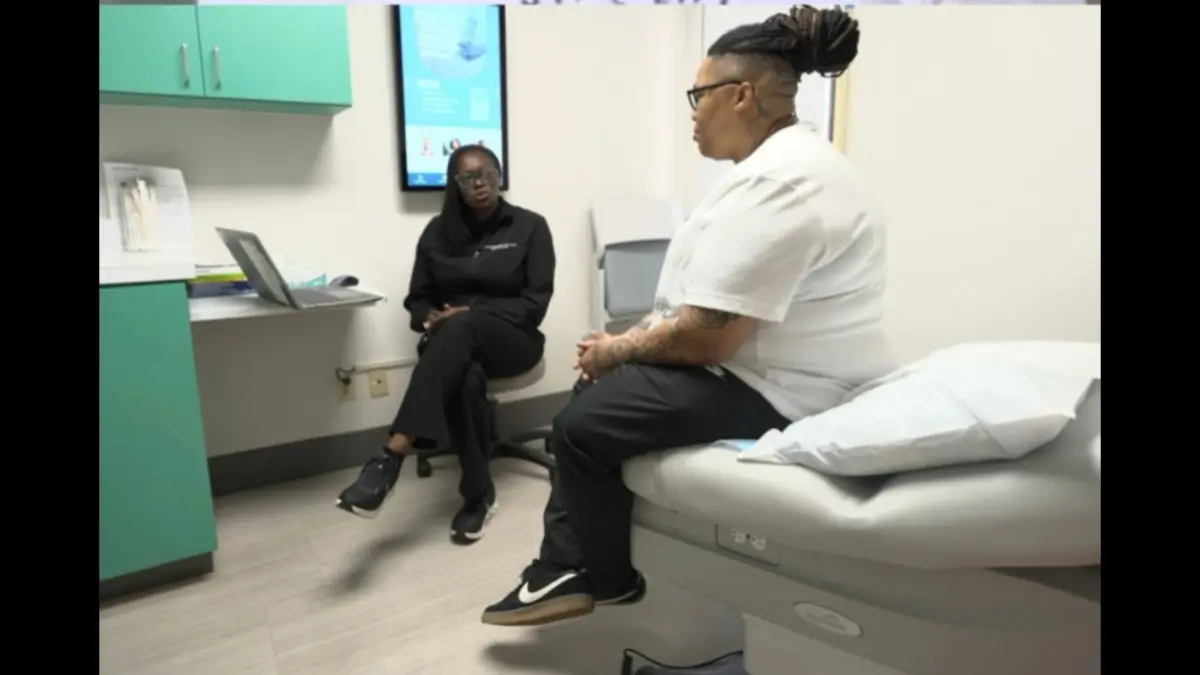
Rashan Williams, a 41-year-old deli manager in St. Petersburg, Florida, said she would feel her uterus bulging from her vagina when she lifted boxes and other heavy objects, and had figured out how to push it back in place.
“I could maneuver it. Push it out. I can flip it to the side. It was just crazy,” she told the New York Post. “I had no pain, but I just knew something was there, and it wasn’t right,” she said.
She’d make frequent trips to the restroom, she said, to “pregame myself” before leaving the house or work for any length of time.
Besides the bewildering bulge, she also experienced heavy periods and constantly needed to pee.
This went on for a decade, during which she was in and out of doctors’ offices with no diagnosis.
“I was really getting the door shut in my face because no one knew what to do or knew what it was,” Williams said.
The Diagnostic
The game changer for Williams was Dr. Nyarai Mushonga, a urogynecologist at Orlando Health who specializes in pelvic floor disorders.
Mushonga quickly diagnosed the issue: Williams was suffering from a pelvic organ prolapse. It’s a condition that can cause the descent of the bladder or uterus into the vagina, along with incontinence and constipation. It can become debilitating with severe pressure and chronic pain, according to Orlando Health.
The private, nonprofit health care system based in Orlando released results of a survey in May that found one in three women “are suffering in silence with common misconceptions about pelvic prolapse.”

Half of the women surveyed didn’t know that urine leakage is not a normal part of aging that women just have to live with, the survey found. About 30% of women surveyed believe pelvic prolapse only happens if you’ve been pregnant, to postmenopausal women, or to women over 60. And 30% didn’t know that surgery is an option to fix pelvic prolapse.
National Research
Those findings are in line with national research, which shows that up to 50% of all women will experience some prolapse in their lifetime, with childbirth, heavier body weight, and aging all increasing risk, according to a 2019 report by the University of Chicago Medicine. Yet only 18-50% of them seek medical attention.
And racial disparities in the urology health sector push the numbers even lower for Black and minority women, who are less likely to be aware of the pelvic organ prolapse (POP) condition and to seek treatment, including surgery.
White women undergo the vast majority of POP surgeries (nearly 90%) while Black women have only 5.5% of pelvic organ prolapse procedures and “others” 4.7%, according to a 2023 article in Urology Times Journal.
The Surgery
Mushonga, a urogynecologist who is also a board-certified reconstructive pelvic surgeon, offers surgical and non-surgical treatments to her patients.
She specializes in a minimally invasive procedure to permanently fix pelvic prolapse with stitches and a Y-shaped mesh sling.
“I tell patients that a [prolapse] is like the roof of your vagina coming down, like a tampon falling out,” Mushonga said. She also compared it to a baby’s head crowning.

“It typically just doesn’t take that long for someone to find it,” she told the Post, but said sometimes the symptoms, such as incontinence and stomach pressure, can lead doctors to think the problem is with the digestive system or urinary tract.
The surgical procedure she uses, called an intraperitoneal colpopexy, is “like wearing suspenders — a suspender is what’s holding the pants up, and those stitches are what’s holding the vagina up,” Mushonga said.
Williams received this outpatient surgery after having a hysterectomy, and said she experienced “pure relief,” with no more incontinence, and bulge-free lady parts.
She said she recovered after only a week and is now able to travel more freely with her wife and daughter and no longer feels tied to the nearest restroom.
“Dr. Mushonga is heaven-sent,” she said, acknowledging she was sometimes depressed during her 10-year journey among multiple medical doctors “who didn’t know what was going on.”
A Care Shortage
Those diagnostic challenges may stem, in part, from a shortage of urology subspecialists. A 2024 study published in the Urogynecology journal found that only about 500 board-certified urogynecologists practice in the United States.
Mushonga said such specialists perform about 300,000 surgeries every year to correct pelvic prolapse, noting that non-surgical measures can also help resolve the condition.
A common treatment for POP symptoms includes the placement of a vaginal pessary, a removable, medical-grade silicone device inserted into the vagina to prop up bulging pelvic tissues.
Mushonga also recommends preventive measures for women, such as exercises to strengthen the core and pelvic floor muscles and practicing Kegels in conjunction with a pelvic floor therapist.
Noting that her father was an orthopedic surgeon and her mother earned a doctorate in nursing, in her self-introductory video at Orlando Health, Mushonga says her parents’ compassion and dedication to medicine inspired her to pursue a similar calling.
“My unique subspecialty allows me to help women find relief from symptoms that can often be confounding,” she says. “When your day-to-day living is disrupted by symptoms from pelvic organ prolapse, urinary or fecal incontinence, it’s time to have an honest conversation about treating your symptoms and gaining your life back. … Ladies, your symptoms aren’t something you should live with.”


