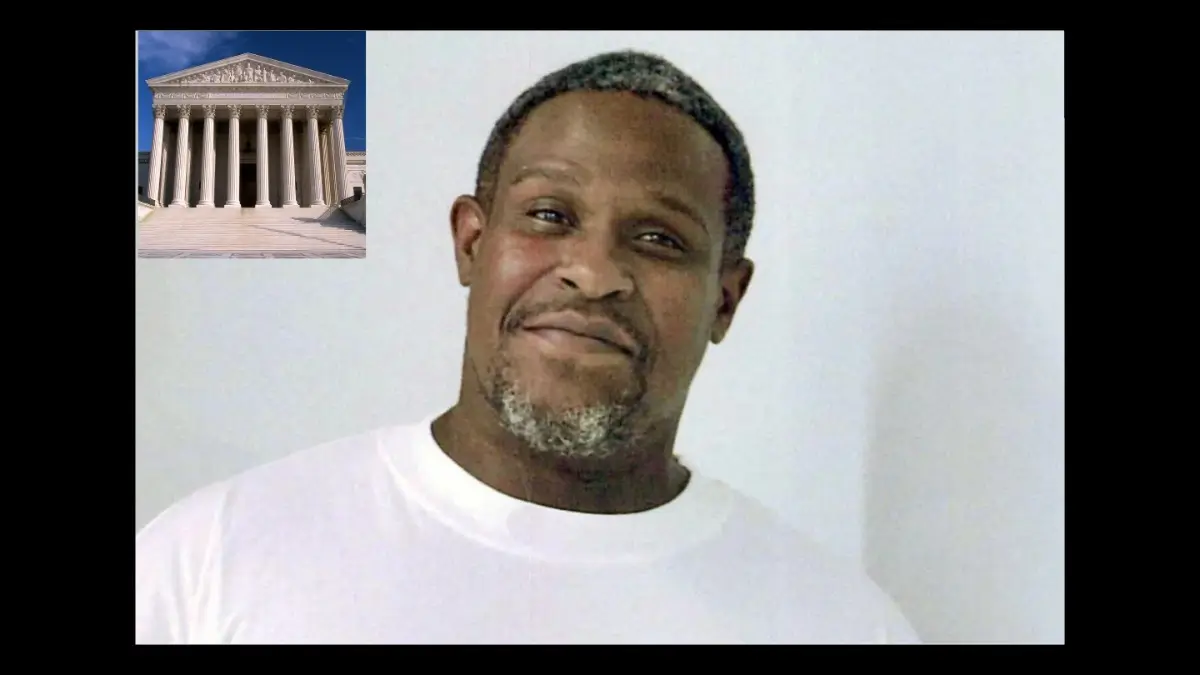
The Supreme Court on Thursday ruled in favor of a Black death row inmate from Mississippi who has been arguing in court for 20 years that the mostly white jury that convicted him of capital murder and sentenced him to death was unjustly composed with racial bias.
In 2004, Terry Pitchford, then 18, robbed a grocery store in Grenada, Mississippi, with Eric Bullins, who was 16. The two Black teenagers both wielded guns.
Bullins fired three shots at the store owner, Reuben Britt, a white man, killing him.
Pitchford also fired a gun, which was loaded with rat shot; in court, each side disputed whether he shot at the store owner or fired into the floor.
Bullins, who was not subject to the death penalty as a minor, reached a plea agreement and received a 20-year sentence for the homicide.
At Pitchford’s trial in a Mississippi state court, during jury selection, prosecutor Doug Evans used peremptory strikes to dismiss four of five Black potential jurors.
Evans, who is now retired, was a prosecutor with a checkered history of striking Black jurors for discriminatory reasons.
In response, Pitchford’s counsel raised objections under Batson v. Kentucky, a precedent based on a 40-year-old Supreme Court ruling that jurors cannot be excused from service because of their race.
As Justice Brett Kavanaugh, who wrote the majority opinion for the Court explained, Batson set up a three-part system for a trial court to determine whether a prosecutor used a peremptory challenge based on race.
First, defense counsel must raise an objection and show how the juror strikes were based on race. In this case, Pitchford’s attorney did so just as jury selection concluded, complaining that 11 of the selected jurors were white, and only one was Black, despite the local population being 40 percent Black.
Second, the prosector must supply race-neutral reasons for each strike.
At Pitchford’s trial, Evans argued that one juror had returned 15 minutes late to court, two others had brothers convicted of violent offenses, and the fourth, like Pitchford, was young, unmarried and a father.
“Upon hearing the prosecutor’s reason for the last strike, Judge Joseph Loper stated that ‘the Court finds that to be race neutral as well,’ and pivoted immediately to the defense’s peremptory strikes,” wrote Kavanaugh.
The trial court judge “did not afford defense counsel an opportunity to rebut the prosecutor’s race-neutral reasons as pretextual” [or false, to cover up a real motive], which is step three in the Batson process, Kavanaugh wrote.
Loper twice cut off Pitchford’s attorney when he raised objections, which ultimately “thwarted” his efforts to effectively represent Pitchford during jury selection.
The jury, stacked with white jurors, found Pitchford guilty of murder and sentenced him to death.
In his motion for a new trial, Kavanaugh noted, Pitchford “advanced the argument he was prevented from making during jury selection” — that “the prosecution’s state of mind was clear as it deselected black people from the jury panel who had the same familial, living, social or marital circumstances as whites who were not deselected, which is a clear violation of Batson.’”
The trial court denied Pitchford’s motion, and Pitchford has spent the last 20-plus years pursuing appellate and other legal challenges to his conviction and death sentence.
The Mississippi Supreme Court upheld the original trial court’s findings, while a U.S. District Court found that decision “contrary to federal law” and “based on an unreasonable determination of the facts in light of the evidence presented” in state court.
The U.S. Court of Appeals then reversed the district court.
In his majority opinion issued on May 28, in which he was joined by Justices Ketanji Brown Jackson, Elena Kagan, John Roberts, and Sonia Sotomayor, Kavanaugh quoted his own 2019 opinion in which the court threw out the conviction of Mississippi inmate Curtis Flowers in a case that involved a preemptive strike of a Black juror by the same discredited prosecutor.
District Attorney Doug Evans tried Flowers six times over 23 years for the same 1996 quadruple murder, relying on all-white or nearly all-white juries by way of striking black jurors.
Following the Supreme Court ruling and the recusal of Evans from the case, Mississippi Attorney General Lynn Fitch officially dropped all charges against Flowers in 2020, declaring that there were no credible witnesses remaining.
Kavanaugh acknowledged that “‘America’s trial judges operate at the front lines of American justice’ and ‘the job of enforcing’” the Supreme Court’s 1986 Batson decision “‘rests first and foremost with trial judges.’”
But in Pitchford’s case, Kavanaugh wrote, “whether due to confusion, oversight, an overly hurried jury selection process, or some other cause, things broke down and the ordinary trial-court procedure for resolving Batson claims never occurred — notwithstanding the efforts of Pitchford’s counsel.”
After the 5-4 decision by the high court, the case will be sent back to the lower federal courts to rule on the Batson claims.
If they determine that the prosecutor’s strikes of four Black potential jurors were racially motivated and unconstitutional, Pitchford’s murder conviction and death sentence will be overturned.
At that point, Mississippi state prosecutors will have to decide whether to drop the charges or retry Pitchford, who is now 40, for the 2004 robbery and murder.
While Mississippi state prosecutors have not yet weighed in, his attorney, Joseph Perkovich, said the Supreme Court ruling means Pitchford is now entitled to “a fair trial in the state court.”


