A Black actress filed a racial discrimination suit against Harvard University’s American Repertory Theater Company in Cambridge last week claiming her hair and scalp were permanently damaged by an unqualified hair stylist, causing her to end her stage career.
Nike Imoru, 60, an acclaimed British-Nigerian actor and casting director, says that during a busy month of rehearsals and pre-production prior to the opening of “The Odyssey” at ART in February 2025, the theater’s costume designer asked her to change her hairstyle from the knotless silver box braids she arrived with to tightly braided cornrows to conform with her artistic vision for Imoru’s character, a Greek chorus member.
Imoru agreed and met with the hair and wig designer for the show, who is “a qualified in-house hair technician and a white woman,” according to the lawsuit, filed on Feb. 19 in Middlesex Superior Court (and obtained by Atlanta Black Star). The hair designer told Imoru that a backstage ART employee, who is Black, could style her hair.
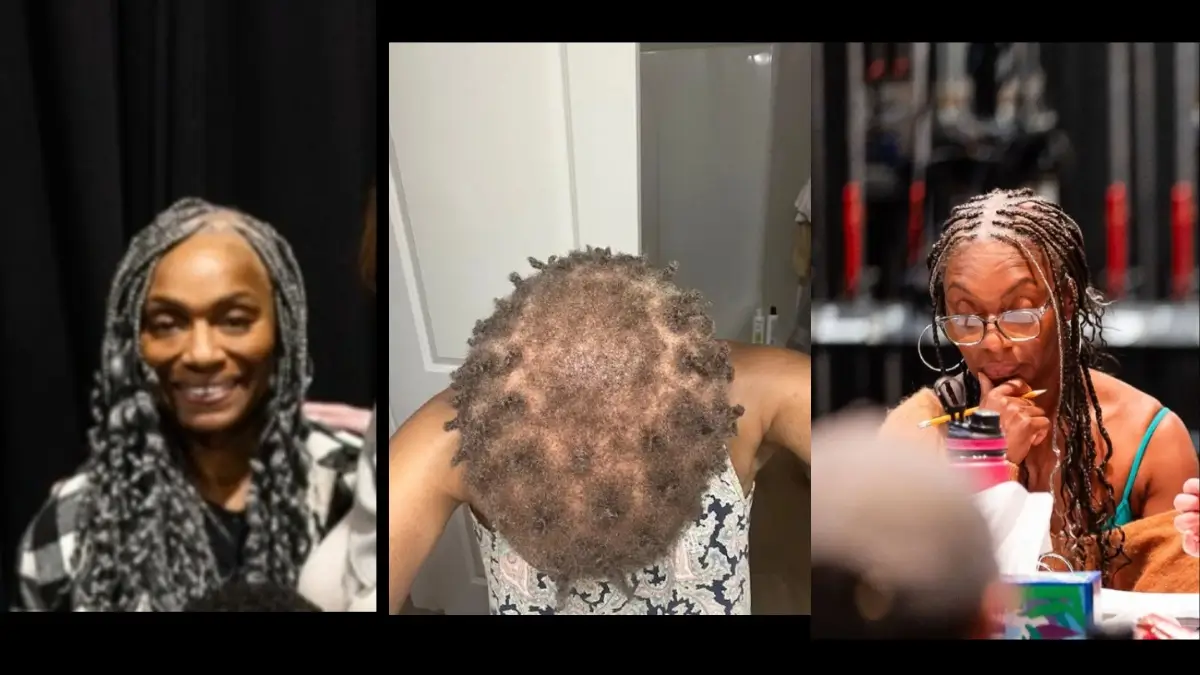
The ART employee was not employed as a hairdresser for “The Odyssey” but was working as a dresser, the complaint says. Unbeknownst to Imoru, she had only informally assisted with hair on one prior production and was not professionally qualified to style hair.
The lawsuit argues this violated the contractual obligation the theater has with the Actor’s Equity Association, which requires regional theaters to provide an actor with a licensed and qualified hair technician “to prevent harm to hair during production styling and to enable its restoration to its natural condition thereafter.”
While Imoru was given the choice of working with an outside stylist, “the short turnaround time that the show schedule required, coupled with Ms. Imoru’s unfamiliarity with local hair professionals, made working with an outside stylist unfeasible,” the lawsuit says. Imoru also believed the ART employee was qualified.
“I was confident that a theater of that stature would have qualified, experienced people to do my hair, to do textured hair,” Imoru told CBS Boston.
On Jan. 21, 2025, the ART employee wove synthetic hair in with Imoru’s natural hair to create cornrows, styling the complaint says, “looked terrible” and caused her considerable pain. The costume designer agreed it needed to be redone, and two weeks later, the ART employee spent five hours rebraiding Imoru’s hair with coiled extensions.
When she was done, Imoru “immediately understood that something was very wrong.” The cornrows were too tight and pulled away from her scalp, causing red welts and pain so intense she could not sleep lying down.
The next day, Feb. 4, Imoru emailed the ART employee about the tightness and twisting sensation in her scalp. The employee allegedly said the synthetic hair she had used was designed for twisting, acknowledging she had used the wrong type of hair extensions, “which twisted into Ms. Imoru’s natural hair and pulled it out from her scalp.”
Later that day, the ART employee removed the cornrows, ripping out some of “her fragile natural hair” in the process, the lawsuit says, and drastically thinning her hair.
Imoru immediately filed a formal accident report and worker’s compensation claim and went to urgent care to receive treatment for her scalp, missing rehearsals just days before the show opened. A medical provider there diagnosed her with “traumatic loss of hair” and advised her she wouldn’t be able to braid her hair for several months.
On Feb. 11 she consulted with a Black dermatologist who recommended Keralase treatments, which use lasers to create wounds on the scalp, followed by application of special serums to encourage follicle growth. The treatment causes “excruciating pain and a burned-skin smell,” the complaints says, and the doctor couldn’t guarantee her hair would grow back.
Imoru, who was “physically and emotionally devastated by these events” just as the production opened on Feb. 18, ended up wearing a hairpiece designed by the hair and wig designer for most of the run of the show. She missed some daytime performances due to pain, lack of sleep and emotional distress, she says, and suffered continual hair shedding that resulted in irregular areas of alopecia on her scalp.
“It’s impossible to explain what it’s like to lose every day a part of your body,” she told the Harvard Crimson. “Part of my cultural identity, my physiology — it was impossible for me to comprehend.”
As a result, on March 13, three days before the play closed, Imoru had her head shaved by a qualified stylist.
Back in Washington, where she lives, Imoru had a scalp biopsy done. The report indicated loss of follicles caused by trauma to the scalp and predicted she is unlikely to achieve hair regrowth close to her pre-injury hair density or length.
“The damage is indescribable. It is cataclysmic,” said Imoru, who estimates she has now lost 90 percent of her hair.
ART agreed to provide support for four months of Keralase treatment for Imoru, which ended in June 2025. Her condition is “likely incurable,” the lawsuit says, and her loss of hair has “destroyed the former trajectory of her career, causing her to withdraw from public and outward-facing endeavors as an actor, casting director, and director across theater and film.”
“I have lost all confidence in my ability to go on stage,” she told the Boston Globe.
The complaint contends that the theater violated state laws against racial discrimination, its contractual obligations to Imoru, and its own public anti-racism pledge to prevent the kind of harms it caused her.
Imoru’s attorney Jody Newman called it “a classic implicit bias case.”
“People claim to have egalitarian values, but they treat and judge people of color differently because of entrenched stereotypes,” she said. “We’re not meaning to be racist or do harm, yet we’re judging and treating you differently.”
During the production of “The Odyssey,” a white female actor required a hair color change, the lawsuit notes, and ART provided her with a consultation, a list of recommended salons, and the option of styling by the hair and wig designer, “who had an extensive portfolio and professional styling background, including work with the Boston Ballet.” The white actress had her hair dyed at the recommended salon, and the ART hair and wig designer then styled her hair.
ART’s misconduct, the complaint asserts, resulted from biased assumptions including that “Imoru’s natural hair would not be complicated to style as compared to white hair; that because of race, [she] would prefer to work with a Black dresser, rather than with a white in-house technician; and that because of race, the chosen stylist would have sufficient experience and qualifications to professionally style [her] hair.”
Years before Imoru’s casting, ART had “explicitly committed itself to prevent precisely the kind of discrimination and harm that the CROWN Act (Creating a Respectful and Open World for Natural Hair) and Actor’s Equity contract provisions were designed to prevent,” the lawsuit says.
Following the exposure of racism in the production of “Witness Uganda” at the ART in 2014, the theater’s artistic director Diane Paulus publicly apologized and committed the theater to an anti-racism pledge.
Over the next two years, ART developed an action plan that was designed to eliminate harm caused by internal race-based discrimination, “including specifically in its physical treatment of Black actors,” the complaint says, “noting in 2021 its commitment to training courses ‘for costumes and wardrobe staff to learn more about working with Black hair and makeup.’”
“They went out on the world stage and said: ‘We will do better. We will be an anti-racist theater,’” Newman told the Globe. “Then, faced with a Black actor with contractual and legal protections, they did her harm. They did not follow the rules. They did not do what they told the public they were going to do.”
The lawsuit seeks a jury trial to determine damages for Imoru’s physical pain, permanent hair loss, significant financial losses, lost professional opportunities, and severe emotional distress, including panic attacks.
Her initial filing listed damages of $1,125,000, including $50,000 for lost wages, $50,000 for future medical expenses, $25,000 for treatment for traumatic alopecia and psychotherapy, and $1 million for emotional distress.
While her future as an actor is in doubt, Imoru got a big career boost last month by being nominated for a prestigious 2026 Artios Award by the Casting Society of America for her role in casting the Oscar-nominated film “Train Dreams.”
“To be recognised is to be truly seen; and to be seen makes the often challenging and involved process of casting all the more worthwhile,” she posted on Facebook, noting “my mad love of actors and the craft of acting.”
The American Repertory Theater did not immediately respond to a request for comment from Atlanta Black Star. The theater has 20 days after being served with the lawsuit to file a response in court.


