A Black man in Detroit who is part of a federal class action lawsuit accusing Wayne County, Michigan, of illegally seizing citizens’ cars won a legal victory last week when the Michigan Supreme Court agreed to hear his state civil case against the county, which claims that local prosecutors slapped him with baseless criminal charges in retaliation for his role in the federal lawsuit.
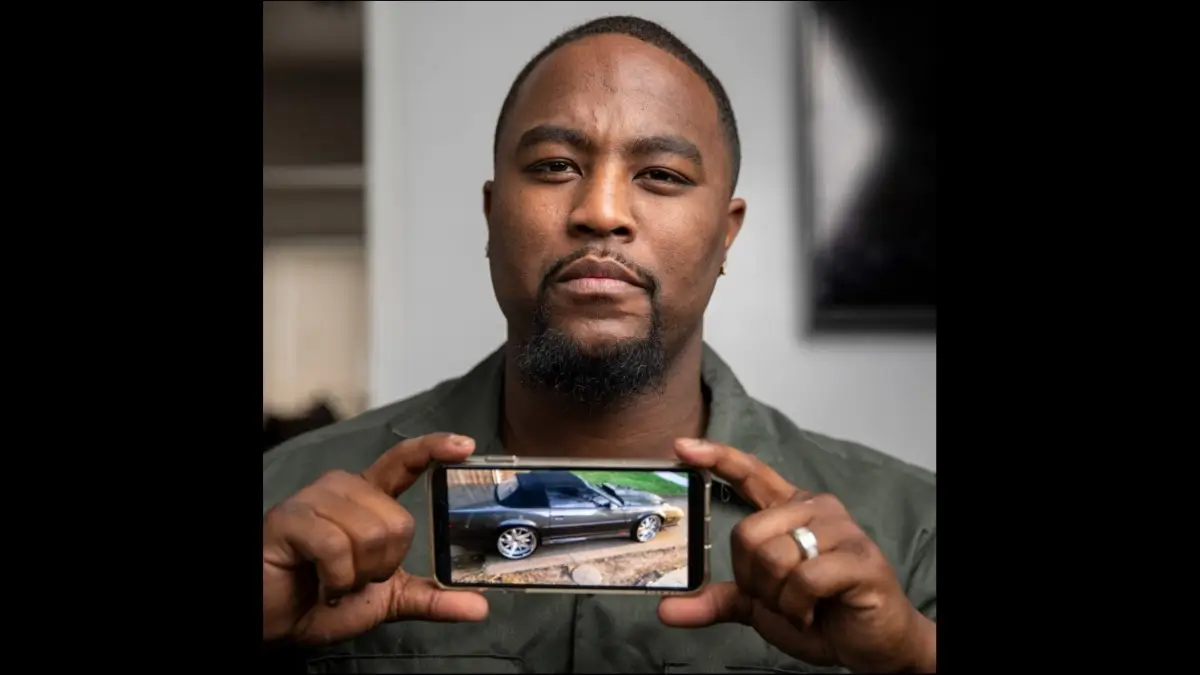
Robert Reeves, now 32, worked in construction and auto repair in early 2019 and had just spent more than $9,000 fixing up a 1991 Chevrolet Camaro that he had bought for $5,500, planning to sell it for a profit, according to his lawsuit filed in Wayne County Circuit Court in March 2023 and obtained by Atlanta Black Star.
In July of that year, he was invited by Javone Williams, whom he worked with on construction jobs, to visit him at a job site and demonstrate that he knew how to operate a skid steer loader. Reeves did so, the complaint says, and the two men agreed to meet the next day on a job clearing rubbish.
After meeting with Williams, Reeves drove to a nearby gas station to buy a bottle of water and was surrounded by police, who demanded to know what he knew about the skid steer, which they alleged was stolen from Home Depot. Reeves was detained for several hours at a local jail and then released, with no charges filed.
Police did not, however, release Reeves’s Camaro, cell phones, or the $2,280 in cash that he had in his pocket. Reeves had to hire an attorney and fight for six months to retrieve his property.
On February 4, 2020, Reeves joined two other plaintiffs in a federal class action lawsuit filed by the Institute for Justice, a public-interest law firm, against Wayne County, claiming that the county’s vehicle forfeiture program violated the U.S. Constitution. The lawsuit said that Wayne County has an official policy of unreasonably seizing cars and other property without probable cause to believe that the property is connected to a crime.
The day after the lawsuit was filed, the Wayne County Prosecutor’s Office instructed the state task force holding Reeves’ property to release it. Two weeks later he received a check for the cash police had seized and then paid $100 to retrieve his impounded car from a tow yard, finding it had sustained significant damage.
In March 2020, a month after he joined the federal lawsuit, the Wayne County Circuit Court issued a warrant for Reeves’s arrest on two counts of felony receipt or concealment of stolen property. The seizure of his car and cash, it turned out, had been part of an investigation by the Michigan State Police task force into a string of rental equipment thefts from Home Depot stores.
The state police had requested the arrest warrant in September 2019, but the Wayne County Prosecutor’s Office did not act on it or file charges against him until Feb. 5, 2020 — one day after Reeves joined the federal lawsuit against the county.
The lawsuit says county prosecutor Dennis Doherty asked a police officer to file a revised warrant request that named only Reeves and Javone Williams, and not other suspects who were implicated by investigation documents as having actually stolen the equipment that Reeves was alleged to have received or concealed.
Learning of the warrant, Reeves tried to turn himself in March 2020, but the court was closed due to the COVID-19 pandemic, the complaint says. On May 8, 2020, he was pulled over for a broken taillight and taken into custody based on the outstanding warrant.
He was held in a Detroit jail “riddled with” coronavirus cases for three days, then released on a $1,000 bond. On Feb. 8, 2021, a district court judge dismissed the charges against Reeves for insufficient evidence. Wayne County prosecutors wasted no time in refiling the two felony charges against him two weeks later, which were again dismissed by the same judge in January 2022.
The state lawsuit filed by Reeves in 2023 alleges that Wayne County maliciously pursued meritless criminal charges against him in retaliation for his participation in the federal lawsuit, and also to gum up the progress in that case. The county attorney, Davidde Stella, successfully argued that the federal court should hold off on hearing Reeves’s claims until the state criminal proceedings against him were concluded.
Reeves’ state lawsuit contends that the county prosecutors’ pursuit of the criminal prosecution is part of a policy of retaliation it pursued in concert with the county’s corporate counsel. IJJ attorneys argued the prosecutors’ true intent was to draw out the local criminal case to impede the federal civil rights case and to intimidate others who might challenge the county’s “lucrative car-forfeiture racket,” which forces people to pay hundreds or thousands of dollars in “redemption” fees to retrieve their seized property.
From 2016 to 2020, police departments in Wayne County raised $3,453,000 through their cut of forfeiture proceeds, while the prosecutor’s office received $578,000, reported Bridge Michigan.
The lawsuit accuses Wayne County, Stella and Doherty of malicious prosecution and abuse of process in violation of Michigan tort law, and of retaliation against Reeves by pursuing multiple criminal charges against him without probable cause, in violation of state and federal law.
Reeves seeks a jury trial to determine compensatory and punitive damages for injuries including spending a weekend in jail, two years of living with the stress of facing felony criminal prosecutions, reputational damage, and difficulty securing employment due to the criminal charges showing up on employment background checks (he was fired by FedEx after being hired to work as a driver, once the pending charges surfaced, the complaint says, and also lost out on a home renovation job for the same reason).
The lawsuit also seeks court orders declaring that the defendants’ pursuit of “bogus” criminal prosecutions against Reeves violated the Michigan Constitution and the First and Fourteenth Amendments, and to bar them from prosecuting him again.
Attorneys for Wayne County previously denied all of Reeves’s allegations and persuaded the Michigan Court of Appeals that a plaintiff alleging state constitutional tort claims against a local government or an individual government employee could not recover monetary damages. Prior case law had only established that individuals can sue state officials.
But on Jan. 16, the Michigan Supreme Court overturned that ruling and invited the parties to submit briefs and make their case for and against the idea that all government actors are accountable for state constitutional violations.
“I was punished for speaking out and defending my rights,” Reeves said in a statement. “I’m glad to be one step closer to making sure government officials will think twice before doing that to anyone else.”