A Black man in Arizona who called police for help after his 4-year-old daughter was abducted by her mother, who did not have custody, only for the cops to treat him like the criminal, forcing him to the ground and handcuffing him for 30 minutes, filed a lawsuit in federal court earlier this month.
Mesa police said at the time they handcuffed Darnay Cockrell on August 4, 2024, because he had “made comments that spiked concern for officer safety.”
But audio from the body camera video released to local media does not reveal any threatening comments towards the cops.
Instead, the audio depicts a distraught father panicking about his missing daughter, who was abducted by her mother, whom he says was unstable and addicted to drugs.
“She took my kid,” Cockrell tells the cops.
“Yeah, we’re out with her, we’re out with her, relax, relax, thank you,” a male cop identified only as Helfrich in the lawsuit but whose first name may be Kelsey, according to LinkedIn.
“She took my f_cking kid,” Cockrell tells the cops.
“Yeah, sit down!” Helfrich orders, raising his voice.
“Who are you talking to like that?” Cockrell asks. “I’m a grown-ass man, she took my f_cking kid.”
“We’re out with her,” the cop responds.
“I said I want my kid now,” Cockrell says.
“Sit on the curb then,” Helfrich orders.
Mesa police did not release any more audio and still have not released the body camera videos to Cockrell’s attorneys.
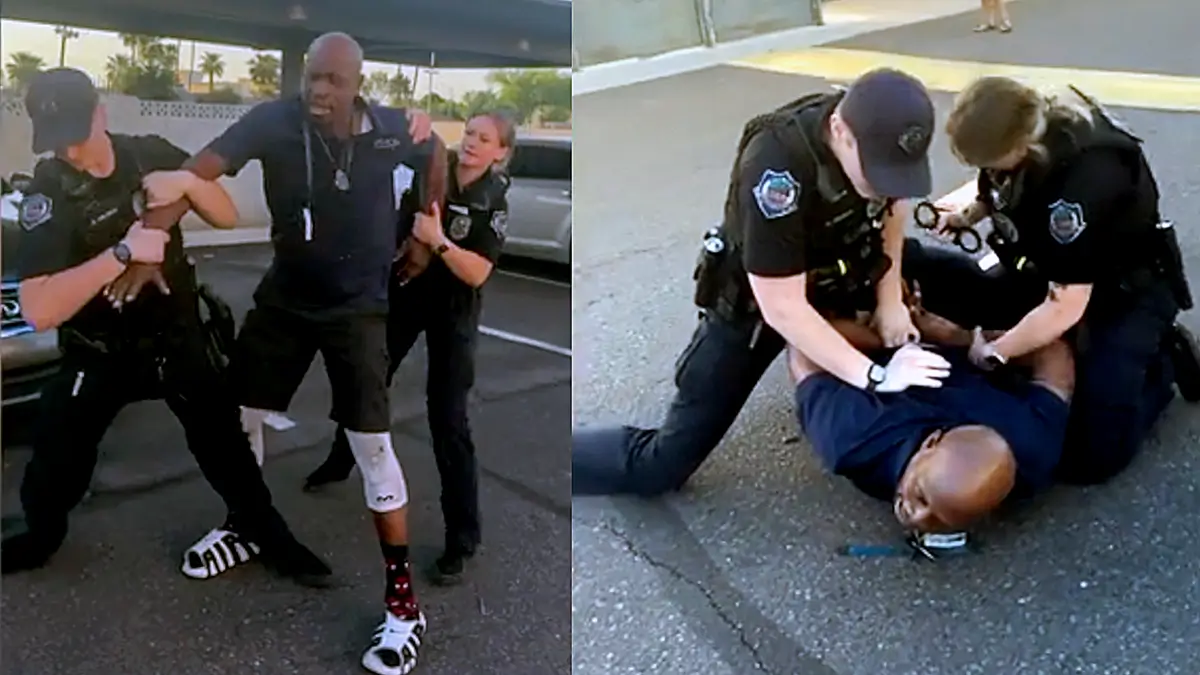
But a neighbor began recording, showing Helfrich and a female cop identified only by her surname, Brown, grabbing him by the arms and trying to trip him and force him to the ground, while Cockrell, who is wearing knee braces, is telling them he just had surgery.
The video also shows Cockrell placing his hands behind his back, telling them to cuff him without having to force him on the ground, but the cops were insistent that he go facedown on the ground.
Helfrich then places his knee on Cockrell’s back and handcuffs him while the man recording is telling the cops, “you escalated everything.”
“So what is going on with your baby mama?” Helfrich leans over and asks Cockrell, finally feeling safe from the tall Black man who was sitting on the ground handcuffed.
“She’s a dope fiend,” a female voice says who was off-camera.
“That’s what I’m trying to figure out,” Helfrich says, although he should have already known what was going on from the dispatcher.
Cockrell attempts to stand up, but Helfrich forces him back down, telling him, “You’re going to stay on the ground.”
“Hey man, don’t touch me no more,” Cockrell says.
“You brought this upon yourself,” the condescending cop tells Cockrell.
“How would you feel if somebody got your kid that’s a dope fiend, then tried to kill them,” responds Cockrell.
‘Officers are Afraid of Black People’
A sergeant arrived 30 minutes later and removed the cuffs from Cockrell and helped him stand back up, the claim states. And other cops arrested the infant’s mother and returned the child to him.
But Cockrell was left with back and knee injuries as well as a broken watch and necklace. And video of the detainment went viral, resulting in Cockrell losing his job and being forced to move out of his apartment – even though he had committed no crime.
“It seems the officers are afraid of Black people in the fact that he’s a victim and he ends up being victimized by the same people he’s calling for help,” Benjamin Taylor, one of the attorneys representing Cockrell, said in a telephone interview with Atlanta Black Star.
“There was no need to put him in handcuffs and throw him to the ground, putting him facedown.”
Taylor is also representing former Arizona Cardinal linebacker Wesley Leasy, who was ordered to the ground at gunpoint with his daughter by Mesa police in a case of mistaken identity in which the real suspect was white, as well as Jalen Woods, the Black Chicago police officer arrested by Tempe police for chirping his tires.
“I never want to play the race card but it’s just very ironic that you have two Black men who are tall in stature and they did that to them,” said Taylor, who is also Black, referring to Cockrell and Leasy.
“A lot of times, officers have some sort of bias and prejudice behind them and they sometimes stereotype people. This might not have had happened if this had been a person of a different color or gender.”
According to the lawsuit that was first filed in state court in August before it was transferred to federal court in December:
Neither Helfrich nor Brown had reasonable suspicion that Darnay had committed any crime.
On information and belief, both Helfrich and Brown treated Darnay as if he had committed a crime because he is African American, tall, and physically fit.
On information and belief, Mesa Police Department trained Helfrich and Brown in a manner in which they felt free to treat African Americans in the community as criminals even without reasonable suspicion of a crime.
Mesa police said the cops broke no policy but they were given additional training to not treat Black victims like suspects which evidently is not taught in the police academy.
But Taylor believes they should have been fired.
“He’s calling as a victim because somebody had kidnapped his daughter and he’s very emotional and instead of just talking to him, they put him in handcuffs and throw him to the ground,” he said.
“Thank goodness the neighbor was able to record on his cellphone to help Mr. Cockrell get justice because we’re still waiting for all the body camera video to be released,” Taylor continued.
The lawsuit accuses the two cops and the Mesa Police Department of assault and battery, and violating Cockrell’s Fourth and 14th Amendment rights.
“Darnay was not under suspicion of having committed any crime but was understood by 911 dispatch and the responding officers to be, along with his daughter, a crime victim,” the claim states.
“In keeping with a long-standing practice of racial discrimination against African Americans, the responding officers from the City of Mesa Police Department treated Darnay like a perpetrator or crime suspect instead of as a crime victim.”