Some California beachfront homeowners are being criticized online for claiming beach areas near their homes are private property and telling people to stay off ‘their’ land.
Due to the 1976 California Coastal Act, which gives residents access to the state’s beaches, people are chiming in on the validity of the claims made in two recent TikTok videos. The separate incidents showing the homeowners telling people to stay off their property went viral.
In the first video, a woman on Laguna Beach’s Victoria Beach yells and curses at a family, which includes a young boy, and tells them to get off of her property. When she mentions a fence, the boy points and says, “There’s no fence.”
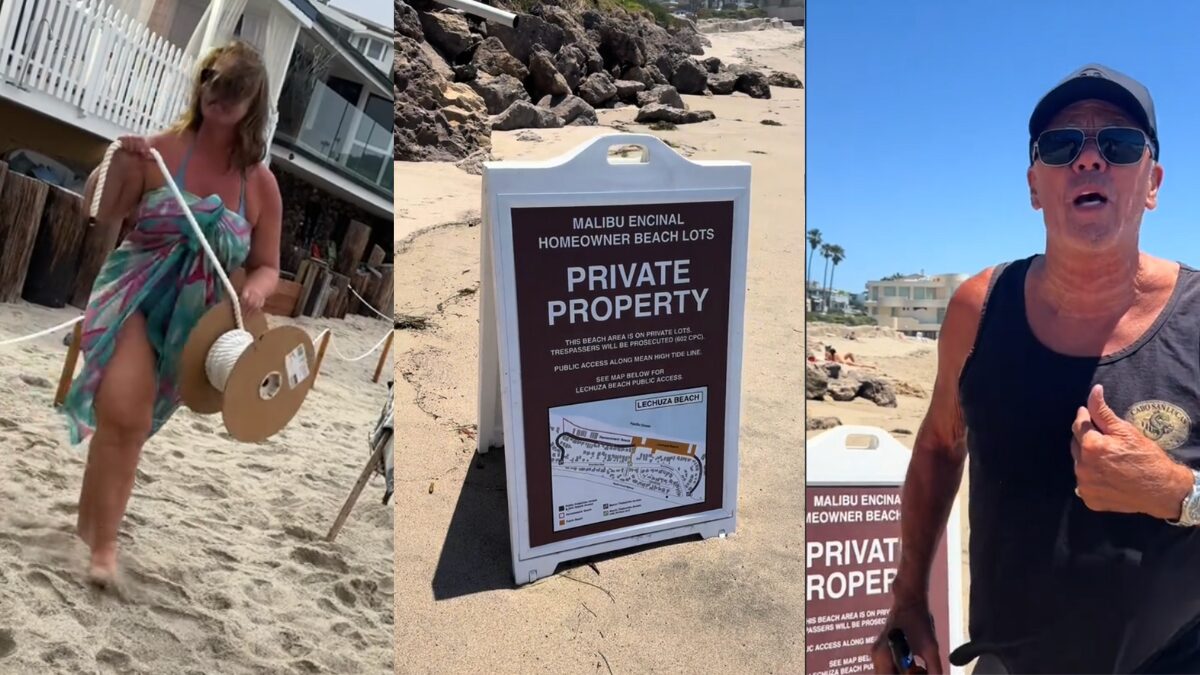
“Get f—ing moving! I’m not joking around,” the woman angrily shouts. “It’s not harassment on the beach, its harassment in my home property! Get out of here now!” Looking on, the young boy tells his family that the yelling woman is “so, so, so, angry,” as she lays out a rope blocking off the area of the beach she claims belongs to her.
The woman who is recording agrees and says, “Yeah that’s what happens when you’re angry for no reason,” to which the woman telling them to leave replies, “You bet I’m angry. This is not an Instagram moment place. You’re in my property! Get moving now!”
When the woman recording says, “Ma’am we’re walking,” the angry rope thrower replies “pretty f—ing slow.” At the end of the vide the family dubs her the “Karen of the Week.”
In a second video, a man is walking along Lechuza Beach in Malibu. He approaches a sign that says the beach is “Private Property” and “trespassers will be prosecuted.”
“Look at this lie. One big ass-lie, private? This ain’t private, bro. This is the sand. This is free land. Anybody can be here. That’s why I’m set up right there,” the man recording says. “It’s a scam, a Karen scam.”
Then the video cuts to the man speaking to the homeowner who attempts to grab his phone. “You just attacked me by grabbing my phone,” the man tells the homeowner. “You’re taking pictures of me without my permission,” the homeowner replies, to which the man filming reubttals, “On public property I can do that.”
The homeowner tells him he’s not on public property, and the man filming says he can’t wait to post the video to social media.
Mandy Sackett is the Senior California Policy Coordinator with the Surfrider Foundation, whose mission is “dedicated to the protection and enjoyment of the world’s ocean, waves, and beaches, for all people, through a powerful activist network.”
She told the Los Angeles Times the people have a right to enjoy the beaches despite how the homeowners feel.
“The beach does belong to the people. It’s free open space. It belongs to all Californians. And that’s enshrined in state constitution and Coastal Act,” Sackett said. “Homeowners think the beach belongs to them because they have expensive real estate, but in reality it belongs to everyone. It’s something we see all too common.”
While the California Coastal Act does give residents access to all beaches, there is a set area that is defined as public, which is typically the wet area. Sarah Christie, a spokeswoman for the Coastal Commission, said they are investigating both incidents but have yet to determine if the homeowners have violated the Coastal Act.
While these incidents are under investigation, the Coastal Commission did block Newport Beach’s attempt to allow homeowners to use the beach as their backyard in 2019.


