A former police officer who was beaten by his colleagues while he was working undercover during a protest in 2017 was just awarded $23.5 million by a judge.
This comes more than three years after the city of St. Louis awarded Luther Hall $5 million in a separate settlement over the incident.
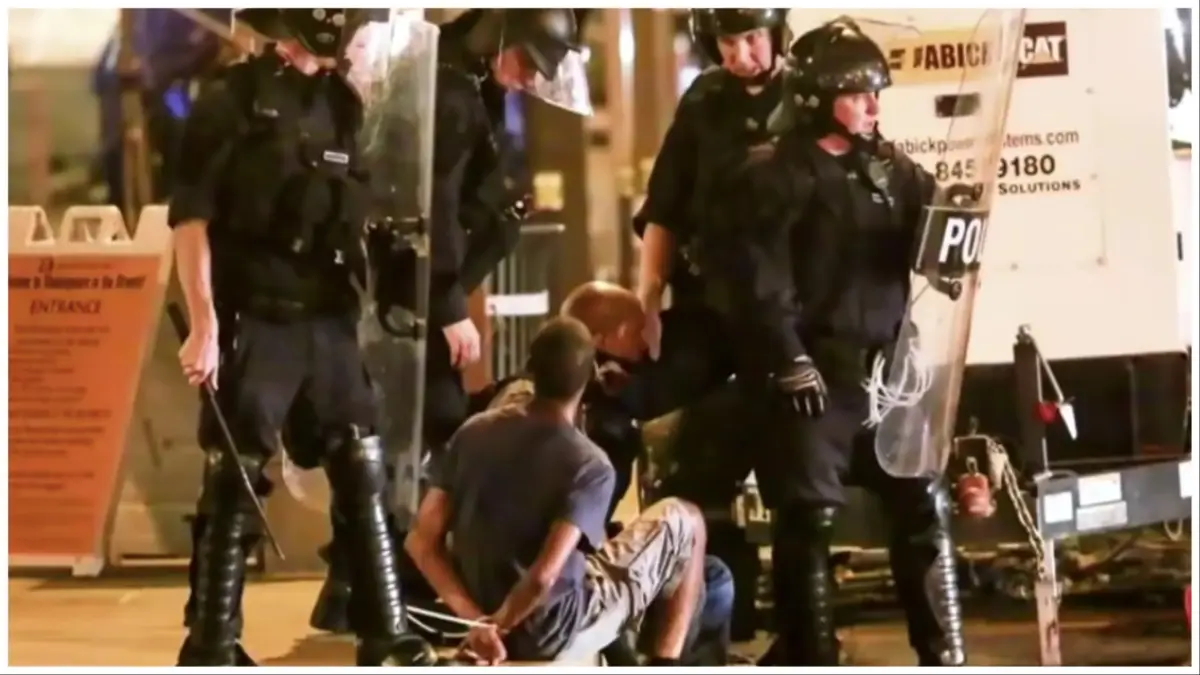
Hall, a Black man, was beaten by three white colleagues with the St. Louis Police Department during a protest on Sept. 17, 2017, after a jury acquitted former St. Louis officer Jason Stockley of the murder charges he faced in the fatal shooting of a Black man, Anthony Lamar Smith in 2011.
He was walking back to police headquarters when the group of uniformed officers stopped him, told him to get on the ground, and then started beating him.
Hall claimed was “beaten like Rodney King,” a Black man who was jumped by a group of Los Angeles Police Department officers in 1991 after a high-speed chase.
Hall was kicked in the face which injured his jaw and left him unable to eat for a time. He also suffered a tailbone injury and had to undergo surgery to repair herniated discs in his neck and back. He also developed gallstone complications which required multiple surgeries.
He sued the colleagues involved in the assault — Randy Hays, Dustin Boone, and Christopher Myers — alleging they beat him because they thought he was a protester and tried to cover it up. This week’s award is the result of a default judgment granted against Hays when he failed to answer the suit. Hall’s claims against Boone and Myers are still being litigated.
St. Louis Circuit Judge Joseph Whyte awarded Hall $10 million in punitive damages, $11 million for past and future physical and emotional pain, and roughly $2 million for lost wages, on April 15, St. Louis Public Radio reported. Another $600,000 was given to Hall for lost delayed retirement, insurance benefits, and past and future medical expenses.
“Luther is grateful that Judge Whyte took his brutal assault by fellow officers and its life-changing consequences more seriously than the City of St. Louis and the St. Louis police department did,” Hall’s lawyer Lynnette Petruska said, according to NPR.
Hays, Boone, Myers, and two other officers were all criminally charged in connection to the attack.
Hays was sentenced to four years and four months in prison after pleading guilty in 2019 to using excessive force against Hall. Boone had to serve one year and one day in federal prison after being convicted in 2021 of a civil rights violation. Myers pleaded guilty in 2022 to another civil rights violation for destroying Hall’s cellphone to conceal evidence in the attack. He received one year of probation.
The other two officers charged in the case were Bailey Colletta and Steven Korte. Colletta pleaded guilty in 2021 to lying to a federal grand jury about what she saw during the attack and was sentenced to three years probation. Korte was acquitted that same year after being accused of a civil rights violation and lying to the FBI.


