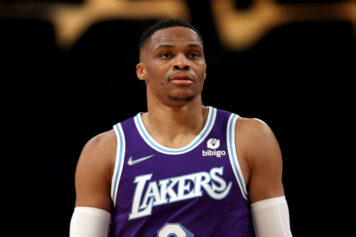
Russell Westbrook has social media buzzing as a clip of his interaction with a seemingly racist heckler during the Los Angeles Clippers and Miami Heat game on Sunday, Feb. 4, has begun to circulate. The showdown that took place at Kaseya Center was briefly interrupted when a white male Heat fan found himself embroiled in a heated exchange with the point guard.
“I’m watching the game, I’m watching the game,” yelled the man at Westbrook who was near the sideline. “I paid for this seat! I paid for the seat, boy!” exclaimed the man who was seated a few rows from the Clippers bench with his son as he and the nine-time NBA All-Star traded words.
At one point, a woman’s hand is observed reaching across the little boy in an effort to calm the man down. However, by that point Westbrook’s Clippers teammate Terance Mann appeared to say, “What boy you see?” members of the organization, and security all had eyes on the unruly spectator.
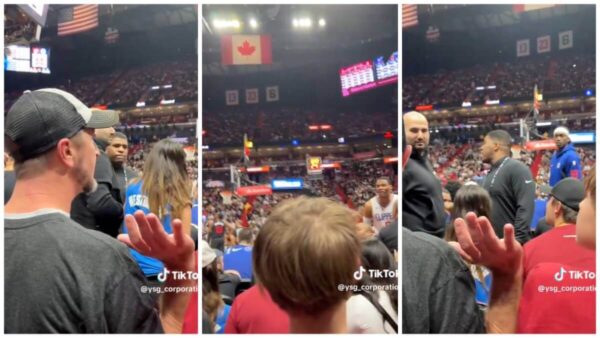
“I’m watching the game,” he then said in a more subdued tone just before he was escorted out of the arena to cheers from those bothered by his disruption. “Bro has too much southern twang in his voice I know his real motives and morals lol,” remarked a TikTok user when the clip landed on the social platform.
“BOY??!! Oh you must of thought you woke up in 1955 out yo go!” wrote another user commenting on the racial epithet, whose use to demean Black men and boys dates back beyond the Jim Crow era.
This is not the former Los Angeles Lakers player’s first run-in with antagonizing fans trying their best to strike a nerve. In 2019, a then-30-year-old Westbrook was ready to go to blows with a couple taunting him from the stands during a game in Utah. At the time, he was playing for the Oklahoma Thunder.
Found the crufuffle from the heat game. @terance_mann standing on bidness 💯 🤝🏾 pic.twitter.com/DzCpeCAZOU
— Kaleab (@kalebfessahaye) February 8, 2024
He said the incident unfolded when the man told him “to get down on my knees like you used to. And for me, that’s just completely disrespectful. To me, I think it’s racial. I think it’s just inappropriate in the sense of there’s no protection for the players. … There are people who come to the game to say mean, disrespectful things about me, my family, for many years.”
“I’ve done all the right things I’ve never done anything to hurt or harm anybody,” the 2017 NBA MVP said. “I’ve never been in any trouble, never fought a fan, been in the league 11 years clean slate… Every time I come here it’s a lot of disrespectful things said and, for me, I’m just not gonna continue to take the disrespect for my family. … There’s gotta be something done, some consequences for those type of people that come to the game just to say and do whatever they wanna say.”
The man, later identified as Shane Keisel, was indefinitely banned from attending future Utah Jazz games. A similar scene, sans the racial aspect, occurred last season during his stint when a Phoenix Suns fan reportedly called him Westbrick, a moniker that grew to prominence during his disappointing stint with the Lakers (2021-2023) thanks to Fox Sports talk show host Skip Bayless.
He told that heckler, “Watch your mouth, motherf–ker,” as he passed by the VIP lounge on his way to the locker room. In 2021, an upset Philadelphia 76ers fan lost his season tickets and was permanently banned from Wells Fargo Center after he dumped popcorn on Westbrook, who was with the Washington Wizards, as he headed through the team tunnel.
Both the NBA and Players Association have expressed support for a stricter fan code of conduct amid the out-of-control taunting athletes endure.