New York has taken a significant step in efforts toward racial justice by approving a new commission to study the history of slavery in the state and consider paying reparations, a controversial issue that has received pushback from some GOP lawmakers nationwide.
New York Gov. Kathy Hochul, a Democrat, signed legislation Tuesday that authorizes the creation of a community commission on reparation remedies, which will study the negative impacts of slavery on African-Americans.
The bill was introduced by Assembly Member Michaelle Solages following the 2022 Buffalo mass shooting that was racially motivated.
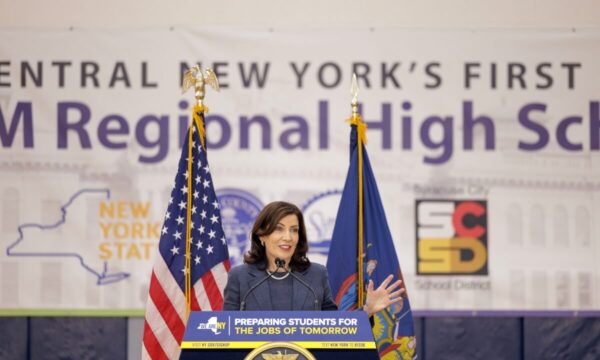
The commission will be composed of nine members who have experience in various fields, including education, training “or lived experiences in the fields of African or American studies,” according to a press release from the office of Gov. Hochul.
“We are continuing our efforts to right the wrongs of the past by acknowledging the painful legacy of slavery in New York,” Hochul said in a written statement. “We have a moral obligation to reckon with all parts of our shared history as New Yorkers, and this commission marks a critical step forward in these efforts.”
At the bill signing event in New York, Hochul was joined by many Black leaders, including Rev. Al Sharpton, who said, “We still see Blacks making 70 cents to every dollar whites make,” CBS reported.
Still, advocates for reparations must continue to fight against attempts by many conservatives to block reparation programs, said Alanna Lamar, board member of the South Florida Chapter of the National Coalition of Blacks For Reparations in America (N’COBRA).
“This is a historic step in the right direction, and a sign of all the progress being made in the reparations movement at the Federal, State and Local levels,” Lamar, who is a lawyer based in Florida, said in an interview with Atlanta Black Star.
“Unfortunately, as we witness progress toward redress and repair, we are also seeing a growing opposition directed towards prevention.”
However, a Republican state senator in Florida is attempting to block the state and local governments from reparation payments to descendants of enslaved Black people.
During the state’s 2024 legislative session, state Sen. Blaise Ingoglia, who represents District 11 in Central Florida, introduced a proposed constitutional amendment that would prohibit Florida from paying compensation in the form of reparations to people who are descendants of an enslaved individual.
“In my home state of Florida … Republican lawmaker (Sen. Blaise Ingoglia) filed a joint resolution, calling to amend the state Constitution to effectively outlaw compensation for reparations by the state, any county, municipality or other political subdivision to descendants of enslaved individuals,” Lamar said.
Meanwhile, a majority of Black people in the country support reparations, based on a 2021 survey conducted by Pew Research. Seventy-seven percent of respondents “think the descendants of people enslaved in the U.S. should be repaid in some way.”
Although reparation payments are popular among African-Americans from both major political parties, “Democrats (81 percent) are more likely to hold this view than Republicans (64 percent),” according to the survey.
The commission comes amid a growing number of local and state governments exploring ways to address reparation payments for slavery.
In fact, California has established a commission and approved a list of recommendations, such as forming an agency that would determine appropriate compensation and issue a public apology, and commissions to study reparations have been largely happening at a city or county level.


